
AMS Technologies
Vibrations firmly in view
To date, MEMS or piezo sensors and microphones have been used to record vibrations - from machine parts, for example. Another approach is an optical sensor based on a self-mixing laser diode.

In order to reliably detect failures not only ad hoc, but also predictively, continuous, automatic monitoring of the function of systems and machines, drives of all kinds and rotating or stored machine parts is required. Vibration patterns play a key role in this type of predictive maintenance.
Until now, technologies such as MEMS or piezo sensors and microphones have been used to record vibrations. Most of these solutions have to be mounted on the drive or machine and require complex cabling or high-maintenance batteries. During installation, the machine or even the system must be at a standstill - unacceptable for many industrial production processes. In addition, sensors based on MEMS, piezo or microphones are rarely sensitive enough to detect changes at an early stage and are also susceptible to interference from ambient noise or vibrations. In addition, microphones cannot detect vibrations from mechanical parts directly, but only when these generate acoustic vibrations in the frequency range of the microphone.
In particular, the enormous number of existing, often decades-old systems can only be retrofitted with sensors of this type at great operational and financial expense - and often not at all if the necessary installation space is not available, the surface is too hot or damp or the object is moving in the room.
Laser measures vibrations
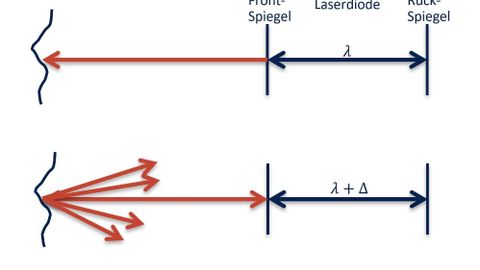
Functional principle of a 'Self-Mixing Laser Diode' (SMLD): In this process, an interferometer is realized on the basis of a laser diode, which measures the speed and distance of a target point relative to the laser diode. The technology is based on interference between the light reflected from the target and the light within the laser cavity.
© AMS TechnologiesAn optical sensor developed by Israeli company VocalZoom and marketed by solution provider AMS Technologies takes a different approach. This sensor enables the precise, contactless measurement of vibration - or more precisely, of position and speed - from a distance of up to 3 meters. This means that a single machine can be easily monitored with several sensors at different points without the need for complex and expensive cabling.
The measurement method is based on a self-mixing laser diode (SMLD). This method uses a laser diode to create an interferometer that measures the speed and distance of a target point relative to the laser diode. The technology is based on interference between the light reflected from the target and the light within the laser cavity. The technology does not require complex optics and only needs a simple focus lens. In addition, the form factor of the sensor is very small and is only determined by the size of the laser diode, the control ASIC and the lens. The functional principle of a self-mixing laser diode: The cavity of the laser diode generates light of a stable wavelength, which is reflected between two mirrors and constantly travels back and forth. A small portion of the light leaves the front mirror in the form of the laser beam in the direction of the target. When this laser beam hits the target, the light is scattered in all directions - and a small part of this scattered light is reflected back into the laser cavity. There, the reflected light interferes with the light generated by the laser diode, causing its wavelength to change minimally. This change in wavelength in turn leads to a minimal change in the power consumption of the laser.
Downtimes are a thing of the past

Concept of the SMLD sensor from VocalZoom: The ASIC measures the power consumption of the self-mixing laser diode with high accuracy, extracts the useful signals speed and distance using sophisticated signal processing and outputs them via a fast HDMI interface.
© AMS TechnologiesThis technology can be used to create an interferometer in which high-precision measurement technology records the interference via the power consumption of the laser diode and extracts the useful signal (speed and distance) using sophisticated signal processing in a special ASIC. This useful data is therefore already available directly at the sensor output and is transferred to a PC for further processing via an HDMI or USB connection.
The application of the sensor, which measures just 15 mm x 6 mm, requires neither downtimes for sensor installation nor certified machine technicians. As the sensor works without contact, it can also measure any surface and any material - even very small, awkward or moving targets as well as hot or wet surfaces. This makes the sensor a simple solution for implementing predictive maintenance for machinery and equipment in all conceivable industrial sectors. For efficient monitoring of large areas, the sensor can be mounted on a robot or drone and aligned sequentially to multiple targets. Vibration frequencies of up to 6 kHz as well as very slow vibration processes in an ultra-low frequency range can be recorded. The interferometer is insensitive to ambient and background light or noise.
Easy entry

AMS Technologies provides a VocalZoom Evaluation Kit for testing the technology. For easier handling, the sensor is housed in a closed housing that has a standard tripod socket (1/4 inch UNC), allowing the unit to be mounted on a variety of commercially available tripods and brackets. A 150 cm long micro HDMI cable connects the sensor housing to the interface unit, which in turn provides a USB interface to a PC. The EVK also comes with software that can be used to record, display, analyze and save the sensor data (speed and distance) on the PC.
On request, AMS Technologies can create customized systems based on the sensor, including robust housing and mounting solutions, electronic components and interfaces according to customer specifications.


You might also be interested in
Pressure: Eleven measuring ranges, seven output signals
Disynet offers the U5300 pressure transducer from TE's 'UltraStable' line: eleven measuring ranges from 0 to 1 bar to 0 to 700 bar, seven different output signals, ten possible electrical connections and fourteen pressure connection options.
 read more...
Level sensors: IO-Link interface included
With the MFN series, EGE is introducing a new generation of level sensors with guided microwave, which enable continuous access to process and parameterization data from PLCs thanks to their IO-Link interface.
read more...Leakage detectors: problem fluids under control
Jola offers a sensor for leakage detection of highly electrically conductive problematic liquids such as antifreeze, liquid manure, silage leachate, acid, lye or salt solution in outdoor areas.
read more...Smart data instead of big data
Continuous communication right down to sensor/actuator level, bidirectional and with access to additional data - IO-Link also increases the potential of industrial cloud services.
read more...Light section and vision sensor combined
The light section method is an often underestimated sensor principle for presence, completeness and position checks and similar tasks. Intelligent light section sensors deliver much more precise and reliable results than other types of sensor.
read more...Taking IO-Link further
Automatically detecting all IO-Link devices in a machine, automatically downloading their device descriptions and parameterizing and monitoring them over their entire life cycle independently of the control system and fieldbus - a software tool...
read more...Measured value is available in 15 s
The CombiLyz conductivity sensor from Baumer helps with the phase separation of food, water and cleaning liquids. It measures the electrical conductivity of the passing medium and draws conclusions about the type of medium and its concentration.
read more...Displacement measurement for measuring lengths up to 5750 mm
ASM has a sensor solution for hydraulic cylinders which, according to the supplier, considerably simplifies installation and maintenance: posichron EasyMount is an absolute, non-contact and wear-free displacement measuring system for measuring...
read more...These are your winners!
We put 96 products in twelve categories to your vote in December, and now the winners have been chosen! The trophies were presented at a 'Winner's Dinner' at the Seehaus in Munich. These are your "Products of the Year 2024"!
read more...