
Sick
Taking IO-Link further
Automatically detecting all IO-Link devices in a machine, automatically downloading their device descriptions and parameterizing and monitoring them over their entire life cycle independently of the control system and fieldbus - a software tool meets this challenge.
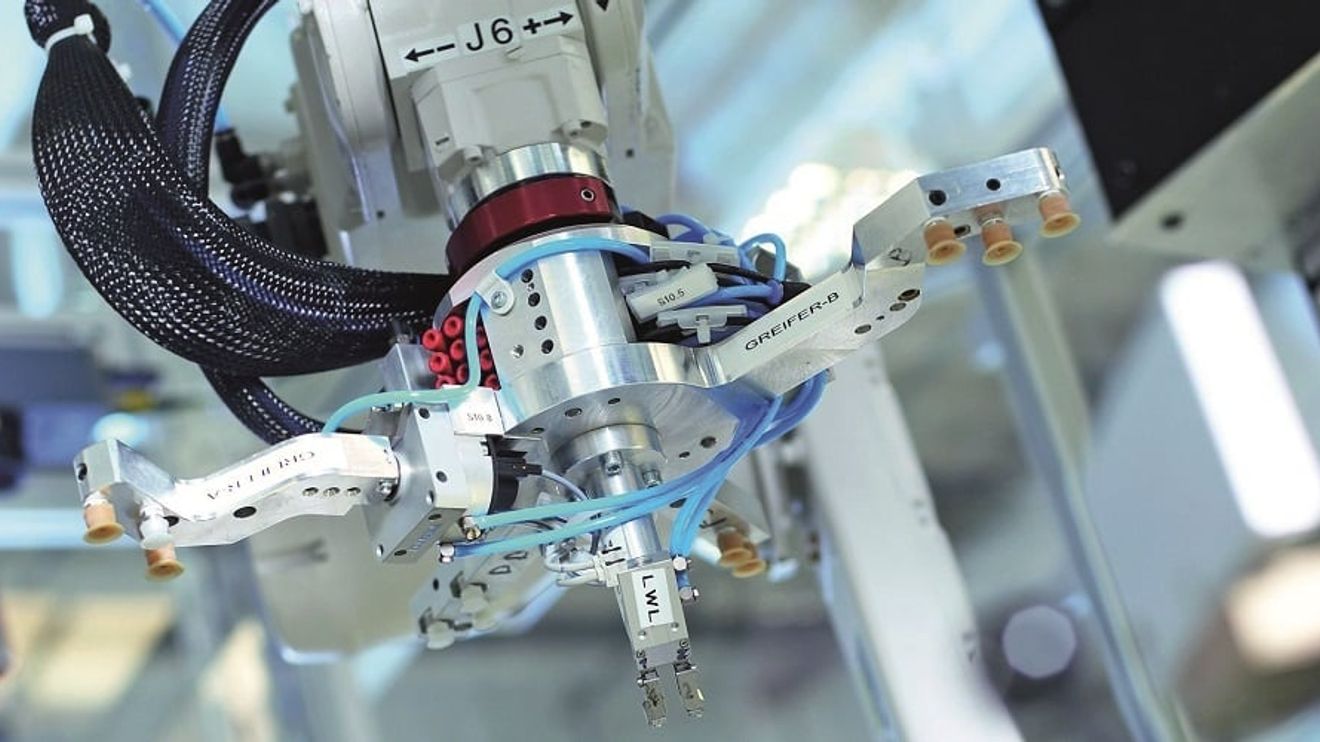
Digitalization, Industry 4.0, the smart factory or the Industrial Internet of Things (IIoT) - the implementation of these trends requires data above all else. IO-Link point-to-point communication is an ideal channel for providing such data, usually measured values, parameter settings and device information.
The fieldbus-independent IO-Link devices reduce the large number of different I/O types in a machine to one IO-Link master, transmit data digitally and provide additional diagnostic information. They are connected via standard sensor cables. They communicate bidirectionally, meaning they can be parameterized and read out at runtime. All of this opens up a wide range of application functionalities - be it production in batch size 1, the locking of operating elements or the provision of pre-processed data. Intelligent sensors can even perform so-called smart tasks independently - for example counting or measuring lengths - and provide this information via IO-Link. More and more field devices - especially those that do not offer space for Ethernet - have the interface on board. Several hundred IO-Link devices in a machine line are no longer a rarity.
Closing integration gaps
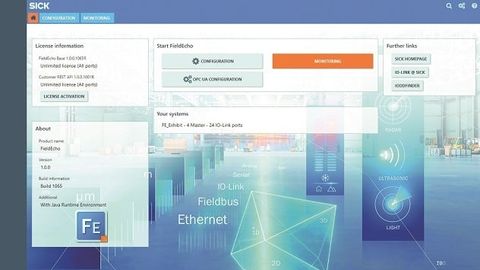
'FieldEcho' parameterizes and monitors all IO-Link devices in a system and provides a web-based graphical user interface.
© SickSick has developed the 'FieldEcho' software tool with the aim of closing any remaining integration gaps, making the use of IO-Link devices as simple and resource-saving as possible and at the same time making IO-Link data available for Industry 4.0 applications in a standard IT manner. It offers full access to all IO-Link device data at any time, allowing it to be called up, monitored or changed via a browser or a Human Machine Interface (HMI). The device descriptions (IODD) of the connected IO-Link devices recognized by 'FieldEcho' are automatically downloaded and made available at the ports of the configured IO-Link masters. This eliminates the need for manual downloads.
As communication is system-independent, it is possible via different PLCs, fieldbuses and IO-Link masters. This requires hardly any development effort, as the machine manufacturer's software developer only has to write a single line of PLC code that calls the generic function block supplied with 'FieldEcho' to send read or write requests to the IO-Link devices. Controllers from Beckhoff, Mitsubishi, Rockwell Automation and Siemens are currently supported.
For read and write data access, the software tool communicates with the machine PLC via OPC UA or TCP/IP. A REST API is also on board, which is used to send and receive data in JSON format. This allows IO-Link device data to be transferred to ERP and MES systems as well as cloud-based services in order to use the data in the Industry 4.0 world for data analysis, predictive maintenance or inventories, for example.
Clearly visualized
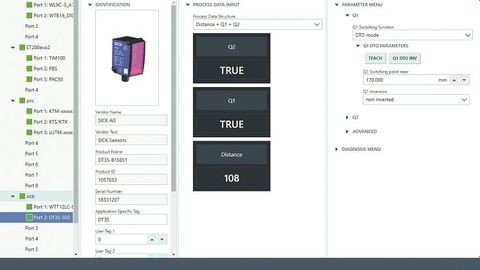
'FieldEcho' provides direct access to the process and service data of all IO-Link devices and warns or alerts autonomously in the event of an anomaly.
© SickThe tool's graphical, web-based user interface can either be opened with a browser or integrated into the HMI of a machine or system. In the system and IO-Link master overview, it visualizes all configured IO-Link masters as well as the automatically detected IO-Link sensors and actuators connected to the respective ports. It also clearly displays the status of all IO-Link devices. It is also possible to open a device page in the software so that users can zoom in on the device data. This view displays the device identification with information such as the serial number or software version as well as the device name and image. Incoming and outgoing process data are visible at a glance. The graphical user interface also offers the option of fully parameterizing all IO-Link devices. The tool thus ensures transparency by allowing the operator to view the entire IO-Link system on his screen like an open book. Machine builders and system integrators save time and reduce the workload on the PLC.
Overview via dashboard
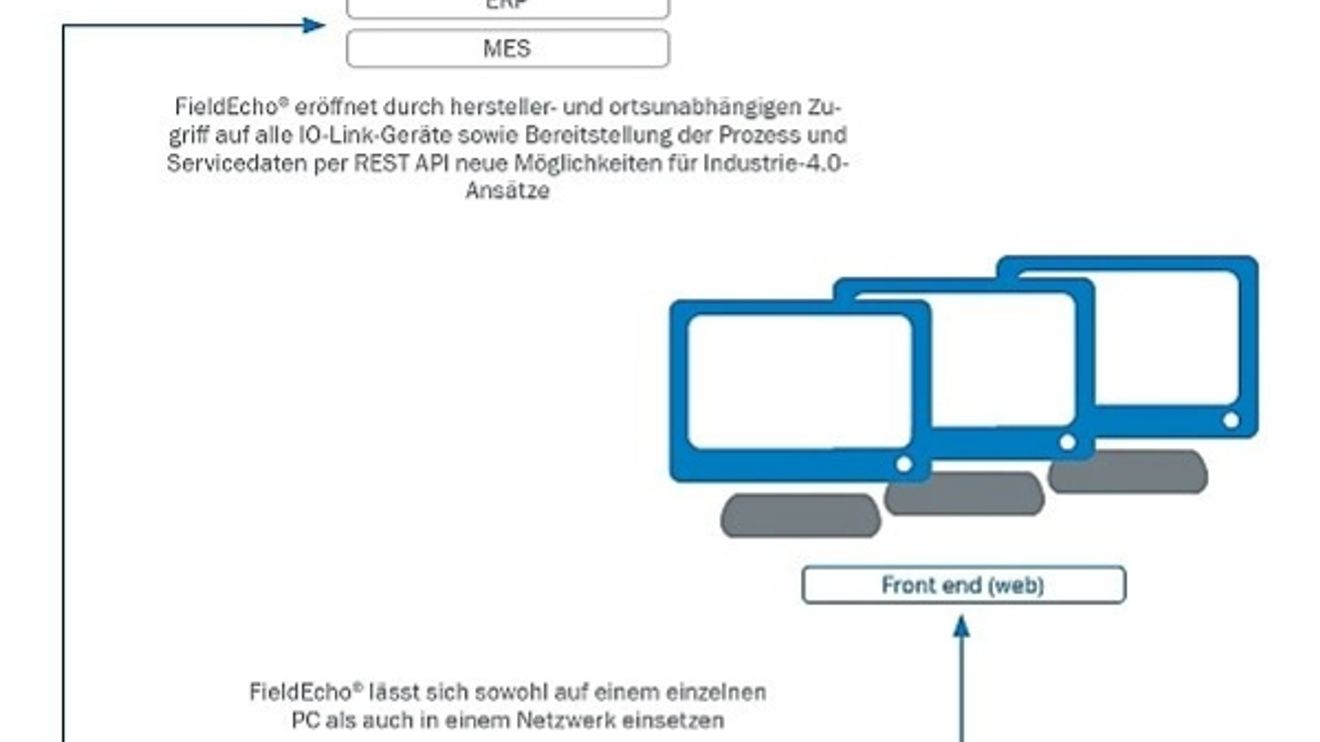
Via the REST API, 'FieldEcho' enables the integration of IO-Link data into ERP and MES systems as well as proprietary applications or cloud-based services.
© SickThe REST API can be used to integrate IO-Link data into ERP and MES systems as well as proprietary applications or cloud-based services. Using this REST API, the 'FieldEcho' dashboard provides a complete overview of the status of all IO-Link devices. It also warns or alerts autonomously in the event of an anomaly. The dashboard automatically connects to 'FieldEcho', independently retrieves information about the entire IO-Link system via the REST API and dynamically builds the interface itself based on the data received - users therefore have no configuration effort whatsoever.
The dashboard has an integrated database to manage a large amount of information from a large number of IO-Link devices. All applications can access this - as an alternative to querying via REST API - and thus reduce the communication load on the fieldbus and via IO-Link. The dashboard makes it possible to select individual process data and device parameters for monitoring from the cloud level - which would have to be laboriously programmed in the PLC without 'FieldEcho' and the dashboard - and to set limit values and alarms.

Peter Kamp is Head of Industrial Software Engineering in the Global Business Center Industrial Integration Space at Sick in Freiburg.
© SickOne example of what is possible with this function is the quality-of-run diagnosis of an optical sensor to determine its detection reliability in the event of soiling. A switching threshold is usually defined in the device for this purpose, at which the sensor automatically generates a corresponding signal. In the dashboard, it is now possible to define and monitor your own contamination limit values independently of the threshold value in the sensor in order to use them in a predictive maintenance application. Warnings and alarms are visualized - also in the form of spoken messages. The dashboard can also send corresponding emails to the person responsible for operating the system or the machine's service personnel, for example.


You might also be interested in
Using an app and vision sensor
With the SensorApp Quality Inspection and the InspectorP62x all-in-one vision sensors, Sick offers a solution for quality assurance in factory automation.
 read more...
SPS Connect 24.11. - 10:40 - 11:00 a.m.
Virtual commissioning of sensors as digital components
How can sensors be easily put into operation as Industry 4.0 components? And how can data from different domains (mechanics, parameterization, I/O interface), which are combined in a digital data set, be used and made available?
read more...SPS Connect 26.11. - 14:10 - 14:30
Switch off at Safety - no thanks!
Today, safety-related control systems for machines and systems are designed in such a way that a safe state is assumed when faults are detected in safety-related components. This is achieved in almost all situations by switching off the power.
read more...SPS Connect 25.11. - 14:50 - 15:10
Intelligent and smart sensor solutions for factory automation
Intelligent sensors and encoders deliver more than just measurement data - diagnostics, efficient communication and smart tasks. Find out more about technologies that enable new solutions for your applications.
read more...Change in the Management Board
Reinhard Bösl, a long-standing member of the Sick Management Board, is leaving the Sick Management Board. After 13 years, his contract will expire on June 30, 2020 when he reaches the specified age limit for Management Board members.
read more...Smart sensor technology for the IIoT
In addition to status information, intelligent sensors provide a wealth of secondary data - on service life, load level and damage detection as well as ambient temperature or contamination. Optical sensors in particular are undergoing a lot of...
read more...Sensor technology and digital services
Sensor technology, sensor apps and the cloud - Sick now wants to use this trio to create a digital solution portfolio. The aim is to enable customers to generate individual added value for their business processes.
read more...Load monitoring simplified
Lütze is upgrading the 'LCOS' bus couplers for universal application options so that the LOCC-Box-Net modules can now also be operated in addition to the electronic load monitors of the LCOS CCI family.
read more...For weld seam inspection
The Saturn 3D is a laser triangulation sensor from EVT, whose 3D point clouds are evaluated and analyzed in the 3D software 'EyeVision'.
read more...