
Schunk and CADFEM
Digital Material Selection reduces CO₂ Emissions
Digital material selection can significantly reduce CO₂ emissions during the manufacture of industrial components. Schunk and CADFEM demonstrate this using a gripper project. Simulations were used to identify potential savings of up to 40%.
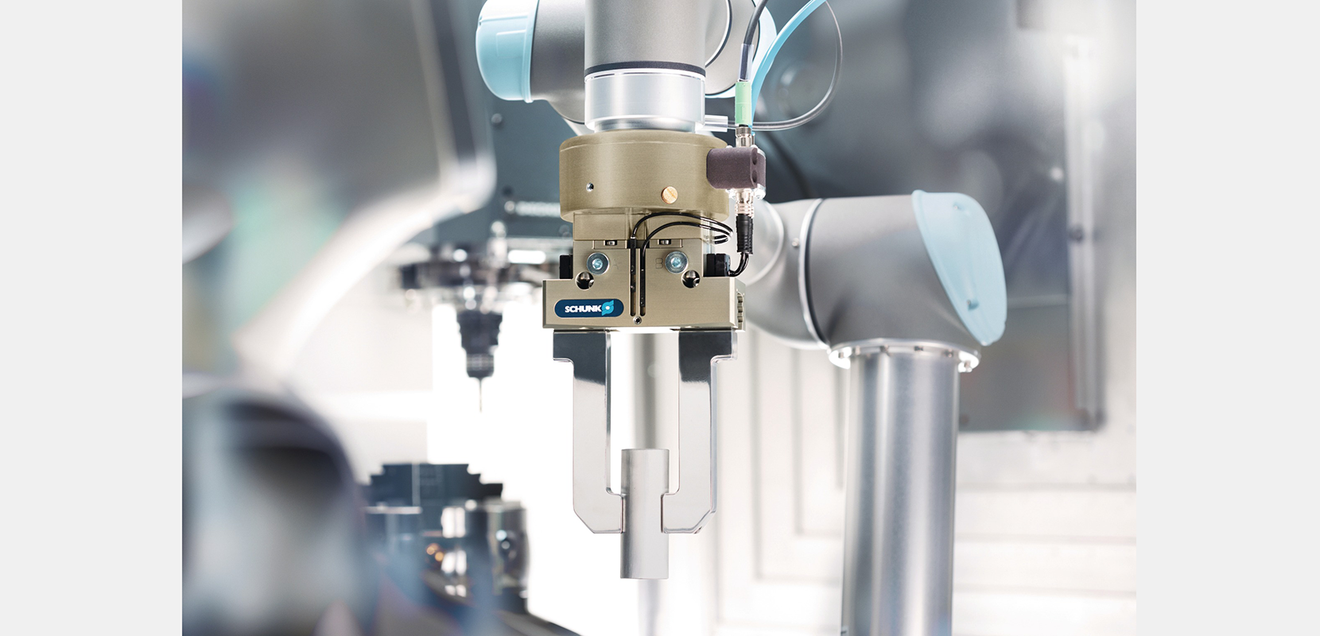
Digital, simulation-based material selection can reduce CO₂ emissions in the production of industrial components by up to 40%. Schunk and simulation specialist CADFEM have reached this conclusion based on a joint project to develop an industrial gripper.
Focus on Secondary Materials and 3D Printing
According to the companies, the project began by identifying the components with the highest emissions. The project partners then investigated alternative materials and manufacturing processes.
“We therefore removed the components with the highest emissions from the gripper and considered how we could reduceCO2 emissions by using alternative materials and manufacturing processes,” explains Daniel Barta, a development engineer at Schunk.
The use of secondary materials with a high recycled content, as well as additive manufacturing processes (3D printing) powered by renewable energy, proved to be particularly effective. Together, these two approaches could reduce the gripper’s CO₂ emissions by up to 40%.
Digital Material Data as a Basis for Decision-Making
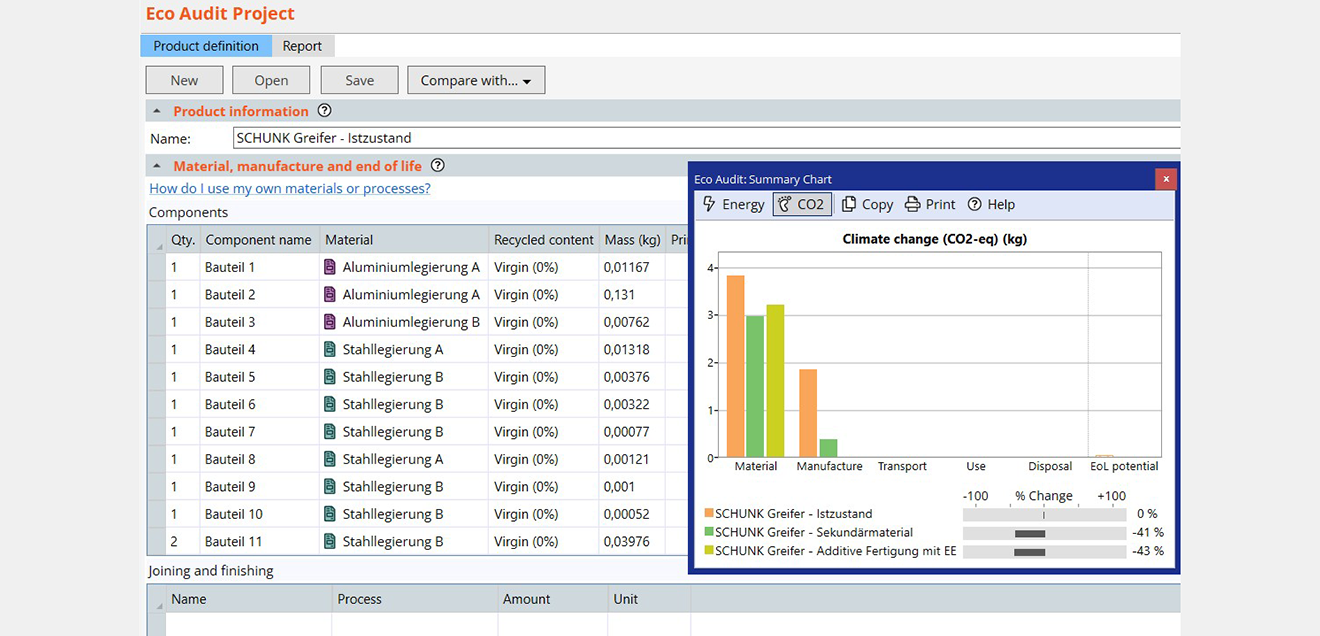
The simulations were based on the simulation software “Ansys Granta Selector.” It contains data on several thousand materials and allows for the comparison of different materials in terms of their technical properties and their environmental footprint.
In addition to this simulation software, the project partners also used the “EcoAudit” calculation module to analyze the environmental footprint and evaluate the various material and manufacturing options. This allowed them to assess different aluminum and steel alloys in terms of processability, load-bearing capacity, and sustainability even before practical implementation.
According to Schunk, the digital materials database is increasingly replacing manual selection processes that were previously often based on experience. At the same time, sustainability metrics can be objectively recorded and documented.
Plans to Expand Materials Data Management
Schunk plans to expand the use of digital material data to other areas of the company in the future. To this end, a centralized material data management system will be established to analyze costs, process efficiency, and sustainability throughout the entire product development process.
The Ansys Granta MI software, distributed by CADFEM, is designed to support not only material selection but also data exchange between development, procurement, quality assurance, and compliance.


You might also be interested in
Aachen-based start-up transfers AI robotics to industrial applications
Many developments in the field of artificial intelligence have so far failed to be transferred from the research laboratory to industrial practice. The spin-off Athenyx Robotics from RWTH Aachen University aims to change this: The start-up is...
 read more...
Hanover Messe starts
Topics such as digitalization and sustainable production will shape Hannover Messe 2026, and a number of prizes will also be awarded during the trade fair.
read more...Strategic Cooperation between SEW-Eurodrive and Safelog
SEW-Eurodrive and Safelog announced a strategic partnership at Logimat to jointly develop and establish a powerful software system for controlling mobile and stationary processes in intralogistics.
read more...International Federation of Robotics
Western Europe leads in Robot Density
Robot density in industry continues to rise worldwide. Western Europe is ahead in an international comparison, followed by North America and Asia. New data from the International Federation of Robotics shows clear differences between regions and...
read more...Rollout of more than 100 AI-controlled Robot Systems planned
Syncore (formerly known as Reesink Logistic Solutions) and Stuttgart-based AI robotics company Sereact are deepening their partnership. At Logimat, the companies signed a letter of intent to expand their partnership with the aim of introducing more...
read more...Modular Robot Hands for Industry
Schunk and DLR intensify Cooperation in Humanoid Robotics
Schunk and the German Aerospace Center (DLR) are expanding their collaboration in humanoid robotics. The aim is to improve the fine motor skills of humanoid robot hands for industrial applications and to translate research into practical solutions...
read more...New Solutions for Physical AI
NXP Semiconductors has introduced innovative robotics solutions for reliable, secure real-time data processing and transmission as well as advanced networking. These enable sensor fusion, machine vision and precise motor control.
read more...IFR presents Award Winners
To give women in the robotics industry more visibility and recognition, the International Federation of Robotics (IFR) has honored eleven women in 2026 who are shaping the future of robotics.
read more...Schaeffler expands its Global Partner Network
Motion Technology Company Schaeffler has agreed a partnership with Leju Robotics Technology, a Chinese technology company in the field of humanoid robotics. This is Schaeffler's first cooperation with a Chinese company.
read more...