
WZL at RWTH Aachen University
"AKIMI" Research Project develops AI for Flexible Robotics
The AKIMI research project has been launched at the Machine Tool Laboratory (WZL) at RWTH Aachen University. The goal is to develop agent-based AI designed to simplify the setup, programming, and reconfiguration of robotic systems, particularly for small and medium-sized enterprises.
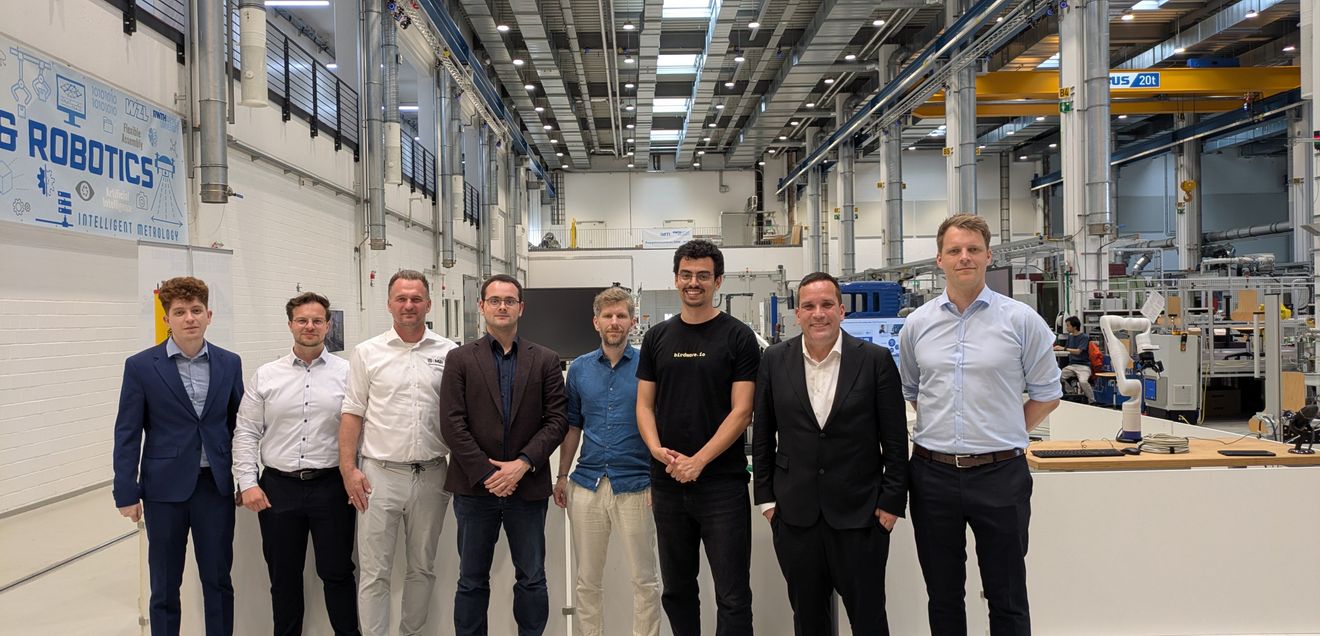
The “AKIMI” (Agent-Based AI for Intuitively Reconfigurable Robotics in Small and Medium-Sized Enterprises) research project was launched in early July at the WZL at RWTH Aachen University. The official project launch took place on July 2, 2026, with a kick-off meeting at the Chair of Information, Quality, and Sensor Systems in Production. In addition to the WZL, the Institute for Business Cybernetics (IfU) e.V. and an industry committee supporting the project are also involved.
The research project addresses the question of how robotic systems can be more easily set up, programmed, and adapted to new requirements for small and medium-sized enterprises (SMEs). Factors driving this effort include volatile markets, smaller batch sizes, and a shortage of skilled workers. According to the project partners, the goal is to reduce existing barriers caused by high programming costs and rigid system architectures.
AI Combines Language Models and Robotics
The focus is on developing a hybrid agent-based artificial intelligence. This involves combining large language models (LLMs) with structured knowledge and basic robotic functions. The AI is designed to independently break down complex instructions into individual steps and control the robot’s kinematics accordingly. This will enable tasks in assembly and logistics to be prepared using natural language, even by employees without programming knowledge. At the same time, the concept calls for continuously verifying proposed action sequences against the laws of physics and defined safety restrictions to ensure transparency, traceability, and safe operations.
Demonstrators for Industrial Applications
At the WZL, the project is being led by Prof. Dr.-Ing. Robert Schmitt. The research focuses on integrating sensory perception, AI-supported decision-making, and robotic execution according to the “Sense – Think – Act” model. As the project progresses, the models and software architectures developed will be tested in demonstrators and validated using use cases provided by the industry partners.
“Small and medium-sized businesses need flexible automation solutions that can be customized without in-depth programming knowledge. With AKIMI, we’re drastically lowering the barriers to adopting robotics: The agent-based AI acts as an intelligent assistant that breaks down complex tasks into understandable steps.”
The project steering committee includes companies and institutions from the fields of mechanical engineering, robotics, and automation, including 3WIN Maschinenbau, Athenyx Robotics, Birdwave Automation, Center Smart Assembly, Ecosphere Automation, ek robotics, Gauss Robotics, Kuhre Robotics, Müller und Partner Sachverständige, Mybotshop, Pilz, Still, Teradyne Robotics, and the Zukunftsallianz Maschinenbau.
The research project is funded by the Federal Ministry for Economic Affairs and Climate Action (BMWK) as part of the Joint Industrial Research (IGF) program, pursuant to a resolution of the German Bundestag.


You might also be interested in
Aachen-based start-up transfers AI robotics to industrial applications
Many developments in the field of artificial intelligence have so far failed to be transferred from the research laboratory to industrial practice. The spin-off Athenyx Robotics from RWTH Aachen University aims to change this: The start-up is...
 read more...
Strike at the start of the Hannover Messe
On the occasion of the strike announced by ver.di on the first two days of Hannover Messe 2026 (20 and 21 April), which will paralyze public transport in Hanover, the organizer, Deutsche Messe, is expressing clear criticism and great concern about...
read more...Strategic Cooperation between SEW-Eurodrive and Safelog
SEW-Eurodrive and Safelog announced a strategic partnership at Logimat to jointly develop and establish a powerful software system for controlling mobile and stationary processes in intralogistics.
read more...Rollout of more than 100 AI-controlled Robot Systems planned
Syncore (formerly known as Reesink Logistic Solutions) and Stuttgart-based AI robotics company Sereact are deepening their partnership. At Logimat, the companies signed a letter of intent to expand their partnership with the aim of introducing more...
read more...Modular Robot Hands for Industry
Schunk and DLR intensify Cooperation in Humanoid Robotics
Schunk and the German Aerospace Center (DLR) are expanding their collaboration in humanoid robotics. The aim is to improve the fine motor skills of humanoid robot hands for industrial applications and to translate research into practical solutions...
read more...IFR presents Award Winners
To give women in the robotics industry more visibility and recognition, the International Federation of Robotics (IFR) has honored eleven women in 2026 who are shaping the future of robotics.
read more...Schaeffler expands its Global Partner Network
Motion Technology Company Schaeffler has agreed a partnership with Leju Robotics Technology, a Chinese technology company in the field of humanoid robotics. This is Schaeffler's first cooperation with a Chinese company.
read more...Exoskeleton: Strength to put on
Automation specialist Comau is expanding its portfolio of wearable robots with a new exoskeleton. The wearable system reduces muscle strain by up to 50 percent and is aimed at a wide range of applications in industry and SMEs.
read more...100 Million US Dollars for the Expansion of Autonomous Industrial Robotics
Robotics company Robco announces a financing round of 100 million US dollars. The company intends to use this to accelerate its roadmap for physical AI and expand its presence in the USA.
read more...