
Software Testing
Keysight Expands Test Automation
Keysight Technologies has introduced a new test automation feature called Eggplant Find by Description. Instead of identifying UI elements using screenshots, they are recognized based on descriptions. This is intended to ensure that UI tests continue to function even after design changes.
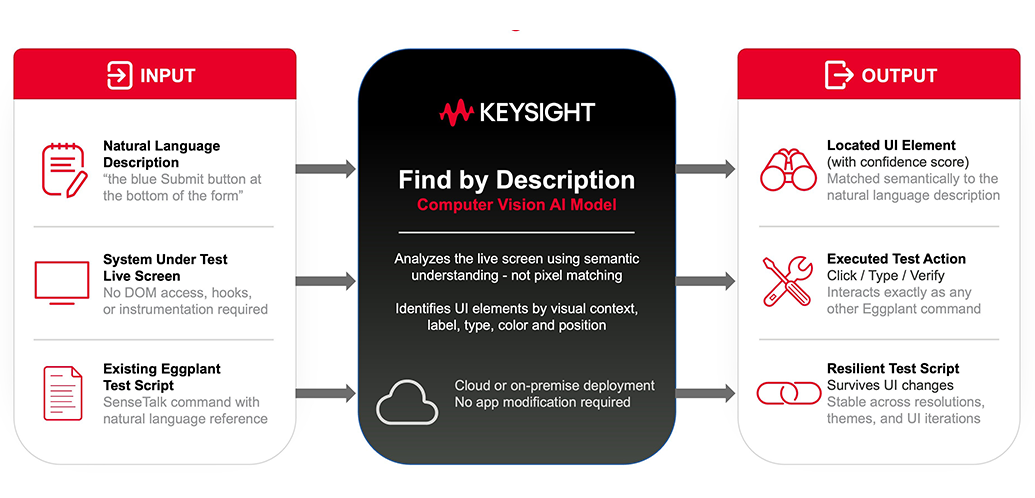
Keysight Technologies has introduced the "Eggplant Find by Description" solution. This feature is part of "Eggplant Studio" and "Eggplant Functional" and enables developers to locate elements of a user interface based on a textual description rather than through image comparisons.
According to the company, this ensures that automated tests remain functional even after redesigns, design changes, or adjustments to screen resolution. The need to recreate screenshots for test scripts—which was often necessary in the past—is expected to be eliminated.
Less maintenance required for test scripts
According to Keysight, about half of all companies view the maintenance of test scripts as one of the biggest obstacles to test automation. In particular, image-based scripts often need to be updated when changes are made to the user interface, even though the actual software functionality has not changed.
The new solution is designed to work without screenshots, without access to the Document Object Model (DOM), and without making any changes to the system under test. Instead, the developer describes the desired user interface element—such as a ticket price for a specific date—which the software then identifies.
Shorter scripts and faster editing
In a company demonstration, Eggplant Find by Description reduced the size of a test script by 92%. At the same time, according to the company, the processing time was cut from more than an hour to less than 15 minutes.
The feature uses artificial intelligence and computer vision and is designed to be suitable for desktop, embedded, and web applications. Other benefits mentioned include greater test stability when changes are made to the user interface, reduced effort required to maintain test scripts, and the automation of tests that were previously performed manually.


You might also be interested in
Digital Panel-Mounted Instruments for Process Values
Optris is expanding its "CTi" series of infrared pyrometers to include EtherCAT and IO-Link communication interfaces.
 read more...
Higher Accuracy for Pressure Transmitter Series
Yokogawa introduces the "EJX S" series of pressure transmitters, featuring a silicon resonant sensor, ±0.025% accuracy, IP68 rating, SIL2 compliance, and support for HART and Profinet.
read more...Virtek Vision International acquires
Ametek has announced the acquisition of Virtek Vision International, a provider of laser-based projection and inspection systems.
read more...Update for multifunctional energy analyzer
The multifunctional energy analyzer 'UMG 806' from Janitza is now available in a low-power version and with UL certification.
read more...Three-phase adapter for test devices and CEE sockets
Gossen Metrawatt has introduced new three-phase adapters for connecting test devices to 5-pin CEE sockets.
read more...Test technology and accessories for test benches
Ceta is coming to Motek/Bondexpo 2024 with test systems and test devices. The range of test devices from Ceta Testsysteme includes leak testers, mass flow testers, volumetric flow testers and digital pressure gauges.
read more...Keysight Acquires VPIphotonics
With the acquisition of VPIphotonics, Keysight Technologies is expanding its software portfolio for photonics development. Going forward, these solutions will cover the entire design process, from component physics to the simulation of complete...
read more...ESA honors Keysight and Sateliot Project
Keysight and Sateliot win an ESA and GSMA competition for 6G innovations. The award went to a concept for the secure integration of satellite and terrestrial networks based on blockchain, AI and machine learning.
read more...EMC and radio testing in Germany and worldwide
In a world filled with smartphones, connected cars, medical devices and smart appliances, supporting optimal electromagnetic compatibility (EMC) and wireless performance to minimize interference between electronic products is critical.
read more...