
Pepperl+Fuchs
Safe via ultrasound
Ultrasonic sensors with safety certification in accordance with EN ISO 13849 category 3 PL d have so far been the exception rather than the rule. However, they offer a number of advantages, for example for cooperation between humans and robots.
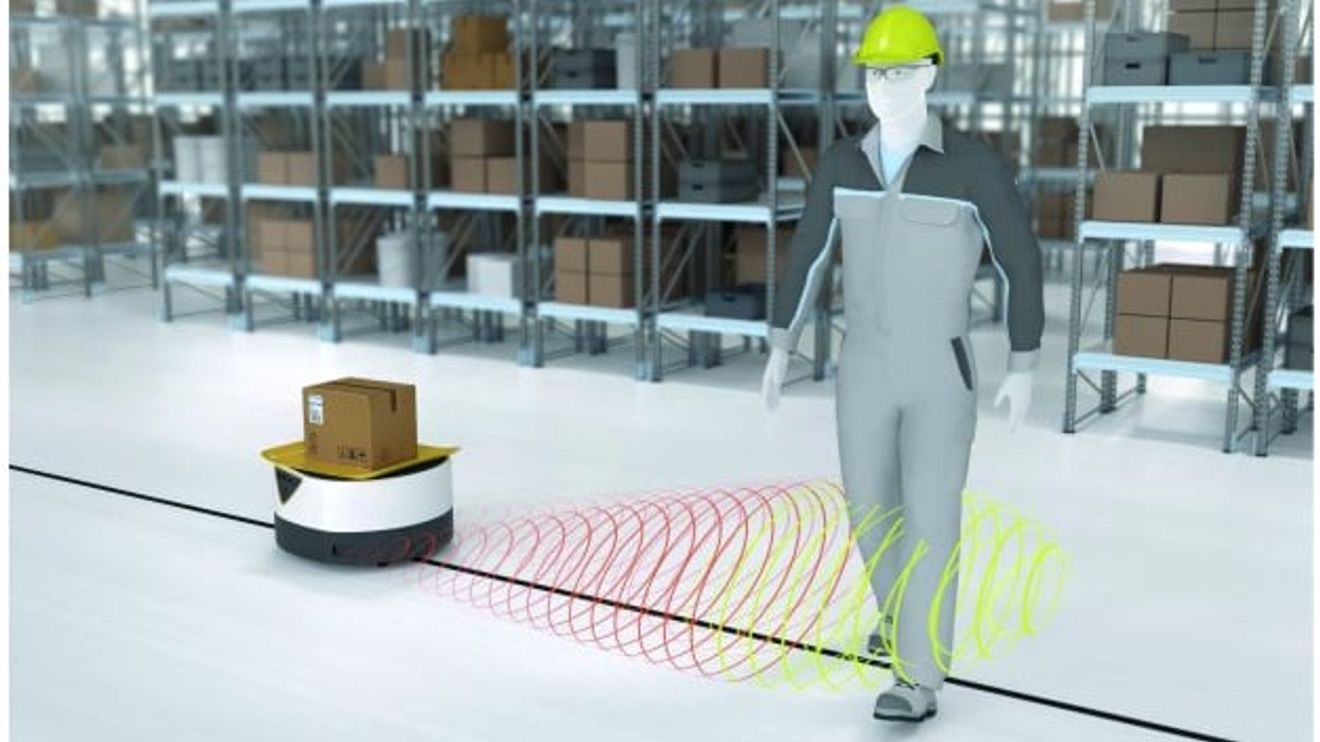
The 'USi-safety' system is suitable for various safety tasks.
© Pepperl+FuchsFor safe interaction between people and machines, compliance with the Machinery Directive is the top priority - especially as there are more and more robots and automated guided vehicles (AGVs) in production and logistics that operate autonomously. Safety concepts that can cope with complex, dynamically variable situations are therefore indispensable for efficiency-enhancing automation. Sensor technology plays a key role here.
Due to their design, ultrasonic sensors are very robust and versatile. Unlike the light beam of an optical sensor, for example, the ultrasonic pulse is practically unaffected by the surrounding atmosphere. Sound waves penetrate vapors, dust and precipitation. And as they do not propagate in a linear point shape, but with the contour of a club, they always hit the target object over a wide area and also reliably detect irregular surfaces. Another plus point: the ultrasonic transducers' sound emission also works in the presence of dirt and adhering deposits. But to what extent do they also meet safety requirements?
Sound lobe modified
The 'USi-safety' system from Pepperl+Fuchs is based on the inherent robustness of ultrasonic sensor technology. Its small sensor units can be integrated practically anywhere. A flexible control system opens up a wide range of options for parameterization. And as a safe ultrasonic system, it is certified in accordance with the EN ISO 13849 category 3 PL d standard.
One of the special features of the system is the shape of the sonic beam, which has been modified for safety applications. Thanks to its compressed shape with an elliptical cross-section, which is greatly widened along a transverse axis, it covers an area of 80 by 32 cm2 at the point of impact at a distance of 1.5 m; the maximum range is 2.5 m. Within this wide range, the sensors can also detect very small objects or body parts.

Access guarding for machines: The flat elliptical sound lobes secure access to a danger zone.
© Pepperl+FuchsThe ultrasonic transducer itself, i.e. the actual sensor unit of the system, is also very small. With its dimensions of 27 mm x 21 mm x 13 mm, it can be installed in the forks of a forklift truck or at the end of a robot arm if required. This compact size is possible because the evaluation unit is not located directly on the transducer, as is usually the case, but is decoupled and can therefore be mounted up to 3 m away from the cable. This design feature allows a high degree of flexibility during installation.
The ultrasonic transducers also have protection class IP69K and are therefore particularly resistant. They can withstand both high-pressure cleaning and outdoor use in harsh weather conditions. An optional temperature sensor automatically compensates for large temperature fluctuations.
Parameterization via software
Each transformer has two parameterizable switching points. If only one protective field is required, they are defined identically. Differentiated definition allows the detection area to be divided into protective and warning fields, for example for slow speed and stop. The response time of the system is 91 ms.
The 'USi-safety' parameterization software can be used to intuitively set the output logic and initialize periodic tests. Standard parameters for safety use are already stored. Protection and warning fields can be individually adapted to the respective application. When configuring in expert mode, physical factors of the ultrasonic sensors can also be taken into account, for example echo amplification, sensitivity, multiple scan, switch-on delay, near field, echo propagation and hysteresis.
The software suppresses interference between the ultrasonic signals if several 'USi' systems are located within the range of the sound waves. This allows several AGVs to meet in the same hall or several machines to be equipped with the system at close range. The detection capability remains unrestricted.
Intelligently secured
Disturbance variables can be suppressed using the software's teach-in function, which is particularly advantageous in confined installation situations where machine components often protrude into the warning or protective field. Other objects that come into the same area are still detected. A permanently installed object in the detection area can also serve as a reference object for tamper protection. Safety protocols for system documentation are created automatically.
The decoupled evaluation unit is equipped with two microcontrollers working in parallel, which monitor both the sensor function and each other and carry out regular inspection and test routines. Noticeable deviations in the sensor units or between the controllers automatically trigger the safety circuit.

Simple installation and parameterization options for the components of the 'USi-safety' system. The evaluation unit is decoupled and can be installed up to 3 m cable length away from the sensor.
© Pepperl+FuchsOne or two ultrasonic transducers can be connected to the evaluation unit, each via two fail-safe, independent channels. Each connected transducer has a signal output as well as safe OSSD outputs in accordance with category 3 PL d for signal output to a safety controller. The requirements for a safe sensor system are met with just one connected sensor unit, thus ensuring reliable protection. The device parameters can be set differently for the two ultrasonic transducers.
Possible applications
The 'USi-safety' system is suitable for various safety tasks. It can also be combined with optical systems, for example to control an AGV. Typical areas of application are

Matthias Sollmann is Global Product Manager in the Ultrasonic Sensors Innovation Unit at Pepperl+Fuchs in Mannheim.
© Pepperl+Fuchs- Access guarding for machines: The flat elliptical sound beams safeguard access to a danger zone. Unlike light grids, they are insensitive to dust and dirt.
- Environment detection for robots: access protection for the safety area
- Tool guarding for human-robot collaboration (HRC): When presenting a workpiece in an ergonomic position, the sonic beam of the 'USi' system monitors the access area.
- Route monitoring for AGVs: For driverless industrial trucks, a 'USi' system with two ultrasonic transducers serves as personal and collision protection when driving forwards and backwards.
- Heel protection for lifting vehicles: In pedestrian vehicles, the person in front is protected without delaying transportation.
- Storage location control in logistics: The sonic beam takes over the compartment occupancy control.
- Distance control and collision protection for service vehicles at airports: The outriggers of the vehicles, such as the mobile baggage conveyor belt, are steered to the end position at low speed; the protective field reliably prevents collisions with the aircraft skin.


You might also be interested in
Aava Mobile becomes part of the Group
Pepperl+Fuchs has acquired Aava Mobile with effect from August 31, 2021, thereby strengthening the 'Mobile Computing and Communication' business unit.
 read more...
Electro-sensitive protective equipment
Pepperl+Fuchs is expanding its product portfolio of ultrasonic sensors with the USi-safety ultrasonic sensor system.
read more...Ex-e solution portfolio completed
With the SR series, Pepperl+Fuchs continues to position itself as a provider of Ex equipment.
read more...Autonomous wireless sensor
With the Wilsen.sonic.level, Pepperl+Fuchs presents an ultrasonic level sensor that can be used to determine filling heights and filling and level levels.
read more...From the sensor to the cloud
One of the 'magic formulas' in the Industrial Internet is 'continuous information flow'. However, the installed base of production cannot be 'converted' as easily as business software. Instead, the migration must integrate different components.
read more...Tablet for the Ex area
With the 'Pad-Ex 01 P12', Pepperl+Fuchs is launching a new tablet for professional use in potentially explosive atmospheres in Zone 2/22, Division 2.
read more...Flow of goods made transparent
With the 'IUR-F800-V1D-4A*', Pepperl+Fuchs is expanding its RFID portfolio with a UHF reader specifically for use in gate applications in logistics.
read more...HANNOVER MESSE DAILY Day 4
The top news from the fourth issue: Robert Habeck at the trade fair tour +++ Technological AI highlights from Beckhoff +++ Radar sensor technology in focus at Pepperl+Fuchs +++ ASi-5 counter module as an active distributor from Bihl+Wiedemann +++...
read more...followed up! - with Dr. Gunther Kegel
"Recognizably alien to the industry"
More and more regulations and bureaucracy are being imposed on companies. In an interview, ZVEI President Dr. Gunther Kegel criticizes politicians and calls for consistent action.
read more...