
Pepperl+Fuchs
From the sensor to the cloud
One of the 'magic formulas' in the Industrial Internet is 'continuous information flow'. However, the installed base of production cannot be 'converted' as easily as business software. Instead, the migration must integrate different components.
No utopia: a regular customer 'threatens' with an urgent large order. The production capacities in Portugal, India and Vietnam are needed to fulfill the order on time. Under no circumstances should there be any downtime now; a review of the systems is urgently required. Instead of booking plane tickets for the service team, all it takes is a look in the cloud.
Extensive data records are stored there for a precise status analysis. In any case, predictive maintenance on this basis has already ensured that the machines are in optimum condition. In the other direction, specific process data for production can be entered centrally via the cloud, meaning that production can begin at any time.
This scenario is now a reality - at least optionally. Global data access has long been part of everyday life at the business process level. And the continuous flow of information is also gaining ground in the Industrial Internet. However, the installed base of production cannot be 'converted' as easily as business software. The migration must integrate many different components and subsystems.
In industrial practice, the question therefore arises as to which steps are possible and what benefits they bring.
Which IIoT solutions can be implemented in existing systems with manageable effort and without taking risks? How can targeted innovations be introduced in a controlled manner for new investments on the basis of existing expertise?
The answer is provided by technologies that have now proven themselves as a bridge between conventional process environments and new IIoT solutions. They create the link between the physical field level and the digital world of cloud-supported processes.
IO-Link plus other standard protocols

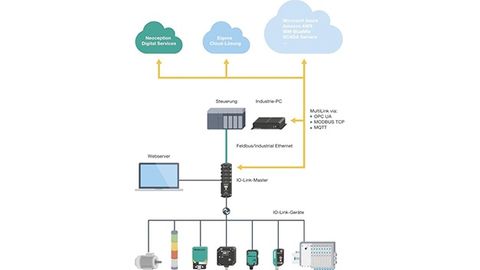
In addition to real-time communication via Profinet or Ethernet/IP, the IO-Link master with OPC UA interface from Pepperl+Fuchs enables the connection of sensors to higher-level cloud systems.
© Pepperl+FuchsIO-Link technology, which uses the existing point-to-point connection and standard 3-wire cabling, can serve as a bridge foundation. Protocols and interfaces for bidirectional communication with the field devices are standardized and independent of the fieldbus used. IO-Link masters, which are designed for standard protocols, ensure a seamless transition. Pepperl+Fuchs already offers an IO-Link master with an interface for OPC UA. On the Industrial Ethernet side, it ensures the connection to Profinet or Ethernet/IP, each including Modbus TCP. The widely used IIoT protocols MQTT and REST:API can also be transmitted via the same communication channel.
These three protocols - OPC UA, MQTT and REST:API - are ideal for getting started with IIoT. However, they differ significantly in terms of functionality and IT footprint:
- MQTT is a pure communication protocol based on a binary data stream, without structuring, visualization or integrated security precautions. The amount of data required in the network (IT footprint) is minimal and individual devices can be integrated with little effort. However, automated transfer of device specifications is not possible. This makes MQTT suitable for an entry into the IIoT world on a small scale; however, the programming effort quickly becomes too great for larger projects and more complex environments.
- REST:API uses XML files. In addition to the binary data stream, additional information on the scope and type of data is available. When integrating similar devices from the same manufacturer, the device specifications can be duplicated. The client-server architecture allows the use of user names and passwords. This means that a certain level of security is integrated; the IT footprint is medium overall. Handling is somewhat simpler than with MQTT, but also requires custom programming.
- As a 'unified architecture',OPC UA offers a considerably larger range of functions and more convenience with a correspondingly larger footprint. The OPC Foundation ensures standardization, certification and the continuous further development of the protocol. The data is structured and already available to users for visualization and further processing. New devices can be integrated almost automatically using standardized specification files. Although the IT capacity required is considerably greater than for the other two protocols, this also applies to the range of functions and ease of use. High-quality security precautions are already integrated. This makes OPC UA particularly suitable for IIoT solutions in more complex environments with many participants.
Coffee machine with IIoT connection
A demo project that Pepperl+Fuchs realized together with the AI experts from the start-up Symate illustrates the possibilities opened up by the end-to-end connection between the field level and the cloud: A fully automatic coffee machine was equipped with numerous additional sensors. These record the fill levels of the water tank and the various coffee bean containers, and recognize the cup and its fill level. The potential coffee consumer identifies himself via an RFID transponder on which his particular preferences are stored. The recorded sensor data is collated and processed in the cloud-based 'Detact' control system.
Among other things, the control system records individual coffee consumption and also recognizes marginal deviations in the cup fill level or parameter fluctuations during the brewing process. Appropriate signals can be used to trigger the upcoming refilling of water and coffee containers. The system uses the historical data to calculate forecasts for future consumption. Both 'production' and maintenance can therefore be planned in advance.
Production control from the cloud

Lukas Pogoda is Product Manager for Industrial Communication at Pepperl+Fuchs in Mannheim.
© Pepperl+FuchsApplied to industrial practice, this model opens up new possibilities for cloud-based control. This is not yet suitable for real-time-critical processes where reliable millisecond intervals are important. However, by no means all production processes are so closely timed. This applies, for example, to the ultrasonic welding of several injection-molded components to form a single part: the components are delivered in trays fitted with RFID transponders. An RFID read head with an IO-Link interface identifies them and at the same time reads specific parameters from previous process steps that are stored on the transponders. Other sensors, such as print mark color scanners, can be used for a physical quality check. They detect any discoloration or burn marks from the injection moulding process. Deviations are registered and rejects are sorted out before further processing. At the same time, the welding process can be automatically adapted to the parameters of the respective components. The finished components are then sorted into suitable trays, which are again fitted with RFID tags.
An IO-Link master with an OPC UA interface collects the sensor signals and the cloud-based controller performs a preliminary analysis. Data from different process chains is merged and synchronized. From this, process settings on the ultrasonic welding system such as contact pressure, welding time or energy to be applied can be derived and automatically adjusted.
The threshold for entering such a process architecture is extremely low, as many sensors already have an IO-Link interface and can be upgraded with little effort. The IO-Link masters with OPC UA interface establish the connection to the field level without interfering with the process control. This allows existing systems to be upgraded; new investments can be based on proven structures and made IIoT-capable with minimal additional effort.


You might also be interested in
3 questions for ... Neoception
"Achieving manageable complexity"
What role does open source play in edge computing? Dr. Jörg Nagel from Neoception explains the advantages of Linux, Docker and Kubernetes.
 read more...
Innovations for the future of automation
With a well thought-out brand strategy and future-proof innovations through to application-oriented cloud connectivity solutions, the Mannheim-based company Pepperl+Fuchs is comprehensively preparing its customers for the challenges of Industry 4.0.
read more...Electro-sensitive protective equipment
Pepperl+Fuchs is expanding its product portfolio of ultrasonic sensors with the USi-safety ultrasonic sensor system.
read more...The open source chip for wireless TSN
What are the options for wireless TSN? Ingrid Moerman and Jeroen Hoebeke, experts from the Universities of Ghent and Antwerp, discuss the 5G and Wi-Fi variants and present an open source chip for wireless TSN.
read more...Ex-e solution portfolio completed
With the SR series, Pepperl+Fuchs continues to position itself as a provider of Ex equipment.
read more...Modular platform for operating and monitoring
Pepperl+Fuchs is presenting a new platform for operating and monitoring solutions with VisuNet FLX. With the modular HMI operating station, the company is addressing the pharmaceutical industry, among others.
read more...Condition monitoring based on AI
The requirements for an industrial sensor system used for condition monitoring tasks are changing dynamically. In addition to battery operation, OTA updates and secure end-to-end communication, AI-based edge data analyses are becoming increasingly...
read more...Monitor critical machine states
TE Connectivity is developing the 830M1 triaxial broadband accelerometer in response to the increasing demand for solutions for monitoring the condition of critical machine states using sensors.
read more...Espace 6D integrated into image processing portfolio
With effect from 6 April 2021, VMT Vision Machine Technic Bildverarbeitungssysteme (VMT) is integrating Espace 6D, a specialist in mobile three-dimensional measurement technology and the digitalization of industrial and robotic systems.
read more...