
Sigmatek at SPS Connect
Versatility in a small space
High power density and multifunctionality are in demand for servo drives for production machines. Sigmatek is therefore presenting a new series that promises to meet these requirements. Alexander Melkus, Managing Director at Sigmatek, explains the background.

What are the current technical trends in servo drives for machines?
Alexander Melkus: The trend is moving more and more towards compact 'all-rounders', and one-cable solutions are increasingly being used. Control cabinets are increasingly being integrated into the machine bed, and this requires different cooling concepts. Integrated safe motion functions are becoming increasingly important. In general, applications are becoming more and more complex, making easy-to-handle commissioning with self-optimization an important factor in servo drive concepts.
What requirements do machine builders place on servo drives today and in the foreseeable future?
The drives should be increasingly multifunctional - from operation as frequency inverters to the control of linear axes. In addition, all common feedback systems should be supported and extended safety functions should be available.
How is the drive or motion data recorded in servo drive systems processed and analyzed? How is it merged with other process data from the machine?
On the one hand, the data is used to optimize the control behaviour during operation. In addition, all drive and controller data is merged and analyzed in the cloud. There they can be used for predictive maintenance or machine learning, for example.
To what extent do today's servo drives require cybersecurity functions in addition to safety functions?
Dedicated controllers without an operating system are used in Sigmatek drives. These are not accessible from the outside via USB or Ethernet. This means that our drives are safe from cyber attacks.
Where do you see the unique selling points of the new MDD-2000 servo drives?
The high power density in an extremely compact installation space is currently unbeaten on the market. The simple connection of the DC link and bus communication between the individual drive modules of a system with the 'DC Connection Block' (DCB) and 'Bus Connection Block' (BCB) simplifies and speeds up wiring considerably. The new servo drives have the Hiperface DSL digital motor feedback interface as standard, but also offer the machine manufacturer a universal interface for a wide variety of encoder types.
Simplified wiring
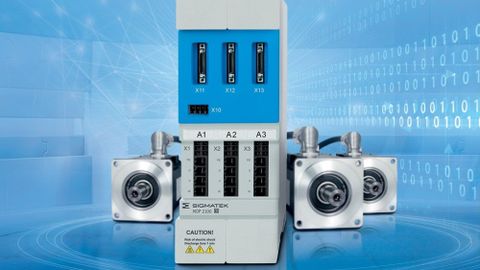
The servo drives in the MDD 2000 series from Sigmatek are characterized by their versatility.
© SigmatekThe 'DIAS-Drive MDD 2000' series is designed as a modular multi-axis servo system with one, two and three-axis modules in two sizes and different performance classes. The servo system can be operated in single-phase or three-phase with 230 to 480 V(AC). In addition to one to three axes, the supply, mains filter, braking resistor and DC link are also integrated in a space measuring just 75 mm x 240 mm x 219 mm in size 1.
The combined MDP 2000 supply and axis module with up to three integrated axes can be used standalone or in combination with any number of MDD 2000 axis modules of both sizes. All modules can be
All modules can be connected quickly and without tools to the 'DC Connection Block' (DCB) and 'Bus Connection Block' (BCB) using baying technology. This eliminates the need for individual wiring for power, DC link coupling and real-time Ethernet communication with Varan bus.
An integrated auto-tuning function and ready-made motion software modules in the extensive library of the 'LASAL' engineering platform shorten the application creation process.
You can also read the big story about the 'DIAS-Drive MDD 2000' here.


You might also be interested in
Available in nine sizes
The FDD 3000 frequency inverter series rounds off Sigmatek's drive portfolio for the low-voltage range for precise control of asynchronous motors.
 read more...
Real-time Ethernet portfolio expanded
A CPU module and an interface module expand the real-time Ethernet bus portfolio of the 'SDIAS' control system from Sigmatek. The CP 313 DIN rail module is a CPU with a dual-core Edge2 Technology processor for control, regulation and motion tasks.
read more...More power in the servo system
Modularity, flexibility and a higher power density are the trend in the development of new production machines. This has an impact on integrated drive technology. A modular, very compact multi-axis servo system meets the challenge.
read more...Intelligent and safe
A new generation of riveting machines relies on servo technology instead of pneumatics and hydraulics. The intelligent drive technology has increased the precision and quality of riveted joints and reduced the number of machine variants.
read more...Relay output module for the top-hat rail
The SRO 022 safety module with two safe, dual-channel outputs from Sigmatek meets the safety requirements of SIL 3, PL e.
read more...S-DIAS series extended
Sigmatek has expanded its S-DIAS series with the CP313 CPU module for control, regulation and motion tasks and the EC121 interface module.
read more...Getriebebau Nord at the SPS 2024
Frequency inverter in booksize format
With the 'Nordac Pro SK 500P', Nord Drivesystems has a control cabinet inverter that is available in variants in a power range from 0.25 to 22 kW, which can be assigned to different requirements in different industries.
read more...Chief Production Officer becomes CEO
Joachim Ley is the new CEO of Ziehl-Abegg, an electric motor and fan manufacturer. He assumes responsibility for the entire management board.
read more...Drive controller with high-current variant
As a high-current variant, the 'SD4B' drive controller from Sieb & Meyer extends the range of possible applications: as a servo amplifier for operating rotary and linear low-voltage servo motors or as a frequency inverter for high-speed...
read more...