
Sigmatek
Intelligent and safe
A new generation of riveting machines relies on servo technology instead of pneumatics and hydraulics. The intelligent drive technology has increased the precision and quality of riveted joints and reduced the number of machine variants.
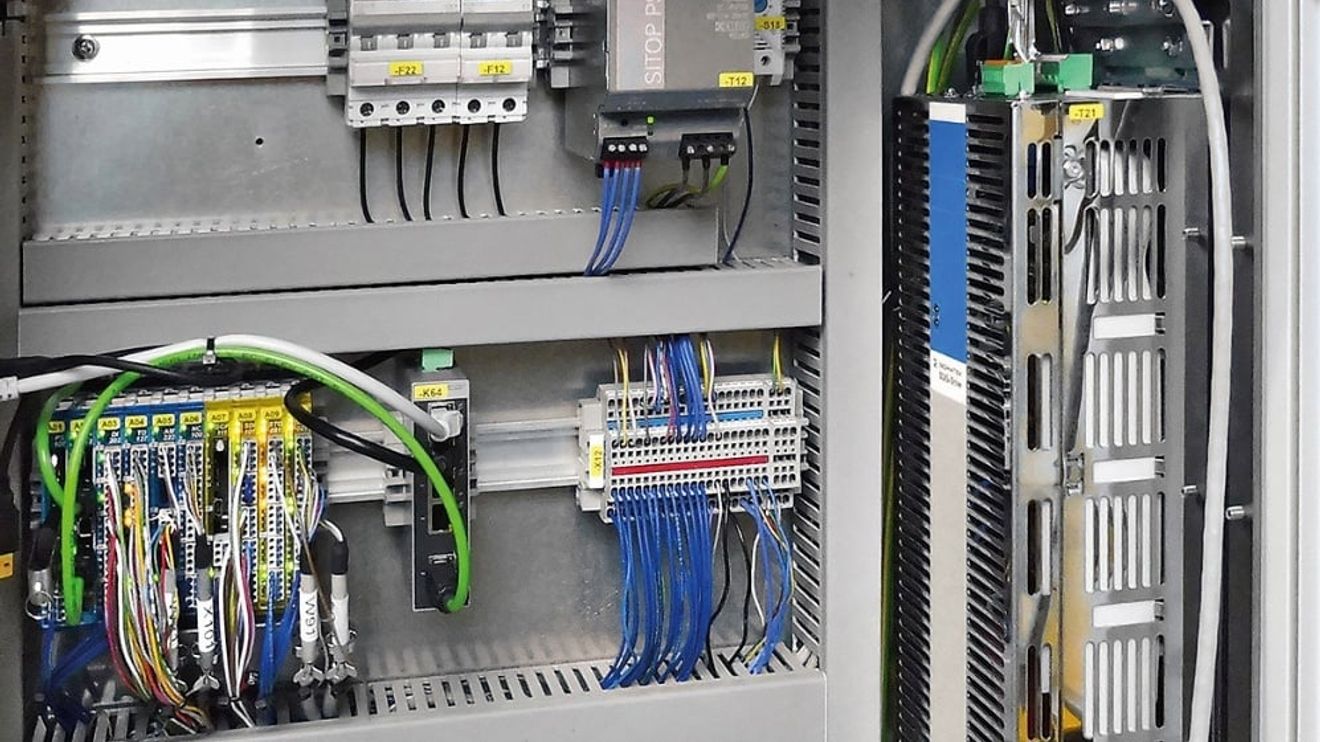
The modular S-DIAS automation system saves space in the control cabinet. It takes over the control and process monitoring and ensures the necessary safety in the riveting process. The SDD 210 servo drive is shown on the right.
© BalTecRiveting technology is used in practically all industries, from the automotive industry to electrical engineering and mechanical engineering. The core competence of the Swiss company BalTec Maschinenbau is to use riveting technology to join components together in a force-fit and form-fit manner. Based on the basic function of the radial riveting process with a linear stroke movement and the superimposed rotational movement, BalTec has succeeded in optimizing radial and wobble riveting technology with a new electromechanical process, thus enabling non-detachable mechanical connections with high speed and precision. Compared to classic pneumatic or hydraulic solutions, BalTec has been able to reduce the number of different machine types from twelve to four models with the use of servo technology in the new 'Electric' machine generation.
Riveting is not the same as riveting

BalTec relies on Sigmatek servo technology for its new riveting machines. The drive system integrates two AC servo motors and monitoring electronics. The S-DIAS automation system from Sigmatek is used for the extended safety functions.
© BalTecDepending on the application, three different methods are used in riveting technology. The so-called radial process can be recognized by the rosette-shaped riveting stamp movement. The deformation takes place smoothly and gently with little force. The advantages include a very good surface structure of the closing heads, low stress on the components, a long service life for machines and tools and minimal friction between the tool and workpiece.
Wobble riveting technology, on the other hand, is suitable for larger-diameter molds and requires a good workpiece holder that absorbs the lateral forces. However, it is less gentle than the radial method.
The third riveting technique is roller burnishing. The process deforms the part by means of
profile rollers that are mounted on a rotating spindle. This process allows the forming of tight radii, has good sealing properties of the formed workpiece and is particularly suitable for large diameters.
No off-the-peg drive
When developing the new electromechanical machine generation 'Electric', the company worked together with Sigmatek in terms of drive and control technology. A standard drive was not an option, as two AC servomotors are compactly integrated in one housing for the riveting technology. The collaboration with Sigmatek resulted in a patented special design from BalTec: the special drive consists of a motor for the linear movement and another for the rotary movement of the process head. All stators were equipped with thermal sensors for temperature monitoring. A total of three position measuring systems are used for the linear axis, two of which are safety-relevant. The various process heads can be exchanged in a few simple steps. An adjustable feed speed of 1 to 140 mm/s and a force of 3 to 15 kN can be achieved with one spindle. The two servo drives for controlling the motors, including mains filter and mains choke, are installed together in a compact housing.
Compared to conventional pneumatic and hydraulic solutions, servo drives offer advantages such as higher production output (up to a factor of 2) due to the short cycle times, reduced maintenance requirements and lower energy consumption.
Everything under control

The process data of the riveting process is displayed in various windows. Target/actual data, driving profile data, history (logger data) or curve displays (distance, force, time and more) can be displayed.
© BalTecDuring the riveting process, the S-DIAS control system from Sigmatek accesses the motor parameters in real time. This enables more precise forming results to be achieved. Recording, visualization and storage of process data and force/displacement process curves for the riveting process are also included. The recorded process data is important for traceability, for example, but also helps to comply with and check predefined quality features as well as for seamless documentation. The data is also important for proof of process capability and product liability. The Varan real-time Ethernet bus is used for fast and secure data exchange between the controller and the SDD 210 servo drive.
Together with another partner, the riveting technology specialist developed the Windows 10-compatible HPPi user interface. An open, bidirectional data interface facilitates communication with a higher-level control system. However, the HMI is not necessary for pure machine operation, because once the parameters have been defined, it works autonomously.
Safety technology implemented

Ingrid Traintinger is Head of Marketing Communications at Sigmatek in Lamprechtshausen, Austria.
© SigmatekRiveting machines are usually integrated into a fully automated production process, which is why control and drive technology must meet high requirements in terms of safety and communication capability. Communication often takes place via digital inputs and outputs, but communication between the machines is now increasingly taking place via Ethernet interfaces with OPC UA protocol. The safety level of BalTec riveting machines is high and corresponds to that of a press. The advantage is that the S-DIAS safety modules are seamlessly integrated not only in the control hardware but also in the software. Despite the increasing degree of automation, the workpieces to be processed in riveting machines are still fed by hand in certain cases. For this reason, the control system must not be affected by whether a light protection grid or a safety door with safety contacts is used as a safety option during the insertion process.
The Sigmatek control system meets these requirements. The integrated safety functions STO (Safe Torque Off) and SOS (Safe Operation Stop) are used in the event of unauthorized intervention by operating personnel.


You might also be interested in
Real-time Ethernet portfolio expanded
A CPU module and an interface module expand the real-time Ethernet bus portfolio of the 'SDIAS' control system from Sigmatek. The CP 313 DIN rail module is a CPU with a dual-core Edge2 Technology processor for control, regulation and motion tasks.
 read more...
Applications in combustion technology
From version 10.12 of the software tool 'PNOZmulti Configurator', the base unit PNOZ m B1 Burner of the safe small controllers 'PNOZmulti 2' from Pilz supports the monitoring and safe control of combustion plants at the same time.
read more...More power in the servo system
Modularity, flexibility and a higher power density are the trend in the development of new production machines. This has an impact on integrated drive technology. A modular, very compact multi-axis servo system meets the challenge.
read more...Supports CC-Link IE TSN
The Anybus product family from HMS Industrial Networks enables data exchange between field devices, machines and systems via common fieldbus and industrial Ethernet networks. The company has expanded the modular embedded family 'Anybus CompactCom'...
read more...Security at the edge
Experts warn that it is not a question of whether a company or production facility will be the target of a cyber attack, but when. The shifting attack surface for cyber attacks is creating a growing need for security solutions at the edge.
read more...Relay output module for the top-hat rail
The SRO 022 safety module with two safe, dual-channel outputs from Sigmatek meets the safety requirements of SIL 3, PL e.
read more...Mobile robot system for assembly and intralogistics
With the 'BionicMobileAssistant', Festo has developed the prototype of a robot system that moves autonomously in space and can recognize objects, grip them adaptively and work on them together with humans.
read more...The e-paper of the summer issue 7/8 for you
The current issue 7/8 is now available as an e-paper or for download. Once again this month, we have special features, practical examples, interviews, exclusive reports and product news for you.
read more...German industry starts full steam ahead after the crisis
Despite the financially devastating effects of the coronavirus pandemic, German industry is using it as an opportunity to become much more efficient, digital and crisis-proof. This is the conclusion of the VDI's 'Corona Restart Survey'.
read more...