
Sigmatek
More power in the servo system
Modularity, flexibility and a higher power density are the trend in the development of new production machines. This has an impact on integrated drive technology. A modular, very compact multi-axis servo system meets the challenge.
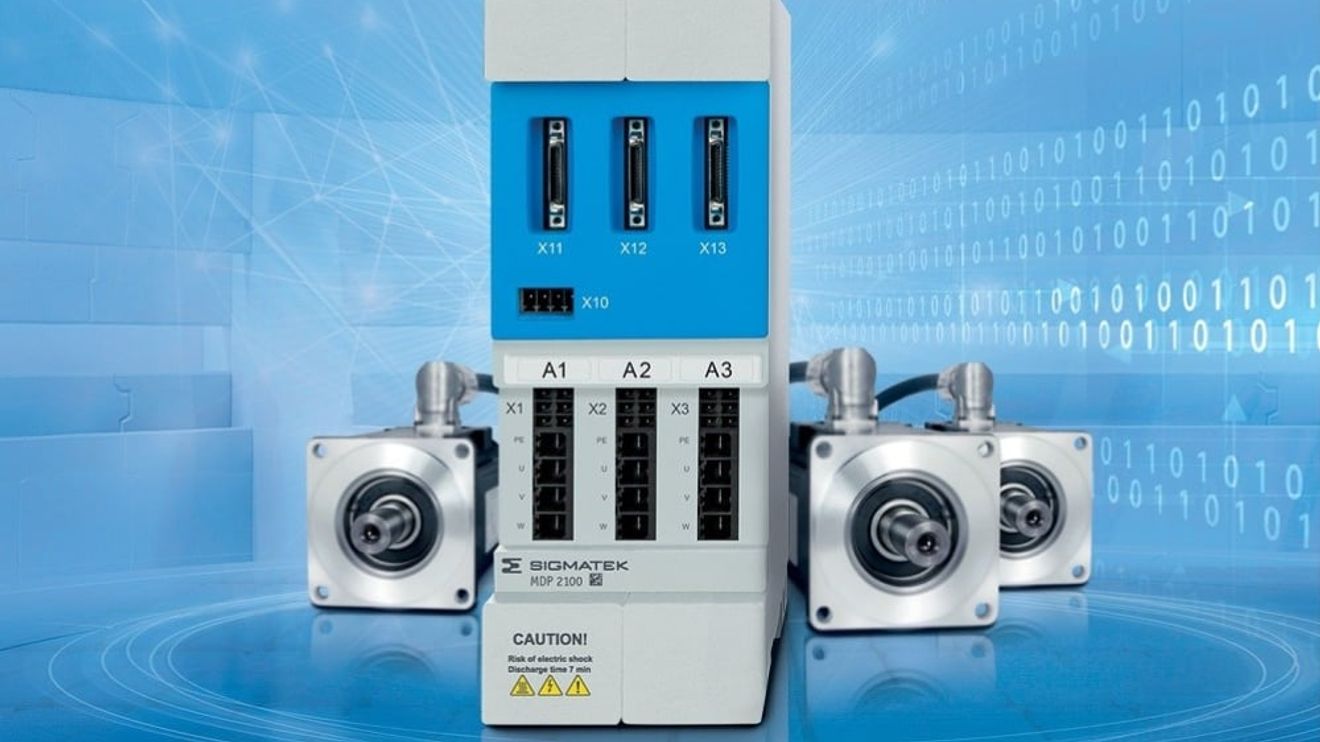
Efficiency and flexibility are the most important factors in the development of new production machines. A key factor here is the drive technology and its integration into the machine process. According to a study, 7.6 servo drives are in use per machine - and the trend is rising [1]. As production machines are also becoming smaller and smaller, this trend is placing new demands on drive technology.
Sigmatek has designed its new generation of MDD 2000 Drives for dynamic multi-axis applications, which are frequently found in series machine construction. This is the latest member of the automation specialist's DIAS Drive series, which complements the servo systems in a higher performance range. To date, the S-DIAS family has comprised the modular MDD 100 series for up to eight servo axes per module and the compact SDD 300 series for the power range from 8 to 14 kVA and up to three drives.
The MDD 2000 series covers all of this in one series and expands it with modules with up to 30 A rated current or 60 A peak current per axis. When developing the new generation of drives, particular attention was also paid to creating a compact and flexible system with high power density and extensive safety functions. For example, the 3-axis device in size 1 with an output of 8.5 kVA measures just 75 mm × 240 mm × 219 mm, including power supply and mains filter. It is currently available with 3 × 5 A rated current and 15 A peak current. Depending on the number of axes, up to 10 A rated current and 25 A peak current will be possible in this size in the future. Size 2 is twice as wide at 150 mm and can handle up to 17.25 kVA. The 3-axis module with 3 × 10 A rated current and 30 A peak current is available for the market launch. Depending on the number of axes, up to 20 A rated current and 45 A peak current are planned for this size.
Modular multi-axis servo system

At market launch, the MDD 2000 series is available in sizes MDD 2100 and MDD 2200. The height and depth of the modules (240 mm x 219 mm) are identical, the width varies. Size 1 measures 75 mm and offers a connected load of up to 8.5 kVA per combined supply/axis module. The double-width size 2 provides up to 17.25 kVA.
© SigmatekA backplane was deliberately omitted from the design, eliminating the need to keep options on hand. Up to three axes are integrated in the combined MDP 2000 supply and axis module. This module can be used as a stand-alone compact drive or expanded with any MDD 2000 axis modules to form a multi-axis system.
multi-axis system. The user can choose between 1-, 2- and 3-axis modules in different performance classes and sizes. All modules can be connected to the 'DC Connection Block' (DCB) and 'Bus Connection Block' (BCB) without tools; there is no need for individual wiring for power, DC link coupling and real-time Ethernet communication. The servo system can be operated with single-phase or three-phase 380 - 480 AC; mains filter and braking resistor are integrated.
The new generation is cooled by fans as standard, which can be replaced without tools ; the drives are optionally available in a cold-plate version or as a through-hole variant. A brake voltage reduction can be configured to reduce the power loss or heat development in the holding brake of the motor.
More integrated safety
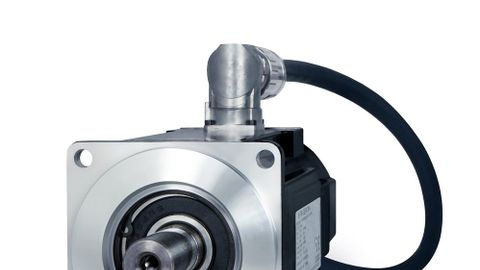
The MDD 2000 series from Sigmatek uses motors with single-cable technology Hiperface DSL encoders as standard.
© SigmatekIn terms of safety, the MDD 2000 series has more safety functions than the MDD 100 and SDD 300 series. In addition to the Safe Torque Off (STO) and Safe Stop 1 (SS1) stop functions, Safe Operating Stop (SOS), the Safe Brake Control (SBC) brake function and the Safely-Limited Speed (SLS) speed function are integrated as standard and enable applications up to SIL 3, PL e, Cat. 4.
The implementation of the safety-relevant drive functions is flexibly solved: The controller enable by the central safety controller can be hard-wired as before via the six integrated enable inputs or now via the Varan real-time Ethernet bus. The safety functions can be parameterized in the safety controller, while the set parameters are monitored in the drive.
Single-cable solution as standard
The new Servodrive generation uses the Hiperface DSL digital motor feedback interface as standard. The single-cable solution for power and feedback signals eliminates the encoder cable and minimizes the cabling effort. In addition to the single-cable solution, the encoder variants EnDat 2.1 and 2.2, Hiperface, Resolver, Sin/Cos, TTL, BiSS-C, SanyoDenki and Tamagawa are also supported.
The position is specified in the controller and is transmitted to the drive via the Varan Ethernet bus
system Varan to the drive. The controller cycle times are 62.5 µs. To avoid unnecessary overhead, the functions of the servo system are limited to current, speed and position control. The positioning and control algorithms are executed by the controller integrated in the drive, which also communicates with the higher-level control system and ensures fast data traffic. Six integrated digital capture inputs enable the position to be saved in the µs range. Three two-channel safe 24 V inputs are also available, which can be configured for specific applications.
Autotuning shortens commissioning

With a depth of just under 219 mm, the drive system fits into smaller, 300 mm deep control cabinets, which are often used directly under the machine. The multi-axis system can also be extended without tools using the DC and Bus Connection Blocks bridging units.
© SigmatekIn the Lasal Engineering Suite, Sigmatek combines object-oriented programming in accordance with IEC 61131-3 with graphical representation and provides packages for all automation disciplines. Lasal Motion, the software package responsible for drive technology, enables configuration, programming, simulation and diagnostics in a clearly structured interface. The new auto-tuning function helps machine builders to quickly match drives and motors to the actual mechanical system. As soon as the user has defined the nominal and maximum current as well as a permitted process space and the drive is ready with the motor connected, automatic motor optimization can be started in the tool. In addition to the controller parameter calculation, the user can also see the Bode diagram and the step responses. If required, the dynamics of the current controller and speed controller can be adjusted.

Ingrid Traintinger is Head of Marketing Communications at Sigmatek in Lamprechtshausen, Austria.
© SigmatekIn the internal data analyzer of the DIAS drives, data can be recorded at sampling rates of 62.5 µs and displayed online in the software tool. As the configuration parameters are managed centrally in the control system, it is not necessary to configure the drive components individually. When a servo drive is replaced, the parameters are loaded automatically; this further reduces commissioning times and prevents errors.
Other functions include the Motor Calculation Software, which helps to find the right drive for the application in question, and the Motion Diagnostic View, which simplifies commissioning and diagnostics.
The integration of control, visualization, motion control and safety in one engineering platform enables improved synchronization of process and motion sequences in the machine. This increases production speed, precision and product quality.
Interview with Alexander Melkus, Managing Director of Sigmatek

Which markets would you like to serve with the new generation and what do you expect from the new product?
The aim of many machine manufacturers is to bring the power electronics close to the motor and thus reduce the amount of cabling required. The more compact the drives are, the easier it is to integrate them decentrally into the machine. The high power density is complemented by modularity and therefore individual design. The new drive system is a tailor-made solution for many markets.
Lasal Motion provides a library of ready-made motion function modules. How flexible is the user, does he want to adapt modules to his needs or add his own modules?
This is where the strength of object orientation, on which the Lasal Software Suite is based, comes into its own. The user can derive all prefabricated and tested motion blocks from the Lasal library and make specific changes. Of course, it is also possible to program your own motion profiles or modules.
How important are software tools in drive technology now and in the future?
By bringing together process data and motion data, Lasal makes it possible to optimize machine cycles. This has a positive impact on the output, life cycles and energy consumption of the machine. It also makes it easier for the user to diagnose faults. Predictive maintenance and the collection or aggregation of drive data that leads to machine learning are topics that will play a role in drive technology in the future.
Sigmatek is known for developing many things itself - the operating system and the Lasal engineering suite are examples of this. Will this remain the case in the future or will Sigmatek bring development partners on board at some point?
Everything from a single source is one of Sigmatek's strengths. However, we concentrate on the core components of machine automation. To round off our range, we offer products that are customized for us by system partners and fit seamlessly into the software suite for our customers.


You might also be interested in
Versatility in a small space
High power density and multifunctionality are in demand for servo drives for production machines. Sigmatek is therefore presenting a new series that promises to meet these requirements. Alexander Melkus, Managing Director at Sigmatek, explains the...
 read more...
Available in nine sizes
The FDD 3000 frequency inverter series rounds off Sigmatek's drive portfolio for the low-voltage range for precise control of asynchronous motors.
read more...Real-time Ethernet portfolio expanded
A CPU module and an interface module expand the real-time Ethernet bus portfolio of the 'SDIAS' control system from Sigmatek. The CP 313 DIN rail module is a CPU with a dual-core Edge2 Technology processor for control, regulation and motion tasks.
read more...SPS Connect 26.11. - 14:50 - 15:10
Saving energy with servo technology
How can we use servo technology to save energy? Intelligent concepts create new possibilities.
read more...I/O portfolio and safety control
Bosch Rexroth is now launching its own I/O line on the market for the first time. With the ctrlX I/O, the sensor/actuator level is to be seamlessly integrated. In addition, a safety solution has now been added to the portfolio.
read more...One year of the ctrlX platform - what now?
A year ago, Bosch Rexroth launched the ctrlX automation platform on the market. What has happened since then? What are the next steps?
read more...Out of the fog
Machine operators increasingly expect digital services from manufacturers - more software, more connectivity, more intelligence in the machines to make their operation more efficient. Cloud and edge computing can be used to add precisely these...
read more...Intelligent and safe
A new generation of riveting machines relies on servo technology instead of pneumatics and hydraulics. The intelligent drive technology has increased the precision and quality of riveted joints and reduced the number of machine variants.
read more...Relay output module for the top-hat rail
The SRO 022 safety module with two safe, dual-channel outputs from Sigmatek meets the safety requirements of SIL 3, PL e.
read more...