
Sensor communication
The principle of the second channel
Standardizing data and its exchange across all system boundaries and into the cloud is one of the concerns of Industry 4.0. One possible approach to efficiently transferring the data generated by sensors is the 'dual-channel principle'.

A large proportion of the data required for Industry 4.0 or IIoT is generated with the help of sensors. Their task is to record process variables and transmit them in the form of data to receiving systems via interfaces. This process data is basically the original data for solving the actual automation task. Depending on the sensor type, a different amount of data is available. The interfaces used are those that are best suited to the complexity of the data transmission: Simple binary switching sensors transmit the process value as well as status and diagnostic messages via the IO-Link point-to-point communication interface. More complex sensors with higher functionality are often integrated into real-time capable fieldbus networks. They also transmit several process and alarm values as well as status and diagnostic messages and can be fully parameterized via the controller.

The dual-channel principle: Channel 1 is used for process control data, while channel 2 is used for monitoring and machine analysis information.
© Leuze electronicIndustry 4.0 is bringing topics such as recipe changes and format changeovers as well as condition monitoring and predictive maintenance more into focus. The data required here is often not absolutely necessary for the automation task, but helps the user to increase the availability of their system with plannable preventive maintenance intervals. The data is brought together from a wide variety of sources at a central location, for example in a cloud. As this results in higher data volumes despite lower update rates, the communication character is different.
Leuze electronic supports this different communication character with the 'dual-channel principle': while the data for process control is transmitted in real time via the first sensor channel, the information for monitoring and analyzing the machine runs via the second sensor channel. The principle is the same for all sensors with interfaces, regardless of their complexity.
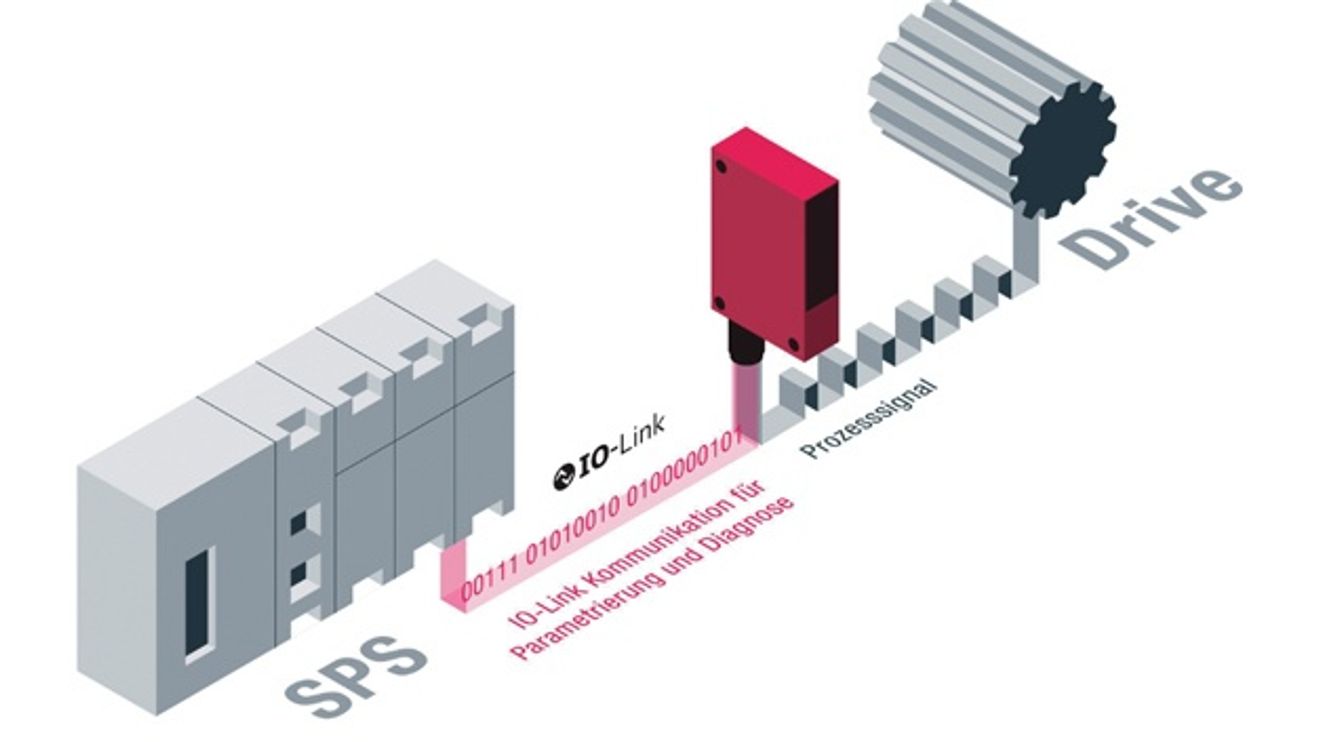
The binary switching sensor

1. connection to a PLC
With the 'KRT18B' contrast sensor, for example, which is used in a high-speed packaging machine to determine an exact cut mark position, the packaging quality of the machine depends on the real-time capability of the switching output. For this reason, the switching output of a contrast scanner is better not looped via a controller, but connected directly to an actuator. In order to still provide the option of monitoring and analyzing the machine, the contrast scanner has an IO-Link communication interface in addition to the fast switching output. It can be used to monitor the process value, determine the function reserve and carry out parameterization. It also supports the customer when changing recipes or changing formats.
2. dual channel and Industry 4.0
In the context of IIoT and Industry 4.0, data must be available to other automation participants - for monitoring and parameterization, for example - as independently of location and worldwide as possible. This is usually done via cloud solutions. If the same requirements apply as described above, a connection to an IO-Link coupling module with an Ethernet interface and OPC UA communication protocol is required instead of the IO-Link connection to the PLC. The connection to the cloud is then established via an IoT Edge Gateway, for example.
Sensors with fieldbus interface

Dual channel and IIoT/Industry 4.0 for sensors with a fieldbus interface: Monitoring data can be transported to the cloud via an integrated cloud connector or an IoT Edge Gateway.
© Leuze electronicLeuze electronic also offers a dual-channel solution for more complex sensors with an integrated fieldbus interface. The 'BCL 348i' barcode scanner, for example, has a Profinet interface. In principle, process and alarm values, detailed status and diagnostic messages as well as the complete device parameterization can be carried out from the control system via this interface. However, if the monitoring data needs to be available globally and from any location, the sensor offers this via its industrial Ethernet interface with the OPC UA communication protocol. This data can be transported to a cloud application via an integrated cloud connector or an IoT Edge Gateway.
A question of real-time capability
Topics such as condition monitoring or predictive maintenance, which are being discussed intensively in the context of IIoT and Industry 4.0, require sensors that are able to provide data worldwide and in a standardized format. A general distinction must be made as to which requirements exist with regard to real-time capability. With the dual-channel principle, it is possible to make data available separately and according to customer requirements. Data with real-time requirements is transmitted via channel 1, while data for process monitoring and parameterization is transmitted via channel 2. The classic IO-Link interface for binary switching sensors, which in SIO mode (standard IO mode) allows either the switching signal or point-to-point communication with the sensor on request, cannot achieve this. This is because both types of information are required in parallel for process control. The user must be able to evaluate the process value, switching reserves to the threshold values or contamination status continuously and online in the packaging process of a packaging machine, for example in a contrast sensor, in order to detect deviations from the target status at an early stage. The dual-channel principle helps here.
Real-time capability and data for monitoring and parameterization are available for sensors with fieldbuses, at least with real-time Ethernet interfaces - but only locally and not location-independent and accessible worldwide. In addition, the information that a sensor provides for condition monitoring or predictive maintenance is usually not evaluated. Here, too, the dual-channel principle is the ideal solution.
Author:
Stefan Ambos is Head of Product Marketing Management at Leuze electronic in Owen.


You might also be interested in
The first steps towards digitization
Real-time transparency in the material flow: this was the goal set by Miba when it set out to digitalize its internal logistics processes. But how successful was the close link between ERP and MES in the end? - A field report.
 read more...
How will the IoT change companies in 2020?
How will network technology in companies change in 2020? Axel Simon, Chief Technologist at HPE Aruba, takes a look into the crystal ball
read more...Digital twin revolutionizes maintenance
As virtual representatives of real machines, digital twins open up new possibilities for maintaining and servicing complex industrial plants and systems. A project report.
read more...You can't do without Edge and Swarm
The IoT has changed the requirements for processing data provided by machine sensors and actuators. This needs to happen as quickly as possible - preferably where the data is generated. Edge nodes and swarm computing systems take on this task.
read more...Online machine data under control
Turning huge amounts of data into valuable information - how can this smart industry approach be implemented? Linking PC-based controllers with Matlab and a cloud-based IoT analytics service can be a viable approach.
read more...From modeling directly into the PLC
Despite digitalization and I4.0, the technical functions in a process plant do not become simpler if you break them down to the smallest detail. Nevertheless, the high level of difficulty can be overcome by combining the right tools in the right way.
read more...Where are the new business models?
The necessary new business models are repeatedly cited as the hallmark of an Industry 4.0 environment. But to date, very few companies have seen any of this. Schneider Electric now has a few models up and running.
read more...Why predictive maintenance?
Investments in predictive maintenance systems are worthwhile in order to proactively detect damage. Not only does this increase the service life of a machine, it also opens up new business models for machine manufacturers.
read more...First customer projects via BaSys 4.0
The BMBF project 'Basissystem Industrie 4.0' expired at the end of June 2019. Together with NetApp and Objective Partner, Fraunhofer IESE now offers Industry 4.0 solutions with support and adaptation to customer systems on the basis of this project....
read more...