
Internet of Things
You can't do without Edge and Swarm
The IoT has changed the requirements for processing data provided by machine sensors and actuators. This needs to happen as quickly as possible - preferably where the data is generated. Edge nodes and swarm computing systems take on this task.

Away from centralized, towards decentralized infrastructures: This development is emerging in networked manufacturing environments. The reason is that IoT components are increasingly being used in such infrastructures. These include sensors and actuators on machines, systems in power plants and automated transport systems. The market research company Gartner has determined that around 400 million 'IoT endpoints' are currently in use worldwide in the manufacturing sector alone. This figure is expected to rise to around half a billion by 2020. Comparable growth rates are expected in building automation and the automotive sector.
However, this development places special demands on the IT infrastructure. The reason for this is the large volumes of data. In its Data 2025 study, the market research company IDC determined that industrial companies worldwide will generate around 22 zettabytes of data in 2025. Of this, 43% will be real-time data, for example from sensors and actuators. This data must be recorded, processed and evaluated within milliseconds. This is not possible with an IT model in which the information is processed in a central data center: the latency times for transmitting the data to the data center and back to the end system are too high.
The way out: edge computing
The solution is to process the data where it is generated, for example on a machine tool. This approach can be implemented with the help of edge computing systems. An edge computing infrastructure consists of three main components:
- IoT components
- Edge systems (nodes) and gateways
- Cloud services
IoT components such as sensors and actuators are integrated into production systems and corresponding processes. For example, they record the temperature values of a machine tool's electric motors or the number of workpieces that a milling machine has processed. The IoT systems are connected to the second core component: the edge nodes.
The edge nodes are independent computers with storage and network components. Systems with 8- and 16-bit microcontrollers, such as those based on the Arduino Uno, are used. However, compact high-performance computing (HPC) systems such as the BullSequana Edge server from Atos are also available. Such edge systems analyze the data transmitted by IoT components on site. High-performance solutions make use of technologies such as artificial intelligence and machine learning. Another task is the intermediate storage of data.
Other systems at the edge computing level are edge gateways. They have interfaces that collect data from sensors and interact with actuators. There are also components for edge cluster management. In addition to management functions, these systems also provide storage services and analysis functions.
Cloud services as a supplement
Central cloud services form the third level. They provide management functions for the IoT systems and edge nodes. Another task of cloud data centers is to store data from IoT components over a longer period of time and perform computationally intensive analyses of information assets that do not require a real-time response. Cloud services also serve as an interface to other IT systems and applications, such as ERP solutions.
In addition to central (cloud) data centers, an edge computing structure requires small, decentralized data centers. Such data centers have comparable facilities to their 'big brothers', such as air conditioning designed for harsh environments such as a production hall, a fail-safe power supply and redundant network connections.
Expansion through swarm computing
But edge computing is only the first step. Swarm computing is an extension of this concept. It is used to connect distributed, autonomous systems with each other via a mesh-like peer-to-peer architecture. This is done with the help of a decentralized storage and computing layer. One advantage of swarm computing is that it dynamically combines IoT endpoints, edge systems and cloud platforms - across the boundaries of companies and locations. This creates an intelligent, distributed infrastructure. Another advantage is that the 'silos' in which edge computing systems are currently located are broken down. This allows IT resources and IT services to be made available as required.
Swarm computing replaces the current model, which is based on predefined IT resources and IT services with limited flexibility. Such approaches are not suitable for highly dynamic areas of application. One example is energy supply. Energy suppliers have to constantly readjust the mix of energy sources depending on the duration of sunshine and wind strength as well as demand and legal requirements. This can only be achieved if a large amount of data is recorded and evaluated. It is also necessary to adjust the production capacity of wind turbines, solar plants, hydroelectric power plants and conventional energy generation plants in real time. Swarm computing offers this flexibility.
Components of Swarm Computing
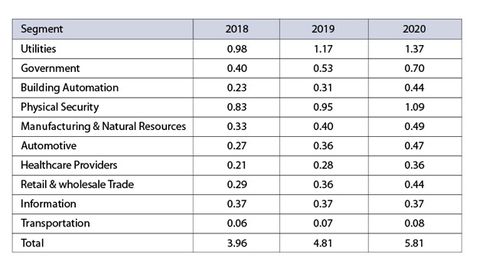
The number of global IoT endpoints by industry and area of application (in billions of systems).
© Gartner (August 2019)A swarm computing environment also consists of three levels. The first comprises the edge computing systems already mentioned, the second multi-cloud computing in conjunction with service orchestration. Thanks to the support of multi-clouds, companies can use cloud services from different providers. For example, a company books storage capacities with one provider and analytics and machine learning services with another. 'Swarm instrumentation' therefore plays an important role. It provides a uniform interface for cloud services that are accessible via a swarm computing platform.
The third component is the end-to-end orchestration (E2E) of the resources and services of a swarm computing infrastructure. Atos experts advocate an open, distributed runtime environment that allows decentralized management of the systems in such an environment. This is necessary in order to manage different types of components, which can also be located in different places. Another component of orchestration is asset lifecycle management. It records the components that are integrated into a Swarm Computing environment. There are also functions for remote access to these systems via telemetry.
IT and OT security
Another key element is securing the swarm and edge computing environment. Companies need to rethink this relationship: IT and OT (operational technology) must not be viewed as separate areas. After all, if edge computing systems fail in a networked production environment, machines and control systems will no longer function either. A protection concept must therefore include all systems, services and components that communicate with each other as part of edge and swarm computing. This applies to a sensor or actuator as well as to big data & analytics software. Protective measures include the 'hardening' of edge computing systems and the use of IoT vulnerability management services that proactively eliminate vulnerabilities.
The new security concepts in swarm and edge computing environments include 'data-ridden security' (DRS). This approach ensures that all components that store and process data have strong security mechanisms. This applies to network, server and storage systems, as well as program interfaces (APIs), applications and IoT and edge computing components. The security precautions that such a system needs to take depend on the importance of the data and also on the risks that loss or misuse could entail.
New forms of network and service management
Edge and swarm computing systems are usually used in conjunction with business-critical IoT applications. New management procedures are therefore also required. For example, they need to detect and rectify network connection failures and overload situations. These technologies include information-centric networking (ICN). It should make it possible to identify information securely and unambiguously, regardless of the channels through which it is distributed. These include content delivery networks (CDN) and peer-to-peer applications (P2P). Thanks to ICN, data is no longer tied to one storage location, one application or one transmission technology. Experts expect benefits such as better scalability in terms of network bandwidth and more robust transmission methods.
Management solutions for swarm computing environments must also be able to manage individual service levels (Quality of Service, QoS) and systems with different processor architectures. This is necessary because 'intelligent' systems at several locations work together in a swarm computing infrastructure and their hardware and software equipment can vary.
Application examples of Swarm Computing
With the help of swarm computing, companies can create 'digital twins' of machines, production environments or products, among other things. These twins make it easier to develop new products and determine how their production and use can be optimized.
Providers of production systems, in turn, have the opportunity to offer their customers innovative services. One example is the predictive maintenance of systems. This is based on data collected by IoT components and edge nodes in real time on site, i.e. at the machine. Usage-based billing models are also conceivable. For example, a provider can calculate the leasing costs of a production machine based on its utilization. IoT systems and edge devices 'measure' how long the user operates a production line per day and at what cycle rate. The leasing fees are calculated based on this.
Author:
Hermann Gouverneur is Chief Technology Officer of Atos Germany and a founding member of the Atos Scientific Community.


You might also be interested in
The first steps towards digitization
Real-time transparency in the material flow: this was the goal set by Miba when it set out to digitalize its internal logistics processes. But how successful was the close link between ERP and MES in the end? - A field report.
 read more...
How will the IoT change companies in 2020?
How will network technology in companies change in 2020? Axel Simon, Chief Technologist at HPE Aruba, takes a look into the crystal ball
read more...Digital twin revolutionizes maintenance
As virtual representatives of real machines, digital twins open up new possibilities for maintaining and servicing complex industrial plants and systems. A project report.
read more...Online machine data under control
Turning huge amounts of data into valuable information - how can this smart industry approach be implemented? Linking PC-based controllers with Matlab and a cloud-based IoT analytics service can be a viable approach.
read more...From modeling directly into the PLC
Despite digitalization and I4.0, the technical functions in a process plant do not become simpler if you break them down to the smallest detail. Nevertheless, the high level of difficulty can be overcome by combining the right tools in the right way.
read more...Where are the new business models?
The necessary new business models are repeatedly cited as the hallmark of an Industry 4.0 environment. But to date, very few companies have seen any of this. Schneider Electric now has a few models up and running.
read more...Why predictive maintenance?
Investments in predictive maintenance systems are worthwhile in order to proactively detect damage. Not only does this increase the service life of a machine, it also opens up new business models for machine manufacturers.
read more...First customer projects via BaSys 4.0
The BMBF project 'Basissystem Industrie 4.0' expired at the end of June 2019. Together with NetApp and Objective Partner, Fraunhofer IESE now offers Industry 4.0 solutions with support and adaptation to customer systems on the basis of this project....
read more...The multi-cloud under control
German companies have been hesitant about the cloud for a long time, but now things are really taking off. More and more manufacturers are using multiple cloud providers - whether strategically or due to shadow IT. But how can the complexity of the...
read more...