
itelligence
Digital twin revolutionizes maintenance
As virtual representatives of real machines, digital twins open up new possibilities for maintaining and servicing complex industrial plants and systems. A project report.

Monitoring around the clock, as failures must not occur.
© XervonXervon Instandhaltung, a German industrial service provider, is developing digital twins for the predictive maintenance of cooling water systems for customers in the process industry and is cooperating with the SAP consulting company itelligence.
To ensure smooth operation, plants in the process industry rely on cooling systems that provide process-oriented, customized and precise cooling. Xervon Instandhaltung, a subsidiary of Remondis Maintenance & Services, operates complex cooling systems for its customers. These systems consist of cooling towers, a branched network of pipelines and several pumps that supply cooled, demineralized water in the correct quantity and at the required temperature.
In order to ensure the continuous operation of the cooling systems, the industrial service provider also takes on the maintenance and servicing of the cooling systems. Monitoring must be carried out around the clock, as failures must not occur. With purely analog means, this ultimately means that service technicians have to monitor the system on site. The personnel required for this increases the costs of maintenance accordingly. In addition, in the traditional approach, maintenance is carried out at regular intervals and therefore sometimes even when it would not have been necessary for the system to run smoothly.
What IoT technologies bring
The use of IoT and Industry 4.0 technologies promises clear efficiency gains here. However, tailored digitalization strategies not only reduce costs, but also improve the quality of maintenance and thus the service life of cooling systems by implementing predictive measures.
To encourage companies across Germany to develop their own digitalization strategies and translate them into concrete projects, the SAP consulting firm itelligence launched the 'itelligence of Things Initiative'. The aim of this competition was to create lighthouse projects for Industry 4.0 and thus highlight the potential of digital technologies for industrial processes. As a winner of the itelligence of Things initiative, Xervon Instandhaltung is supported by itelligence in the development of a tailor-made digitalization solution for a cooling system in the process industry. A central element of the resulting project between Xervon Instandhaltung and itelligence is the practical testing of a digital twin of a complex cooling system.
This digital twin can best be described as a virtual image of the real system. Its most important advantages are
- Sensor data is continuously sent to the cloud, allowing the digital twin to be quickly and automatically monitored for deviations.
- Wear can be simulated 'at the touch of a button'; operating hours and environmental conditions are simply set - predictive maintenance processes can thus be taken to a new level.
The digital twin enables more efficient control and maintenance of the system. It can be used to optimize units in a digital test run so that electricity costs, wear and unplanned downtime are reduced and maintenance is only carried out when it is really necessary.
Digital twin and real system
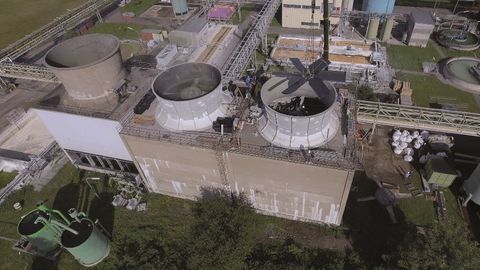
Xervon Instandhaltung operates complex cooling systems for its customers, including cooling towers, an intricate network of pipelines and several pumps.
© XervonTo create a digital twin, technical drawings and specifications such as location, design and agreed performance data must be digitized , but digitizing such data alone is not enough. The digital twin must also be connected to the real world in order to be able to continuously monitor the system. This connection is made via data from sensors. Exactly how many sensors need to be installed and where depends on the use of the digital machine twin.
How complex the creation of a digital twin is always depends on the complexity of the physical original and the parameters that are required to design the digital twin in such a way that it actually reproduces the processes of the original. In the project example, the definition and data collection to specify the parameters took several days. In contrast, the implementation in the system only took a few hours.
The joint project between Xervon Instandhaltung and itelligence is primarily concerned with two application scenarios:
1. operational safety - ensuring sufficient cooling water at the specified temperature.
2. condition monitoring, i.e. the continuous monitoring of the system's operating status.
The pumps that supply the cooling water from the cooling towers to the customer are crucial for both scenarios. Each pump is therefore equipped with three sensors and two more on the gearboxes. These sensors provide data on the pump capacity or flow rate, the speed and torque, the temperature of the pump motor and the energy consumption. In addition to this data, weather data such as outside temperature and humidity are collected, as these also influence the temperature of the cooling water. The picture is rounded off by data from vibration sensors, which measure vibrations at relevant frequencies and different spectra. The vibration data is used to create fault and wear images, and is therefore primarily used for condition monitoring.
Theoretically, the sensor data can be collected in real time. However, the more frequently such measurements are taken, the larger the data volumes and the associated storage requirements. Pre-processing software therefore cleans up the raw data collected at the cooling system. Only then is it sent to the cloud and assigned to the corresponding digital twin. This results in meaningful information that can now be analyzed.
Machine learning included
In his role as project manager at itelligence, Adrian Kostrz supports Xervon Instandhaltung in the implementation of its digitalization strategy.
© itelligenceThe SAP Predictive Maintenance & Service software compares incoming, current data with parameters based on historical data. The software's algorithm is programmed to recognize patterns and react to anomalies such as material fatigue or foreign objects. In this way, peaks can be detected and compensated for in good time. The output of the pump is automatically optimized to the respective cooling water requirements, which not only reduces power consumption but also minimizes wear on pump components.
The digital twin also takes on the task of predictive maintenance. In other words, it predicts how the condition of the system will develop as the operating time progresses. The recorded values are compared with typical fault patterns for this purpose. If there are deviations from the desired operating status, the system personnel are alerted.
Thanks to the digital twin, various scenarios can be run through. This is particularly useful if a repair is indicated but may not be urgent. If the analysis predicts an imminent defect, the repair can be scheduled so that spare parts can be procured in good time and the pump is switched off outside of predicted peak loads. In all of this, machine learning algorithms ensure that the digital twin learns from every event and thus delivers better and better results over time.
The cost-benefit balance for the use of the digital twin is clearly positive. Personnel-intensive observations and adjustments to the system are largely eliminated. If changes necessitate reactions, these can be implemented quickly and in a targeted manner. The deployment of service technicians can be reduced and usually planned in a resource-saving manner. Not all of the added value of the digital twin can be expressed in figures, but it is already clear that its use makes system control far more efficient. This is also helped by the fact that the maintenance effort for the digital twin in the project is low and is limited to cases in which individual components on the physical system need to be replaced. Updating does not result in any particular additional work.

Humans remain indispensable
In theory, digital twins make it possible to take over routine tasks and even control systems within certain limit parameters. However, they will not replace humans. This is because systems such as the project presented by Xervon Instandhaltung and itelligence will ultimately only ever make recommendations.
Whether these are accepted and implemented is still ultimately decided by humans. However, they will no longer be able to do without the use of intelligent systems in the future. After all, IoT and Industry 4.0 technologies increase the possibilities in production and logistics many times over. However, IoT and Industry 4.0 technologies also make this diversity manageable. Digital twins and condition monitoring based on artificial intelligence are good examples of this.


You might also be interested in
Simply monitored
Basic knowledge of industrial IoT applications is available in many companies today - but they often lack the know-how to implement them independently. A solution that can be integrated quickly should help to easily monitor the status of...
 read more...
How will the IoT change companies in 2020?
How will network technology in companies change in 2020? Axel Simon, Chief Technologist at HPE Aruba, takes a look into the crystal ball
read more...Machine tool industry 2019/2020
Digital networking is becoming a hot topic
The VDW expects the machine tool industry to decline by 18 percent this year, but also sees the downturn as an opportunity for the industry to reinvent itself. The biggest lever here is digital networking.
read more...Rethinking the value stream
Until now, flexibility and efficiency have been opposing process parameters in industrial value streams: The use of modern IoT technologies offers new opportunities to resolve this old contradiction in a 'smart' way.
read more...In continuous transformation mode
ABB has not had an easy year: internal restructuring and a difficult market environment caused the Group's profit to fall by over 30 percent. The year-end balance sheet for 2019.
read more...Grid operators under pressure to act
The high investment costs for the expansion of the 5G network are causing problems for network operators. The technology consultancy BearingPoint assumes that network operators therefore need to reposition themselves - now!
read more...Smart services and cloud technology bundled
On January 1, 2020, the Phoenix Contact Group bundled its digital service portfolio in the subsidiary Phoenix Contact Smart Business in Berlin. This includes all activities relating to cloud technology and data analytics as well as software services.
read more...The first steps towards digitization
Real-time transparency in the material flow: this was the goal set by Miba when it set out to digitalize its internal logistics processes. But how successful was the close link between ERP and MES in the end? - A field report.
read more...How will the IoT change companies in 2020?
How will network technology in companies change in 2020? Axel Simon, Chief Technologist at HPE Aruba, takes a look into the crystal ball
read more...