
Industry 4.0
Where are the new business models?
The necessary new business models are repeatedly cited as the hallmark of an Industry 4.0 environment. But to date, very few companies have seen any of this. Schneider Electric now has a few models up and running.
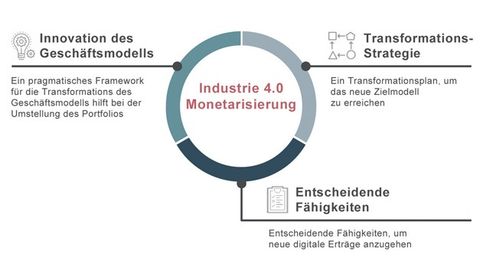
The transformation of the business model requires ambitious targets: Within five years, companies should generate 20% of their turnover with recurring revenues through 'as-a-service' solutions for devices and services.
© Zuora, Roland BergerNew business models have been dramatically transforming many sectors for several years. The term subscription economy covers all business models in which monetization takes place via additional digital services, flexible subscription models or pay per use. In addition to new revenue opportunities, this offers further advantages: Providers of such models can analyze the use of their products by users much more precisely and thus adapt them exactly to customer needs. This enables genuine customer orientation, which was often just wishful thinking in the past. But how can this transformation succeed for providers of traditional industrial products - i.e. physical goods?
Models for the manufacturing industry
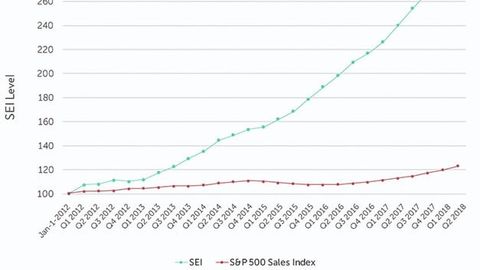
Companies in the subscription economy have grown five to nine times faster on average than the Standard&Poor's index in recent years.
© Zuora, Roland BergerDigital transformation programs have been launched in almost every company in the manufacturing industry. The Industrial Internet of Things, artificial intelligence, cloud solutions and blockchain are the main technological drivers of Industry 4.0. Everyone involved is also aware that data is an important resource. However, the development of suitable business models that turn this data into profitable revenue is often still in its infancy. However, the greatest opportunities of the digital transformation lie in new business models. The Subscription Economy Index, which is regularly compiled by Zuora, shows how successful companies can be if they develop their business models in the direction of flexible subscription and pay-per-use models: Compared to Standard&Poor's index, companies in the Subscription Economy show an average of five to nine times greater growth in recent years.
However, the development of new business models in the manufacturing industry is a complex task. As material goods are involved, the solutions of the software and media industry cannot be transferred one-to-one. The focus here is not only on the new opportunities for monetization, but also on the changes that need to be made within the corporate structure. In any case, there is an urgent need for a rethink at management level in terms of value creation and value enhancement.
Schneider Electric as a prime example
Schneider Electric, one of the world's leading companies in the fields of energy management and industrial automation, has already converted numerous offerings to flexible usage models. The company wants to drive forward the digital realignment of energy management and automation technology and ensures that IoT-enabled solutions can be seamlessly networked in order to collect and analyze data in real time. With its EcoStruxure Facility Advisor, for example, Schneider Electric helps building owners or operators to improve the energy efficiency of small to medium-sized buildings, ensure smooth operation and optimize operating and maintenance costs. The Advisor is one of many solutions in the EcoStruxure platform, which is used in 480,000 properties worldwide and to which over 1.6 million devices are connected. Over 20,000 partners and system integrators support customers with this platform. The Advisor works with cloud-based software that accesses data in the buildings in real time and evaluates it using modern analysis methods. The customer receives valuable information that supports them in the optimal operation of the building. At the same time, partners and system integrators receive valuable information about their customers' needs. This information, in turn, is helpful when it comes to selling additional services or devices. The software is available on a subscription basis, works with both new and existing hardware and is manufacturer-independent.
Another example is TelevisBlue, which serves as a retrofit solution for monitoring small and medium-sized refrigeration systems. The devices enable connectivity with the cloud-based software via a mobile phone connection. The platform, specially developed for tablets and smartphones, provides access to all systems and makes the information available anytime and anywhere. With this plug & play solution, users can very easily implement temperature monitoring of their existing cooling systems and also increase their energy efficiency. TelevisBlue already includes a service period of twelve months. Small and medium-sized retailers can use the service immediately. All they have to do is register online, and payment is made as a self-service without any red tape by credit card. The subscriptions for this service are very flexible: users can choose from various packages that differ in terms of functionality and the maximum number of monitored systems.
Adapt billing systems
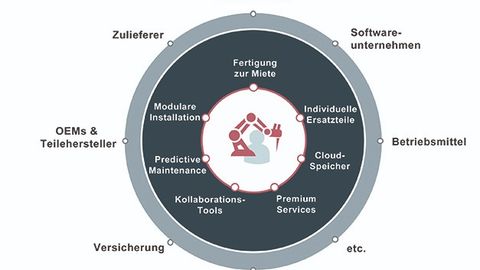
In Germany, 20% of revenue is currently generated through services. In future, this share is set to grow further through new added value based on data collection, pay-per-use models or the introduction of platform models.
© Zuora, Roland BergerOne of the important aspects of the transformation to new business models of the subscription economy is the adaptation of the business management systems of manufacturing companies. Conventional processes are based on traditional ERP systems. They are fixed to the steps from quotation to order and delivery through to accounts receivable management. With modern flexible business models, however, classic ERP systems reach their limits, as they are not designed for recurring sales with flexible subscription models. Companies therefore need a solution in addition to their ERP and CRM systems in order to easily implement such new business models and respond flexibly to customer needs. At Schneider Electric, the Zuora billing system helps to expand the existing business to include models with regular sales. The flexible billing solution allows offers to be adapted to individual customer requirements. The result: Responsive prices and offer packages, uniform customer insights and processing in different currencies. Thanks to this flexibility, Schneider Electric can quickly and easily introduce new offers and become active in different markets.
More detailed information

New business models - The white paper "Reaping the recurring Benefits of Industry 4.0" by Jean-Michel Cagin (Roland Berger) and Michael Mansard (Zuora) contains numerous other examples in addition to the Schneider Electric reference. A step-by-step guide to digital transformation rounds off the 64-page paper. It is available for download on the Internet.
Authors:
Jean-Michel Cagin is a Senior Partner at Roland Berger,
Michael Mansard is Principal Business Transformation & Innovation at Zuora.


You might also be interested in
Educational cooperation for Industry 4.0
The aim of a cooperation between the Teutloff Technical Academy, system integrator CSAE and automation supplier Turck is to provide practical training for Industry 4.0
 read more...
Lack of trust in employees
Since 2016, the importance of digital transformation has steadily increased in large German companies. Now it is declining for the first time, according to the latest survey by digital consultancy Etventure. One of the main reasons: trust in their...
read more...The first steps towards digitization
Real-time transparency in the material flow: this was the goal set by Miba when it set out to digitalize its internal logistics processes. But how successful was the close link between ERP and MES in the end? - A field report.
read more...How will the IoT change companies in 2020?
How will network technology in companies change in 2020? Axel Simon, Chief Technologist at HPE Aruba, takes a look into the crystal ball
read more...Digital twin revolutionizes maintenance
As virtual representatives of real machines, digital twins open up new possibilities for maintaining and servicing complex industrial plants and systems. A project report.
read more...You can't do without Edge and Swarm
The IoT has changed the requirements for processing data provided by machine sensors and actuators. This needs to happen as quickly as possible - preferably where the data is generated. Edge nodes and swarm computing systems take on this task.
read more...Online machine data under control
Turning huge amounts of data into valuable information - how can this smart industry approach be implemented? Linking PC-based controllers with Matlab and a cloud-based IoT analytics service can be a viable approach.
read more...From modeling directly into the PLC
Despite digitalization and I4.0, the technical functions in a process plant do not become simpler if you break them down to the smallest detail. Nevertheless, the high level of difficulty can be overcome by combining the right tools in the right way.
read more...Why predictive maintenance?
Investments in predictive maintenance systems are worthwhile in order to proactively detect damage. Not only does this increase the service life of a machine, it also opens up new business models for machine manufacturers.
read more...