
Industry 4.0
First customer projects via BaSys 4.0
The BMBF project 'Basissystem Industrie 4.0' expired at the end of June 2019. Together with NetApp and Objective Partner, Fraunhofer IESE now offers Industry 4.0 solutions with support and adaptation to customer systems on the basis of this project. - An interview with the project managers.


Jürgen Hamm, Solutions Architect at NetApp Germany: "We want to create a platform that provides everything in containers."
© NetAppLet's start with a fundamental question: you are all intensively involved with the networking of production. What is the core of Industry 4.0 for you?
Dr. Thomas Kuhn: The most important aspect is to achieve adaptable production. Actions and processes that were not originally planned must be able to be phased in without stopping the production flow. The prerequisite for this changeability is the end-to-end digitalization of production processes, which initially allows the creation of live images via digital twins of each work step and maps the associated documentation. Both are important for companies in order to prove and monitor the quality with which a product has been manufactured.
Jürgen Hamm: " The resulting findings can be used to achieve significantly higher quality standards in production. If the newly acquired data models from production are enriched and analyzed with the business data from an ERP system, a company can define significantly improved business models for all its activities. By enriching production data, it is possible, for example, to retrospectively review supplier evaluations. - This is what Industry 4.0 is all about.
The end-to-end digitalization of production through to ERP systems such as SAP requires data to be transferred to interfaces. Which ones are particularly important?

Andreas Bader: Well, we prefer to talk about integration here and follow SAP's side-by-side approach. Our image is characterized less by asynchronous and more by synchronous processes. Components such as the SAP Data Hub certainly play a key role here. On the other hand, in the Industry 4.0 environment, we are very much talking about the consistency of process chains. But these start right at the beginning with the order or even the quotation. Basically, the required interfaces depend entirely on the customer, their environment and their requirements.
Industry 4.0 is still aimed at the much-cited batch size 1, the individual workpiece, isn't it?
Jürgen Hamm: Quite clearly! One goal of Industry 4.0 is batch size 1, which ultimately includes the described changeability of production and covers it economically. The digital twins are important here. They can be used to simulate every change in advance. A digital twin virtually maps each system component with all its functions and services. Many digital twins are networked for an entire production line, which can be used to run through various scenarios and gain new insights.
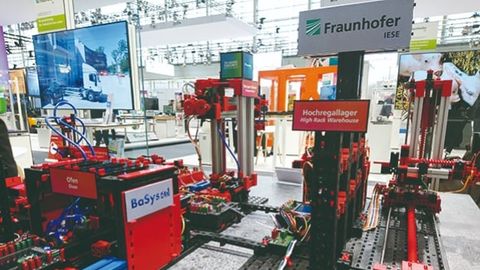
Real production with all work steps: the joint Industry 4.0 demo of the project partners. It implements the requirements of Industry 4.0 in detail.
© Fraunhofer IESEIn practice, this means that If you want to produce differently, faster or more cheaply, you first have to copy the data generated for the digital twins, which takes a considerable amount of time and incurs high costs. Doesn't that put companies off?
Thomas Kuhn: That's right, it does put companies off. But by using modern technologies, a replica can be created much more easily and provided at low cost. In our BaSys 4.0 project, we discovered that it is possible to create a replica very quickly using NetApp's snapshot technology. This technology proves to be optimal for the digital twins because only a small amount of data changes during the simulation. A Monte Carlo simulation that stochastically solves an analytically unsolvable problem using probability theory, including countless random experiments, can thus be mapped smoothly and efficiently. The knowledge gained can be fed back into production planning. In this way, self-optimizing production is realized.
You have now mentioned the basic system Industry 4.0, BaSys 4.0 for short, which you have been developing at Fraunhofer IESE with fourteen cooperation partners since 2016. What does this open operating system do?
Thomas Kuhn : With BaSys 4.0, we have created a middleware that networks machines. The store floor and office floor, i.e. production and the IT landscape, now talk to each other. This is done via administration shells to which machines send their data. A data model structures and specifies how the data is to be organized. These sub-models combine and prepare the information so that it can be used. For example, BaSys 4.0 brings together the production data of a workpiece and stores it in an administration shell that is assigned to this workpiece. The workpiece and its data run together through the production line. The data can be used to track the quality of the workpiece and the production process. The moment the data is stored in the asset administration shell, it takes on a meaning, a semantics. No matter what source it comes from, you can continue working with it. We show: End-to-end communication across protocols is possible.
Why else do machines 'talk past' each other?
Jürgen Hamm: We are currently seeing isolated solutions in the manufacturing industry. Machine manufacturers use different communication protocols. With BaSys 4.0, however, it no longer matters which protocols the machines speak or whether the data is only available at terminals. The gateway concept from Fraunhofer IESE makes it possible to dock any protocol to BaSys 4.0. The middleware is, so to speak, the key to opening the silos that the manufacturers have built. The open software platform turns unstructured data into a structured stream that business applications such as ERP systems and analysis tools can easily process.
The link to the SAP world is not a foregone conclusion
BaSys 4.0 therefore ensures end-to-end communication and processed data. Why is the link to the SAP world, for example, still not a sure-fire success?
Andreas Bader: As already mentioned, we always consider the entire value chain in our solution approaches. And in BaSys 4.0, we now have a perfect component for linking the store floor with the commercial and business processes in the company. This makes the end-to-end view possible in the first place. In the course of digitalization, for example, this is essential for a successful customer journey. If we want to create greater changeability in production with batch size 1, we must also succeed in allowing the client to participate in this.
Let's keep in mind: an administration shell loads the digital twins of the systems and receives the machine data that BaSys 4.0 standardizes; the data flows and the machines produce; a digital twin can be changed and loaded relatively quickly. What else is needed to insert a small order in between?
Thomas Kuhn: We use service-based production to manufacture small batch sizes down to number 1. This capability is based on an architectural paradigm that has long existed in the IT world with service-based programming. With BaSys 4.0, we are implementing this for the automation processes that are coded in programmable logic controllers. For service-based production, we encapsulate these processes in services that ideally have no side effects, but instead have a defined interface. In other words, the controllers no longer execute processes, but provide services. These services are called up by service users, who use them to define and change production processes. The controllers do not need to know when which service is required for the production of a workpiece and therefore do not need to be reprogrammed if the service sequence for a production changes. Only the service users need to be reprogrammed. As these are defined at a higher level of abstraction, for example using Business Process Modeling Notation - BPMN for short - this is much simpler and therefore more efficient than reprogramming a PLC.
Fraunhofer IESE, NetApp and Objective Partner have now developed a reference architecture for the open source middleware BaSys 4.0. What does this look like?
Jürgen Hamm: The primary goal is to create a future-proof and cost-effective platform for manufacturing that provides everything in containers and uses Kubernetes for this purpose. In our reference architecture, the 'NetApp HCI system' - a hyper-converged infrastructure - forms the basis, with all components already virtualized and coordinated. We build a container landscape on top of this, which is provided on the store floor. BaSys 4.0 is contained in the containers that we operate in a cybernetic cluster, which saves on license costs. Containers have the advantage that they can be deployed quickly.
However, containers do not only have advantages. There is a risk of data loss every time the system is restarted because containers do not support persistent storage. The data, which is generated in vast quantities, must be stored somewhere and be highly available. How do you solve this problem?
Jürgen Hamm: With our open source storage provisioner 'Trident', which not only provides the memory when the container boots. The provisioner also imports the last data status using snapshot technology, which only takes a few seconds and thus prevents data loss. Trident and snapshots make BaSys 4.0 highly available in the container. The Trident software solution also shows on which volume the system is writing the data from tens of containers. The central virtualized data storage is managed with our 'Ontap Select' software. It is important to note that BaSys 4.0 in the container must be operated on the machine. The middleware preselects the data. Mapping the administration shells keeps the data volumes small. At this point, a company could consider transporting data from the asset administration shell to the cloud in order to run downstream analyses or use applications for artificial intelligence.
BaSys 4.0 to the cloud?
Assuming the amount of data is not too large and the bandwidth is sufficient: When does it make sense to connect BaSys 4.0 to the cloud?
Andreas Bader: In general, it makes sense to store production data and its context in a centralized location. This makes it possible to consume data from different sources worldwide. The cloud fulfills this task very well. In our view, this is already a key criterion for the cloud. At this point, the changes in the customer's infrastructure also play a role, which are certainly also influenced by SAP's side-by-side approaches.
Where does the transfer to SAP take place?
Jürgen Hamm: We keep the data from BaSys 4.0 in an intermediate buffer for further processing, such as predictive maintenance or SAP standard processes, whereby this data lake can be realized in many ways technologically. The 'SAP Data Hub', the interface to the SAP world, docks onto the data lake.
The reference architecture for BaSys 4.0 includes SAP. What happens automatically in BaSys 4.0 when a business customer orders something and it is booked into SAP?
Andreas Bader: A lot is possible here. For the demonstration, we connected the customer's mobile order entry to the SAP backend. A sales order is generated in the background in the 'SAP SD module'. SAP reports the ordered material to BaSys 4.0 - and where it is stored in the warehouse. In the demo example, we also store the sensor data of the devices from production in the SAP backend.
As a project partner, you want to jointly market BaSys 4.0 with reference architecture. However, every production line has its own peculiarities. What should a user company be prepared for?
Thomas Kuhn: We use ready-made software components and a coordinated IT stack and can also interact with cloud services. However, what happens before that is complex: we have to ensure that machines communicate with the data system. We adapt the retrieval of the correct machine data and the creation of the data models to the user-specific conditions. If machines only have terminals, for example, we need additional hardware. Once we have mapped the measured and logical data structure, we plan the IT infrastructure and decide what kind of data lake to integrate. This is followed by integration into the ERP system. At the end, the company can see at a glance on the dashboard where the order is currently located between resource management and the dispatch warehouse. Live data shows whether the machine is producing the required quality. The company has then arrived at smart production, which can be supplemented and further optimized by machine learning and other means. We advise and support companies intensively on this path. They also need support to master the transformation.


You might also be interested in
Digital platforms - threat or benefit?
Does the emergence of digital platforms threaten your own business? Or is it useful to set up your own platform? Or an investment to develop new business models? A recent study by Sopra Steria Consulting answers these questions.
 read more...
Automation in mechanical engineering
Bosch Rexroth announces 'ctrlX Automation'
At the beginning of September, Bosch Rexroth invited the trade press to an exclusive preview in Ulm. The curtain came down on 'ctrlX Automation' in the Innovation Lab there. This is based on a completely open software architecture combined with a...
read more...The first steps towards digitization
Real-time transparency in the material flow: this was the goal set by Miba when it set out to digitalize its internal logistics processes. But how successful was the close link between ERP and MES in the end? - A field report.
read more...How will the IoT change companies in 2020?
How will network technology in companies change in 2020? Axel Simon, Chief Technologist at HPE Aruba, takes a look into the crystal ball
read more...Digital twin revolutionizes maintenance
As virtual representatives of real machines, digital twins open up new possibilities for maintaining and servicing complex industrial plants and systems. A project report.
read more...You can't do without Edge and Swarm
The IoT has changed the requirements for processing data provided by machine sensors and actuators. This needs to happen as quickly as possible - preferably where the data is generated. Edge nodes and swarm computing systems take on this task.
read more...Online machine data under control
Turning huge amounts of data into valuable information - how can this smart industry approach be implemented? Linking PC-based controllers with Matlab and a cloud-based IoT analytics service can be a viable approach.
read more...From modeling directly into the PLC
Despite digitalization and I4.0, the technical functions in a process plant do not become simpler if you break them down to the smallest detail. Nevertheless, the high level of difficulty can be overcome by combining the right tools in the right way.
read more...Where are the new business models?
The necessary new business models are repeatedly cited as the hallmark of an Industry 4.0 environment. But to date, very few companies have seen any of this. Schneider Electric now has a few models up and running.
read more...