
Smartphones in the industry
Cell phone instead of controller
Can smartphones and tablets replace tried-and-tested machine control systems? And if so, what conclusions can be drawn from this for classic automation?
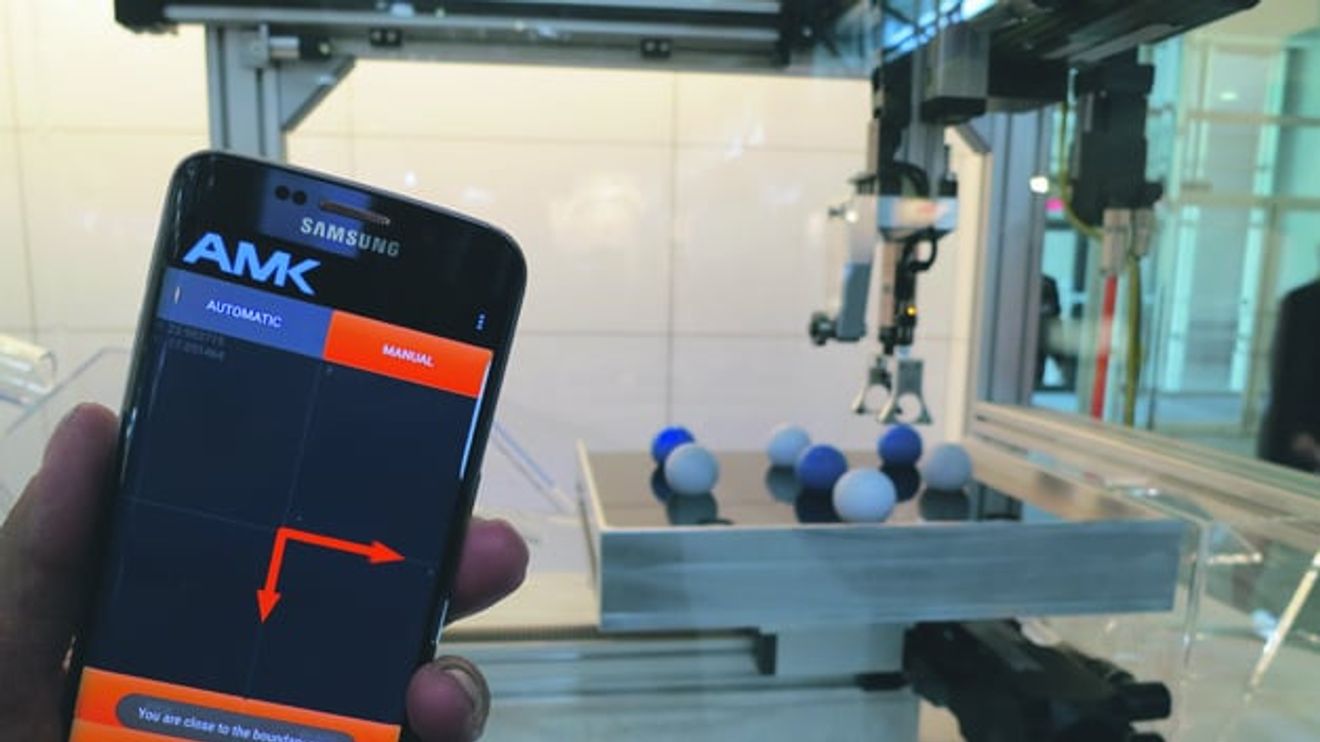
AMK and ITQ have investigated these questions, developed a demo system and presented it for the first time at Automatica in Munich.
Hardware is increasingly taking a back seat in all automation solutions; communication and software determine development - the two managing directors Dr. Rainer Stetter, ITQ, and Dr. Ulrich Viethen, AMK, are equally convinced of this. The company leaders conclude that the most effective way to achieve innovation in mechanical and plant engineering is through software.
But why are smartphones and tablets becoming the focus of attention here? "The use of these devices means that developers and service and production staff are becoming very interested in 'ease of use'," Dr. Stetter is certain.
But what about the issue of machine performance? Stetter: "Smartphones have enough computing power to take over most machine control tasks." Remaining time-critical movement tasks, for example, are then the responsibility of high-performance drives - as in the demo system that was implemented. AMK is addressing precisely this interface with the new AMK MultiServo device series.
Separate tasks from each other
Dr. Rainer Stetter: "The use of smartphones and tablets means that the topic of 'ease of use' in the automation of tomorrow will be even more of a focus for developers and service and production personnel."
© AMKIn addition to the integrated power supply, AMK's multi-axis devices also feature motion control. In addition to the pure control of the motors, the computing power is also sufficient to take over the motion control tasks in real time. In other words, the real-time-critical task package is completely transferred to the drive level. Industrial hardware is therefore no longer required for the non-time-critical sequence control; smartphones or tablets can be used. To ensure that the drive and smartphone understand each other well, the demo machine from AMK and ITQ uses OPC UA, a current industrial communication standard.

Dr. Ulrich Viethen: "In the future, we will need less traditional machine programmers and more Internet programmers and experts for graphical user interfaces."
© AMK"The protocol comes with all the necessary security mechanisms for secure communication as standard," says Dr. Stetter. Because the OPC UA protocol solves all future requirements for M2M communication that are located above the fieldbuses, AMK Managing Director Dr. Ulrich Viethen believes that "the PLC is no longer the focus of automation".
But how do machine and plant manufacturers benefit from the use of smartphones? First of all, they benefit financially, because technology is used that is produced by the millions for the consumer market. However, the material costs of a machine only play a comparatively minor role when it comes to the introduction of smartphones into industrial automation. Without question, economies of scale reduce costs. Nevertheless, the operating and visualization concepts that smart devices bring with them are much more exciting. The special type of app programming should be mentioned in the same breath. But more on that later.
Understand machine operation more quickly
If - as in the demo machine from AMK and ITQ - the sequence control flows into the smartphone or tablet, developers, commissioning engineers and on-site personnel use a human-machine interface that they are used to using on their own smartphone. The logical consequence: handling production machines is much quicker to learn because the operating philosophy is familiar from the private environment. Another consequence of this approach is that the entire operation and programming of the system - including motion control - is carried out in functionally divided apps. They provide the necessary functionality for controlling, operating and visualizing the machine - replacing central, powerful engineering environments that are correspondingly complicated to master.

The system shows a sorting and palletizing process in which golf balls are removed from a hopper and palletized according to color using a gantry robot. The process can be controlled and operated via smartphone.
© AMKFor example, the demo system has a teach app for teaching the travel movements of a gantry robot. Once the travel profile has been defined, the app data with all profiles can be transferred to the AMK MultiServo in order to operate the gantry robot in automatic mode. Additional service and motion apps in turn provide the user with functions ranging from commissioning to preventive maintenance and classic motion control functions.
As both control tasks and motion control appear as an app - and therefore as a firmly defined container - the software is clearly separated from the hardware. Thanks to clearly defined interfaces, it is both interchangeable and can be updated without risk. "Bringing software into containers and making it available via app stores will become increasingly important in the future," says AMK Managing Director Dr. Ulrich Viethen, looking ahead to the coming years. What's more, the innovation cycles of hardware and software can be separated from each other. Because the apps are detached from specialized electronics, no one has to wait for the other for further developments. This means that further developments in programming can be used immediately and profitably for your own machine. In addition, the risk of a new firmware update no longer being able to run on an older device platform is a thing of the past.
Generally speaking, connecting the control technology to app stores is easier, meaning that the machine software can always be kept up to date. "This approach allows us to industrialize the innovation steps of the consumer world, so to speak," summarizes Rainer Stetter.
The importance of hardware is dwindling
With the approach demonstrated in the project, the mechanical and plant engineering industry is freeing itself to a large extent from its dependence on large control system manufacturers. Until now, machine developments have always depended on the extent to which new ideas can be implemented with the automation systems used to date - this dependency is now crumbling. The approach demonstrated goes beyond the usual network structures with proprietary hardware connections and instead pursues a clear separation of hardware and software, which also works independently of specific platforms from individual manufacturers.
Author: Thorsten Sienk is a freelance journalist.


You might also be interested in
The first steps towards digitization
Real-time transparency in the material flow: this was the goal set by Miba when it set out to digitalize its internal logistics processes. But how successful was the close link between ERP and MES in the end? - A field report.
 read more...
How will the IoT change companies in 2020?
How will network technology in companies change in 2020? Axel Simon, Chief Technologist at HPE Aruba, takes a look into the crystal ball
read more...Digital twin revolutionizes maintenance
As virtual representatives of real machines, digital twins open up new possibilities for maintaining and servicing complex industrial plants and systems. A project report.
read more...You can't do without Edge and Swarm
The IoT has changed the requirements for processing data provided by machine sensors and actuators. This needs to happen as quickly as possible - preferably where the data is generated. Edge nodes and swarm computing systems take on this task.
read more...Online machine data under control
Turning huge amounts of data into valuable information - how can this smart industry approach be implemented? Linking PC-based controllers with Matlab and a cloud-based IoT analytics service can be a viable approach.
read more...From modeling directly into the PLC
Despite digitalization and I4.0, the technical functions in a process plant do not become simpler if you break them down to the smallest detail. Nevertheless, the high level of difficulty can be overcome by combining the right tools in the right way.
read more...Where are the new business models?
The necessary new business models are repeatedly cited as the hallmark of an Industry 4.0 environment. But to date, very few companies have seen any of this. Schneider Electric now has a few models up and running.
read more...Why predictive maintenance?
Investments in predictive maintenance systems are worthwhile in order to proactively detect damage. Not only does this increase the service life of a machine, it also opens up new business models for machine manufacturers.
read more...First customer projects via BaSys 4.0
The BMBF project 'Basissystem Industrie 4.0' expired at the end of June 2019. Together with NetApp and Objective Partner, Fraunhofer IESE now offers Industry 4.0 solutions with support and adaptation to customer systems on the basis of this project....
read more...