
Digitization
How production technology and the IT world come together
A huge obstacle on the way to Industry 4.0 and the Internet of Things (IoT) is still the separation between the IT world and production technology or 'Operational Technology' (OT). Together with SAP, Mitsubishi Electric wants to close this gap.

The integration of IT and OT is the key to the successful implementation of Industry 4.0. While data protection and confidentiality are the top priorities for information technology, availability is the be-all and end-all in production. With the connection of previously closed production systems to the Internet and the new responsibility of IT for managing and securing production equipment, both sides must come together in order to work productively and efficiently in the age of IoT - a challenge that Mitsubishi Electric and SAP are facing together.

The transfer of predefined data from the automation solutions to the 'SAP Cloud Platform' creates the basis for value-adding IoT-based services in the manufacturing and process industry.
© Mitsubishi ElectricA joint showcase at the recent Hannover Messe trade fair illustrated how far the coordination of production on the one hand and the MES/ERP world on the other has already progressed: This involved a real robot cell with a digital image (digital twin) of the physical product in the 'SAP Cloud Platform'. The digital twin enabled the comprehensive analysis and use of all system and process data by both the manufacturer and the operator - by means of user-defined OEE dashboards and the use of augmented reality for predictive maintenance.
Before the project could finally be implemented, SAP on the IT side and Mitsubishi Electric on the OT side first had to agree on common definitions of terms in order to realize the connection of the automation world with its PLCs, robots, motion controllers and CNC controllers to the SAP cloud. Thomas Lantermann, Senior Solution Consultant at Mitsubishi Electric, gives an example: "When the IT users wanted to read the power consumption of the axes in 'their' real time - i.e. every second - the OT people had to smile; for them, real time means milliseconds. When scanning in seconds, the axis could theoretically always be at a standstill. In the end, the solution was to calculate an average value in the OT world." Another key requirement for smooth integration is centralized data transfer to the IoT services of the SAP cloud platform. The basis for this is plant-wide transparency, which means that all Mitsubishi devices, as well as various other automation devices, can be connected from one point in the network. This means that all data can be accessed from a central point in production and data can also be easily exchanged with other components such as RFID readers, sensors or other control systems.

Status and maintenance tasks at a glance: In the event of unplanned system downtime, the cost of regular maintenance cycles can be minimized by bringing forward timely work.
© SAPThe special feature and major simplification of the joint solution from Mitsubishi Electric and SAP is the direct connection to production without the use of additional gateways. This means that Mitsubishi Electrics uses a proprietary technology that bypasses Windows-based systems, which ensures a high level of security (cyber security) for the systems, among other things. Alternatively, or with other manufacturers, the connection is made with a software gateway via OPC UA. Lantermann comments: "The OPC UA connection, just like the web service-based connection directly from the Mitsubishi Electric platform, includes numerous certification, encryption and authentication options. However, additional gateways are also an additional source of errors, especially if they are Windows-based."
Finally, the SAP cloud platform efficiently stores very large volumes of data in a 'big data lake'. This storage then makes the data available to all applications and services in the cloud environment. Short-term data, such as time series from the past four weeks, is stored in an in-memory database to enable quick access. Historical data, on the other hand, is managed in more cost-effective classic big data storage. As SAP offers this as a service (PaaS), the user does not have to set up and operate a big data architecture in their own data center.
For the connection to SAP, a structure for the data (structured data type (SDT) in accordance with IEC 61131-3) that is to be sent to the SAP platform is defined on the iQ Works programming platform from Mitsubishi Electric.
This is how the IT connection of production takes place
1000 measured values were specified for the showcase; however, the size of the data structure can be freely selected. Only the IP address of the IoT services and the login data (name, password) then need to be parameterized at the 'C Application Server' communication interface. The data is then exchanged continuously, typically every 500 ms. In principle, other data structures with different transmission intervals can also be defined, whereby the event-controlled transmission of individual data is possible in parallel.
In the cloud, this information is distributed to the various applications. The services available here include analysis tools for evaluating error codes, machine learning services, development services for the cross-device development of custom applications and integration services for local ERP systems. In the final step, the evaluated data is transferred back to the automation world in a predefined data structure.
The data structures for sending and receiving were defined jointly by the IT and OT teams. The data structures were then edited from the various robot values, such as the position or energy consumption, as well as the SAP ticket number in the OT programming tool. The values can now be checked and visualized directly with the tools of the IoT services and distributed to the directly usable applications.
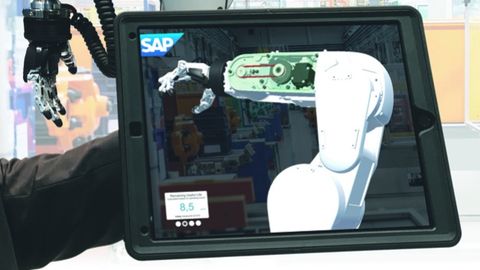
The displayed 3D model of the robot can be used to show a service technician which part should be replaced and how to proceed.
© Mitsubishi Electric / SAP / Getty ImagesThe 'Digital Twin' is ultimately the point where all information about an asset comes together - from CAD data to live cycle information. Parameters, programs and libraries about the automation devices can also be stored here. This enables automated data exchange from design to simulation. "The digital twin is actually old hat," says Adrian Langlouis, Solution Architect, Discrete Industries at SAP: "Some manufacturers of intelligent devices have already been managing the digital image in their service module for a long time, and plant operators use their maintenance module to define maintenance intervals. Until now, however, manufacturers and operators have each had a one-sided view of the processes in their own modules." According to Adrian Langlouis, a modern digital twin is created when information about the physical product can be exchanged between all parties on a cloud platform, such as the SAP Asset Intelligence Network. In this way, manufacturers, service partners and plant operators each receive an individualized view of the plant.
Manufacturers can use the digital twin in the asset network as a service portal, where they can provide documentation, 3D models or maintenance instructions for the plant and set up self-service functions for customers, such as ordering spare parts directly by selecting them from the 3D model. Plant operators, in turn, receive a standardized view of the digital machine file and can create a service ticket directly in the customer portal if required and order spare parts from the original manufacturer or, for example, via a connected 3D printing marketplace from SAP. The latter also opens up optimization potential on the manufacturer's side - for example, by eliminating the need to stock and manage printable spare parts that are rarely ordered.
Optimizing maintenance with predictive maintenance

The 'FA-IT Open Platform' allows all data from production to be read and written. It is then pre-processed at edge level and forwarded to various applications (preventive maintenance, analytics, etc.).
© Mitsubishi ElectricA central task in the context of Industry 4.0 is the analysis of historical machine data from the control system and sensors in order to identify deviations and error patterns and ultimately use the knowledge gained to monitor systems or optimize maintenance cycles. The 'SAP Predictive Maintenance and Service' solution provides the necessary data models and algorithms for training the models and also creates the basis for monitoring the systems by means of regularly calculated and visualized 'health scores', from which the 'health status' of a system can be derived. In addition, integration into SAP's maintenance and service solutions is ensured.
Manufacturers with a large number of identical machines in use by customers can provide a particularly solid database for the health scores thanks to a statistically relevant number of similar devices and either offer monitoring and predictive maintenance as a service themselves, or make maintenance easier for the operator by making this information available externally via the service portal. In either case, maintenance cycles can be optimized in this way and, in some cases, considerable costs can be saved. As far as the database is concerned, the maintenance case on the operator side and the service case on the manufacturer side are nothing more than two sides of the same coin.
Augmented reality in maintenance
Given the shortage of skilled workers in the industry, service organizations or maintenance departments are hit hard when experienced employees retire or leave the company. One way out of this dilemma is the use of augmented reality (AR) for maintenance work. Visualizing maintenance instructions step by step using a 3D model with data glasses makes it possible to assign more complex maintenance tasks to inexperienced employees. If support is still required, an experienced technician can be connected via video and assist their colleague on site.
SAP and Mitsubishi Electric have also addressed this topic in their joint showcase and implemented a corresponding solution: The technician can point a mobile device - such as an industrial tablet - directly at the robot and the 3D model is displayed in front of the physical product. The 3D model shows him which part needs to be replaced and how he needs to proceed. One conceivable scenario in this context would be for the robot to report independently when it needs maintenance. Measures are then initiated in SAP to carry out the service with a technician as efficiently as possible.
Equipment as a Service (EaaS)
Thanks to the complete connection to the device data via the cloud and the use of the new possibilities in terms of remote monitoring, plant manufacturers will be able to position themselves as full-service providers in the future and ultimately assume complete responsibility for the maintenance and availability of the systems. While manufacturing companies can thus outsource unproductive activities and focus on value creation activities, the manufacturer benefits from customer loyalty and improved continuity and sustainability of its revenue streams.

Thomas Lantermann, Senior Solution Consultant at Mitsubishi Electric: "Absolute data transparency is the basis for new business models beyond the usual appliance sales."
© Mitsubishi ElectricConsistently thinking ahead, new business models can be developed on the basis of universal data transparency - i.e. away from the usual appliance sales. "I see a very clear business model in the fact that operators may no longer buy the system because the investment is too high for them. Instead, they use the service, which is billed according to a pay-per-use model," says Thomas Lantermann from Mitsubishi Electric, describing his vision. In other words, the customer receives an all-round carefree package with guaranteed availability as part of service level agreements (SLAs). The machine or system remains the property and responsibility of the manufacturer, who calculates the performance or output for the customer on the basis of a metric. Existing examples from the industry include the number of printed pages for printing machines, operating hours for construction equipment and the amount of compressed air for compressors.
Author:
Margit Röntgen is a freelance editor from Kronshagen.


You might also be interested in
The first steps towards digitization
Real-time transparency in the material flow: this was the goal set by Miba when it set out to digitalize its internal logistics processes. But how successful was the close link between ERP and MES in the end? - A field report.
 read more...
How will the IoT change companies in 2020?
How will network technology in companies change in 2020? Axel Simon, Chief Technologist at HPE Aruba, takes a look into the crystal ball
read more...Digital twin revolutionizes maintenance
As virtual representatives of real machines, digital twins open up new possibilities for maintaining and servicing complex industrial plants and systems. A project report.
read more...You can't do without Edge and Swarm
The IoT has changed the requirements for processing data provided by machine sensors and actuators. This needs to happen as quickly as possible - preferably where the data is generated. Edge nodes and swarm computing systems take on this task.
read more...Online machine data under control
Turning huge amounts of data into valuable information - how can this smart industry approach be implemented? Linking PC-based controllers with Matlab and a cloud-based IoT analytics service can be a viable approach.
read more...From modeling directly into the PLC
Despite digitalization and I4.0, the technical functions in a process plant do not become simpler if you break them down to the smallest detail. Nevertheless, the high level of difficulty can be overcome by combining the right tools in the right way.
read more...Where are the new business models?
The necessary new business models are repeatedly cited as the hallmark of an Industry 4.0 environment. But to date, very few companies have seen any of this. Schneider Electric now has a few models up and running.
read more...Why predictive maintenance?
Investments in predictive maintenance systems are worthwhile in order to proactively detect damage. Not only does this increase the service life of a machine, it also opens up new business models for machine manufacturers.
read more...First customer projects via BaSys 4.0
The BMBF project 'Basissystem Industrie 4.0' expired at the end of June 2019. Together with NetApp and Objective Partner, Fraunhofer IESE now offers Industry 4.0 solutions with support and adaptation to customer systems on the basis of this project....
read more...