
VMT
Dynamic visual guidance for 6-axis robots
As part of the production ramp-up for the Audi model derivatives of the A3 successor at the Ingolstadt plant, an automated system for the application of primary seals in vehicle doors was put into operation together with the image processing system solution provider VMT. The details.
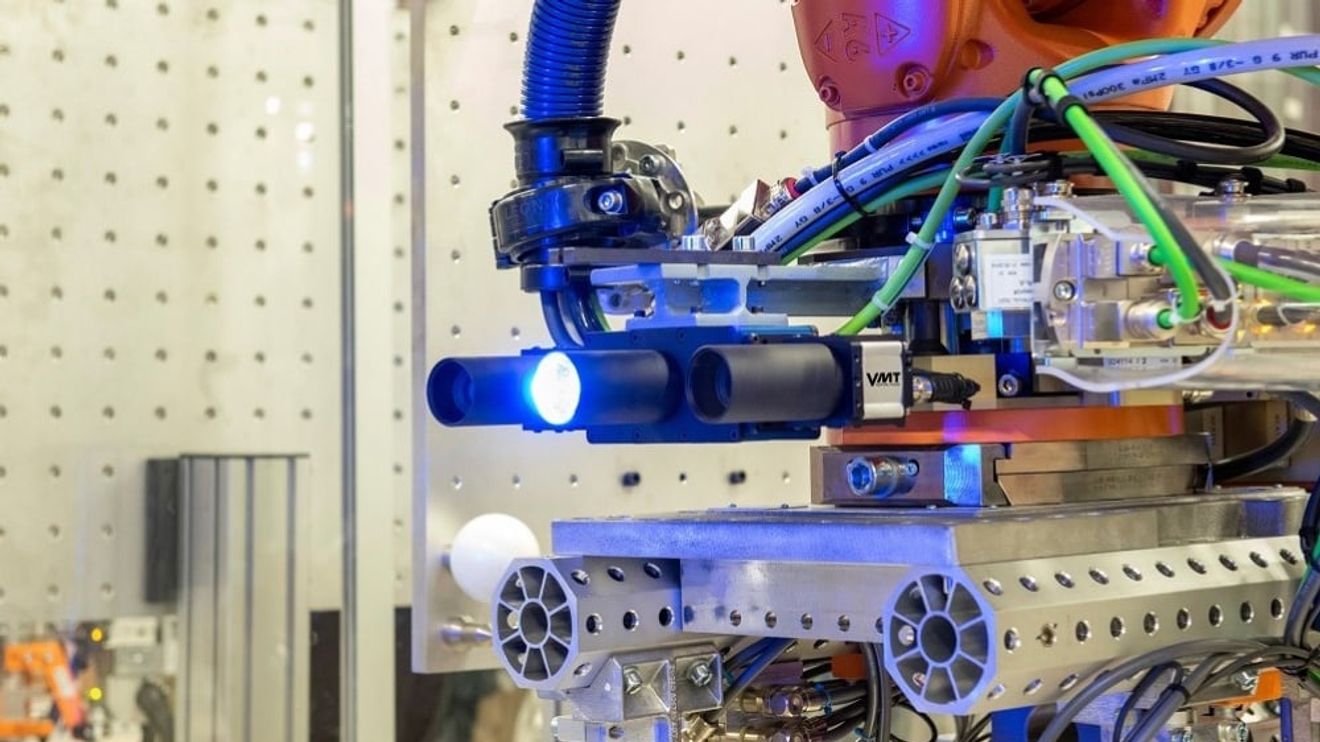
In future, the sealing profiles will be fed directly from the endless roll and applied to the components in the robot-supported rolling head application system at Audi. All pre-operations - cutting the gasket to length, cutting out profile joints typical of semi-finished products and inserting holes for water management - are an innovative, already patented part of the application process.
The dynamic rolling head technology replaces the more technically complex and maintenance-intensive plate technology previously used in assembly. The gaskets are applied or fitted to the individual doors using a clamping frame that is designed specifically for the geometry and can only apply prefabricated profiles that have been individually cut to length and joined to form the sealing ring. In future, the rolling head technology will make both the cost-intensive detailed constructions, for example for profile holders, and the provision of type-specific, pre-assembled individual seals, which would otherwise have to be prepared in separate storage magazines on the system side, unnecessary. In addition, the concept-related type flexibility will significantly increase the degree of utilization of the application system. But what does it all look like in detail?
New process standard for vehicle assembly
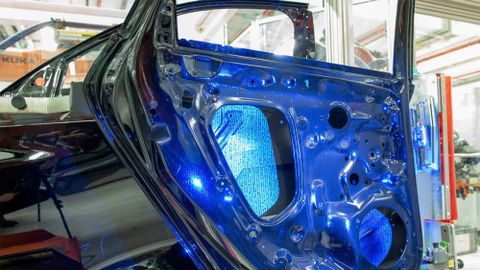
In contrast to scanning edges, holes and other mechanical component features, the surface-based scanning of the VMT OSC6D always provides sufficient detail for exact position detection and identification of the door types.
© AudiWith the robot-assisted application of door primary seals using rolling head technology, car manufacturer Audi has developed a new process standard for its vehicle assembly. The image processing solution 'VMT OSC6D' from VMT Vision Machine Technic Bildverarbeitungs-systeme ensures the millimeter-precise visual guidance of the 6-axis robots required for the process. The vision system determines the contour and position data of the vehicle doors of various models that roll off the production line at the Audi plant in Ingolstadt. The shape and position of the components in a transport rack are recorded by a stereo projection sensor. In contrast to scanning edges, holes and other mechanical component features, surface-based scanning always provides sufficient detail for exact position detection and identification of the door types.
The image processing system's 'MSS' (Multi Sensor System) software platform compares the detected contour and position values with the stored CAD reference data and determines the actual component position coordinates for guiding the 6-axis robots. In this way, the system ensures controllable, stable and highly available application processes for different door variants - to which the doors of new models can be added at any time using the 'MSS setup wizard'.
Application of door seals
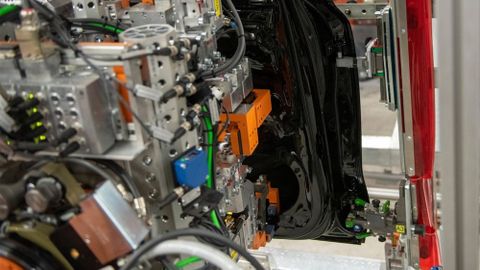
The spatial robot coordinate base is adapted to the actual component position in the door frame using the data from the 'VMT OSC6D',
© AudiAudi's 'Manufacturing Engineering' production division planned the robot-supported rolling head application system as a system supplier. It consists of four identical robot cells which, in addition to the 6-axis robot with gripper, are each essentially made up of a rolling head with a leading cleaning unit, a seal feed with integrated bumper detection and hole embossing unit as well as the 'VMT OSC6D' camera system solution. The rolling head technology replaces the plate technology that was previously standard.
This change is tantamount to a paradigm shift, because instead of prefabricated door primary gaskets provided for specific components, gasket profiles are now processed from a continuous roll and individually produced for each door type. The second key difference is that the entire door is now guided along a stationary rolling head with maximum precision. Functionally correct, exact seal application therefore requires precise positional handling of the door. Precise recognition of the component contour before removal by the robot is a decisive prerequisite for this: the optical resolution of the image processing system is better than ±1 mm and thus defines the gripping accuracy that can be achieved during visual guidance by the camera system.
BV system compensates for position shifts

In order to ensure the highest possible safety when gripping, the shape of each component must be recognized beforehand and its position in the room must be recorded with high precision. This sensing is necessary because the doors can shift position during the synchronized delivery to the rolling head application system, even though they are suspended and locked in the transport frame with a position tolerance of ±0.3 mm on the hinge pins. As each rack delivers two doors - front and rear - which are removed by two robots, an additional, unavoidable disturbance must be compensated for here.
When the transport rack with the doors reaches the removal window of the station, a position message is sent which initiates the application process. Each door in the rack is detected by the image processing system of the respective rolling head application cell using a 3D scan before it is removed. The surface-based scanning with a stereo projection sensor mounted on the robot's manual axis maps the component as a point cloud. This contains a large number of measured values that ensure shape and position recognition and enable the representation of an exact 3D image of the component in space. Color variations or different optical properties of the component surfaces have no practical influence on the data quality - and therefore the process reliability.
Using the data from the 'VMT OSC6D', the 'MSS' software determines the required position shift of the coordinate system (base shift 1), whereby the spatial robot coordinate base is adapted and shifted to the actual component position in the door frame.
Furthermore, it should be noted for the robot guidance that the doors hang in the transport racks under pre-tension or slightly tilted due to their weight. This tilting is taken into account by an additional adjustment of the robot coordinate base (base displacement 2).
360° door handling accurate to the millimeter

Manuela Müller works in the Simulation and Robotics Planning department at Audi in Neckarsulm.
© AudiWith the data from the image processing system, the robots of the rolling head application system now know the exact gripping position of the component. The primary door profile is continuously supplied by an endless feed line consisting of an unwinding unit and a sealing buffer. The robot rotates the vehicle door 360° past the application roller head, which attaches the sealing profile to the door frame by applying pressure perpendicular to the sheet metal surface. The position tolerance of the seal of ±1 mm compared to the CAD reference is maintained during this process. This ensures that the geometry of the shoring specified in the design ensures reliable function on the finished vehicle. Once the application process is complete, the door is placed back into the transport frame with the displacement value determined during lifting. Any set-down error that may occur is detected and prevented by sensors in the gripping device.
Future-proof automation

Dr. Michael Kleinkes is responsible for technical management at VMT Vision Machine Technic Bildverarbeitungssysteme in Mannheim.
© VMTThanks to the new concept of robot-supported rolling head application, Audi has achieved a significant reduction in both material investments and individual costs. In addition, the type flexibility within the application system increases, resulting in an additional cost advantage for subsequent production runs. The holistic 'VMT OSC6D' system solution with data evaluation via the 'MSS' platform supports such a variety of types: the integrated set-up wizard enables additional door types to be integrated into the system with significantly reduced commissioning effort.
During the process, the vision system ensures reliable 3D detection of the component geometry and position with minimal latency. The open sensor approach makes it possible to integrate other image sensors, such as LiDAR sensors, instead of a stereo projection sensor and to optimize the overall system for different requirements and boundary conditions in other Audi plants depending on the application.


You might also be interested in
Use in hazardous areas
With the Tab-Ex Pro, the Pepperl+Fuchs brand Ecom Instruments is expanding the existing Tab-Ex series and thus the range of mobile devices for hazardous areas.
 read more...
SPS Connect 24.11. - 16:20 - 16:40
"Intelligent Supermarket" Digital Kanban Management System
Kanban systems are indispensable in manufacturing companies and have many advantages. Nevertheless, error-prone, manual workflows and a low level of digitization cloud the picture.
read more...SPS Connect 11/25 - 13:35 - 13:55
Digital twin for sensors as a machine-readable data source
Development of standards-based sensor technology sub-models for the asset administration shell in the ZVEI working group "Industry 4.0 in sensor technology".
read more...SPS Connect 11/24 - 10:20 - 10:40 a.m.
Corona - catalyst for digitalization?
In his keynote speech, Dr. Gunther Kegel, Chairman of the Board/CEO at Pepperl+Fuchs, will address the effects of the coronavirus pandemic and the digital transformation.
read more...Precisely align the protective housing
The positioning system is a compact solution for the precise alignment of protective camera housings. The core of the modular system consists of fine positioning axes with 150 mm stroke, which ensure high adjustment accuracy with their hand-cranked...
read more...Exclusive interview on the Digital Days
"New paths for hybrid formats"
After the Hannover Messe had to be postponed and ultimately canceled due to the coronavirus pandemic, the digital version will take place shortly. Arno Reich, Business Unit Director Industry, Energy & Logistics of the organizer Deutsche Messe,...
read more...Grasp like a gecko
With the Single Pad Gecko gripper, OnRobot is launching a compact version of the 'Gecko' gripper, which is particularly space-saving and lightweight. It is designed for three different payloads.
read more...Robot programs itself
Robot welding processes have been unprofitable in steel construction to date. This has changed with a solution in which the robot programs itself and then welds each component immediately.
read more...Four new USB camera models
Allied Vision has added a total of four Alvium cameras with a USB3 Vision interface to the '1800' series. All models feature a 2nd generation Sony CMOS sensor, either with Pregius global shutter technology or with rolling shutter.
read more...