
Lenze
The digital twin as an accelerator
The digital twin is primarily associated with industry. However, the digital blueprint can be more than just a means of analyzing systems and processes. On the whole, the technology is a key to greater sustainability and climate protection.
The digital twin as an accelerator
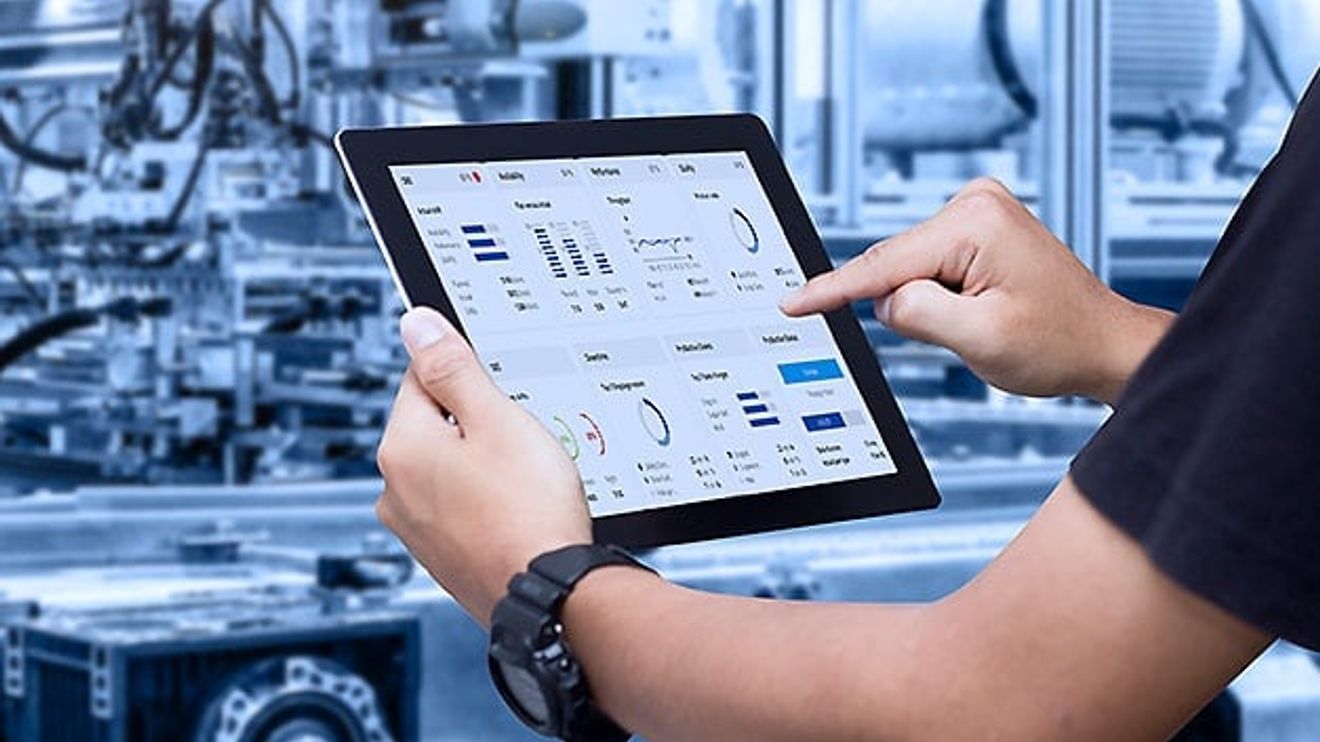
© LenzeA project from Switzerland is giving the topic of 'digital twins' a whole new dimension: ETH Zurich is developing a digital earth model, a twin for monitoring development and predicting possible future trajectories (development paths). In addition to the observation data conventionally used for weather and climate simulations, the researchers want to integrate new data on human activities into the model that are also relevant for the climate system, so that the virtual earth system model represents the entire processes on the earth's surface, the influence of humans in relation to water, food and energy management - including the processes in the physical earth system - as realistically as possible. Various sectors and scientific disciplines benefit from the technology. Industry is also making a contribution with the digital twins so that, for example, climate data from industrial sectors can be systematically collected. This makes it possible to initiate optimizations and accelerate processes - in other words, shorten engineering time or extend machine service life. Every factory, every machine, every device becomes a digital twin. Companies like Lenze support their customers here - from the system to the sensor to the entire life cycle, from engineering in mechanical engineering to maintenance by the operator and beyond.
Common data master
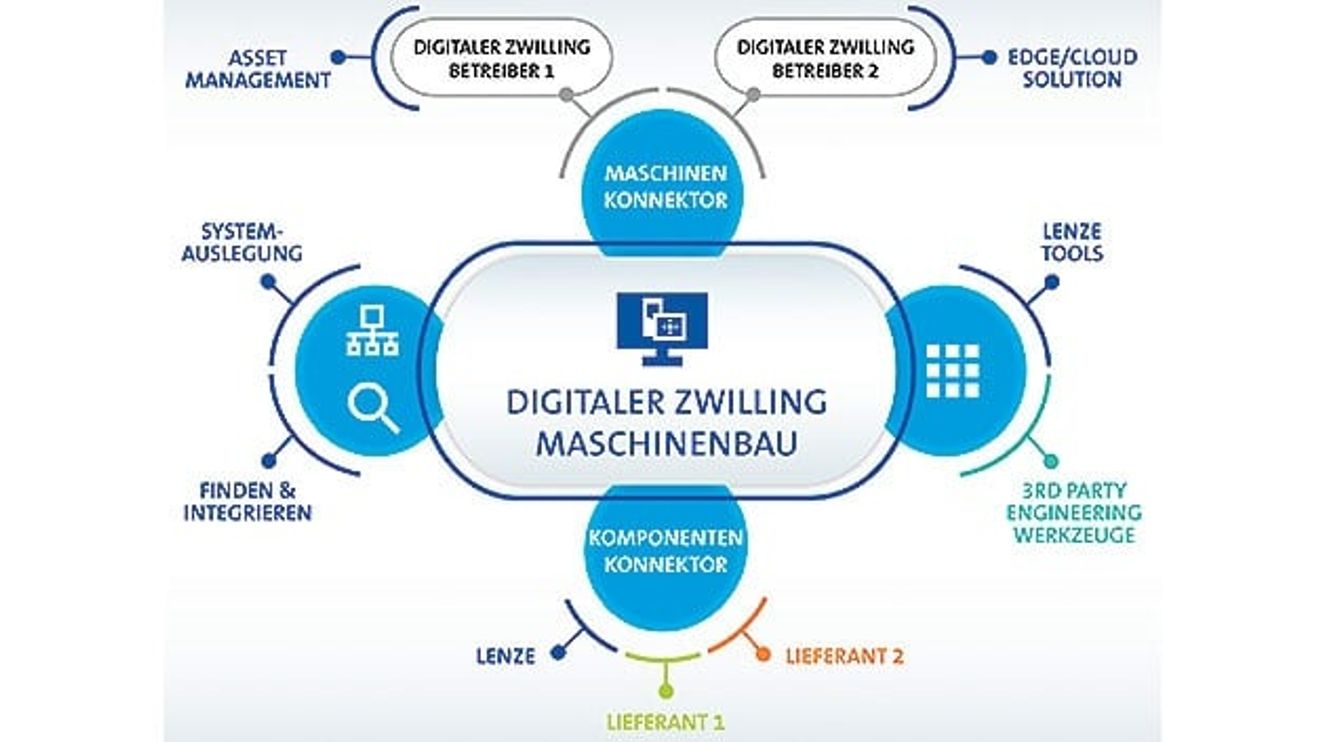
Lenze wants to move away from the pure visualization of a product. A digital twin is the complete digital representation of a machine or system in all its aspects. The digital twin is not necessarily a specific file or a specific model, but a bracket around all versioned and referenced data of a product. All tools in the product life cycle can work on a common data master, which is successively supplemented with additional information.
In this way, the digital twin accompanies a product throughout its entire life cycle. It grows with the product and fits in alongside it. You can think of it like a matryoshka: The twin of the sensor, the twin of the drive, the twin of the inverter - all are part of the twin of the machine and this is part of the twin of the production line and this in turn is part of the twin of the factory. All the twins are described and bring their own data and information with them. And the user accesses standardized data and information and can, for example, run the real data against plan data, detect errors and carry out optimizations - purely virtually at first, without the risk of downtimes. Software modules or models can even be added to the digital twin.
Standards are in demand
However, it will still be some time before the digital twin is used across the board in production halls. In many factories - as things stand today - there is hardly any data consistency or strategy, numerous assets are unknown and the engineering time consumes a lot of money. But progress is being made: the industry is working on standards. As a founding member of the Industrial Digital Twin Association (IDTA), Lenze is taking a big step towards greater consistency together with other companies. In the coming months, the company will implement the first published standards for its devices and is already serving specific use cases.
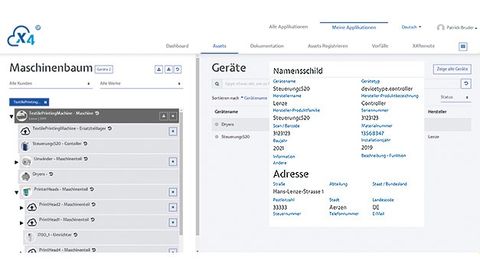
Figure 2: Asset management uses the digital twin. It combines the instance and type data and thus provides the information required for service and maintenance, for example.
© LenzeKeyword standards: A fundamental principle is that models should be as simple as possible and as accurate as necessary in every phase and for every application. This means that it is generally not necessary to map the physics completely, but only with sufficient accuracy for the respective application - this creates transparency, but also relieves the systems that provide the digital twin.
In fact, there are already a lot of standards for the digital twin and the number is constantly increasing. Many are very industry-specific, others are more generic. User organizations such as the IDTA have set themselves the goal of 'tidying things up' here. Well-known standards at machine level are the OPC UA Companion Specifications, such as EUROMAP, which define machine models. In contrast, ECLASS, which describes the characteristics of the devices, is very generic. Last year, partial models for technical data and the digital type plate were published by the Industry 4.0 platform in cooperation with the ZVEI. If we talk about communication, then OPC UA or MQTT are certainly the main representatives.
Concrete implementation along the life cycle
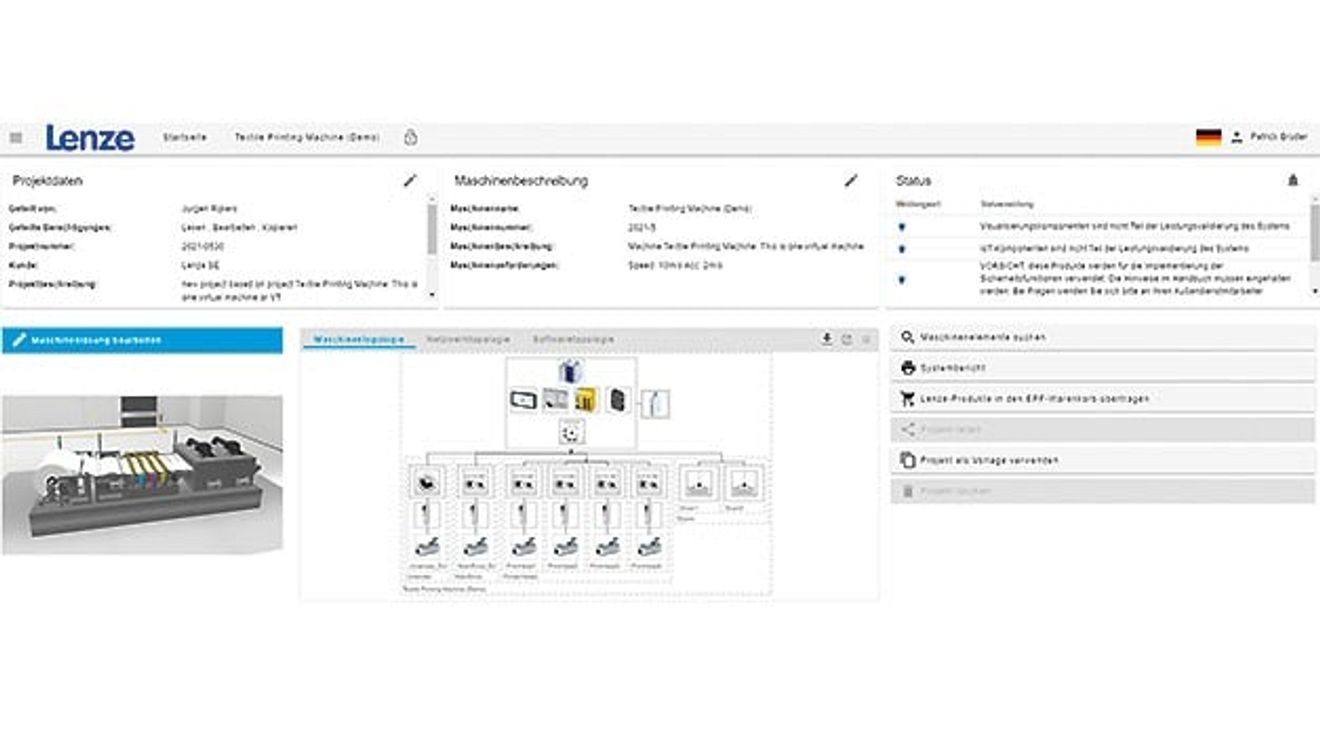
Image 3: With the web-based engineering tool 'Easy System Designer', the digital twin for the machine is created virtually 'on the side'.
© LenzeIn future, Lenze will offer developers and designers the opportunity to create the first digital image of a machine - for example via the 'Easy System Designer' web service. This structure can be enriched with technical data and documentation for a device using other web services. This digital twin serves as the basis for further tools and applications, creating a new standardized and automated consistency of data and information.
In the concrete implementation at Lenze, the asset data of all components - i.e. the digital type plate, technical data and documentation - are provided via web services. The added value along the entire life cycle of a system is enormous, as this data is passed on - from engineering to commissioning and maintenance.
The provision of component data by the supplier also simplifies integration processes in the development project. The aim is to be able to bring products to market faster and more cost-effectively by avoiding duplicate modeling work and, ideally, completely hardware-free development.
The digital twins can also be used to document entire systems, for example for maintenance tasks. There are also companies that have no overview of which assets are available in production. This is where the twin creates transparency - in the inventory lists and in the processes. Based on this, companies can analyze and optimize overall equipment effectiveness.
Willingness to change
Companies do not need to create any special prerequisites in order to use the digital twin, they just need to be prepared to embrace new technologies and methodologies. It is important to find the right partners for implementation. It's also not about throwing everything you're used to overboard straight away, but about getting started, making your first forays and learning.
An entrepreneur does not create a digital twin as an end in itself. It is worth looking at the requirements of your own customers: A classic example is the end customer's demand for OPC UA Companion Specifications, such as PackML. On the other hand, machine manufacturers should also think about what useful information they can provide, such as asset information for maintenance tools.
Lenze is convinced of the strategy of making data available via web services: "In the future, the digital twin will be as commonplace as the provision of data sheets on the homepage is today. Anyone who falls out of this digital twin supply chain will sooner or later fall out of the real value chain, as otherwise the modeling effort on the part of the customer will be too great.
However, what is good for the user can be challenging for component manufacturers: The interchangeability of components is easier for the customer. But here too, it is the inner values that make the difference.
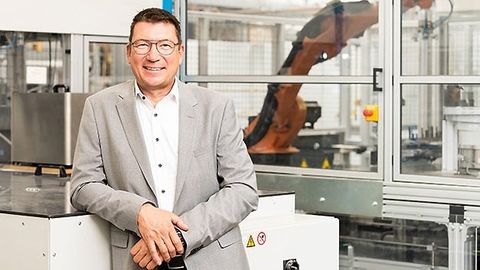
Interview with Burkhard Balz - Lenze and the digital twin
What does Lenze understand by the 'digital twin' and how does the company use it for itself?
Burkhard Balz: The digital twin stands for the new, open and standardized interoperability in Industry 4.0. As a single point of information, it is the basis for many applications and services along the life cycle of devices and machines. It therefore offers real support in industrial automation, enabling virtual commissioning and asset management, for example. With the consistency and access options to relevant data and documents for all installed devices, potential savings in the double-digit percentage range are possible over the entire life cycle. Lenze supports the digital twin for its own components; for example, we provide type and instance data for our own assets and as an exchange format in engineering, but of course we also provide support for implementation on the OEM side.
What distinguishes the digital twin from a simulation or a CAD model?
Balz: Simulation is just one of the many use cases for the digital twin. But it is about much more than simulation or a CAD model. The digital twin covers the entire life cycle. It provides the associated documentation, real-time data and much more; depending on the use case, different data or different interfaces are used. The digital twin is also the basis for the use of cloud services that contribute to the optimization of manufacturing processes, including the intelligent evaluation of operating data from the drives, which makes additional sensors superfluous. Last but not least, it increases the flexibility of systems in which entire production modules can simply be replaced via plug & produce.
How does the digital twin change workflows and processes?
Balz : When it comes to engineering in particular, we expect it to make things considerably easier for our customers and, as a result, save them time and money. Just imagine: ONE database and the various trades accessing it - no redundancies, no duplication of work because you can build on what has already been created, and a return flow of information. In addition, integrated information and simulation models simplify commissioning and operating processes are improved - for example, through quick access to relevant information in the event of a fault. As you can see, the possibilities are many and varied.
What services does it make possible?
Balz: Let's look at our customers, the machine manufacturers. Here, for example, we are focusing on asset and ticket management. This will help them to find help quickly and easily in the event of a fault, for example through correct documentation or with a ticket system between the machine operator and the machine manufacturer. The controller also prepares live asset data based on standards such as OPC UA DI and makes it available. It then goes into the cloud, including remote access options and connection to component documentation or the options for OEE and downtime tracking as well as condition monitoring. The ideas here are diverse - the important thing is the consistency of the data and information, which can then be further linked and processed.
How do you classify the terms asset administration shell (AAS) and digital twin?
Balz: In principle, they can be used as synonyms, although I find the statement "The AAS is the standardized digital twin" quite appropriate, as it once again emphasizes the aspect of standardization. And this is a central point for the success of the digital twin.
What specific applications and tools are there in relation to the digital twin?
Balz : We are already working very specifically on asset and ticket management. We are also making progress with our EASY System Designer. This new web-based tool uses the AAS to create a digital image or digital twin of a machine. The machine can be described, designed and partially managed in a modular way. A structure for the digital twin is also derived. In addition, we already offer web services for component information and are continuously expanding the range.


You might also be interested in
Dr. Lutz Steiner is Senior Vice President Innovation
In the newly created position of Senior Vice President Innovation, Dr. Lutz Steiner will drive forward Lenze's growth and innovation strategy.
 read more...
The heart of Industry 4.0
Optimizing business processes, increasing efficiency and improving employee performance - the digital twin can do all of this. This makes it the 'secret weapon' of Industry 4.0.
read more...Digital twin for process plants
More efficient thanks to intelligent assistance system
A digital twin that reliably predicts the status of process systems is the aim of the TwinGuide research project. The aim is to expand the capabilities of the digital twin.
read more...Smooth human-machine interaction
Machines and systems have many different functions. This complexity must be mastered. User-friendly visualization is crucial here.
read more...Car tuning for industrial drives
Machines only function optimally if the drives used are adapted to the drive train during commissioning: This requires the parameters of the software in the inverter to be set specifically for the machine. Integrated auto-tuning shortens this...
read more...Lenze sells 'Mobile Drives' business unit
Lenze is divesting the 'Mobile Drives' division of its Swiss subsidiary Lenze Schmidhauser. A buyer has already been found.
read more...Connecting Wireless Sensors and Analog Control Systems
Hottinger Brüel & Kjær (HBK) has reintroduced the "WSDA-101" wireless gateway to the market. The wireless gateway is particularly well-suited for applications that require predictable analog signals with low latency.
read more...esd electronics at the SPS 2025
Gateway connects Ethercat with CAN FD
With the 'CAN-EtherCAT/2-FD', esd electronics presents a stand-alone gateway that allows a direct connection from CAN FD to Ethercat.
read more...Innovation partner for automation
Bihl+Wiedemann is a medium-sized, owner-managed company - founded in 1992 by Jochen Bihl and Bernhard Wiedemann in Mannheim. It develops and manufactures complete solutions for functional safety and data communication in machines and systems.
read more...