
Digital twin for process plants
More efficient thanks to intelligent assistance system
A digital twin that reliably predicts the status of process systems is the aim of the TwinGuide research project. The aim is to expand the capabilities of the digital twin.
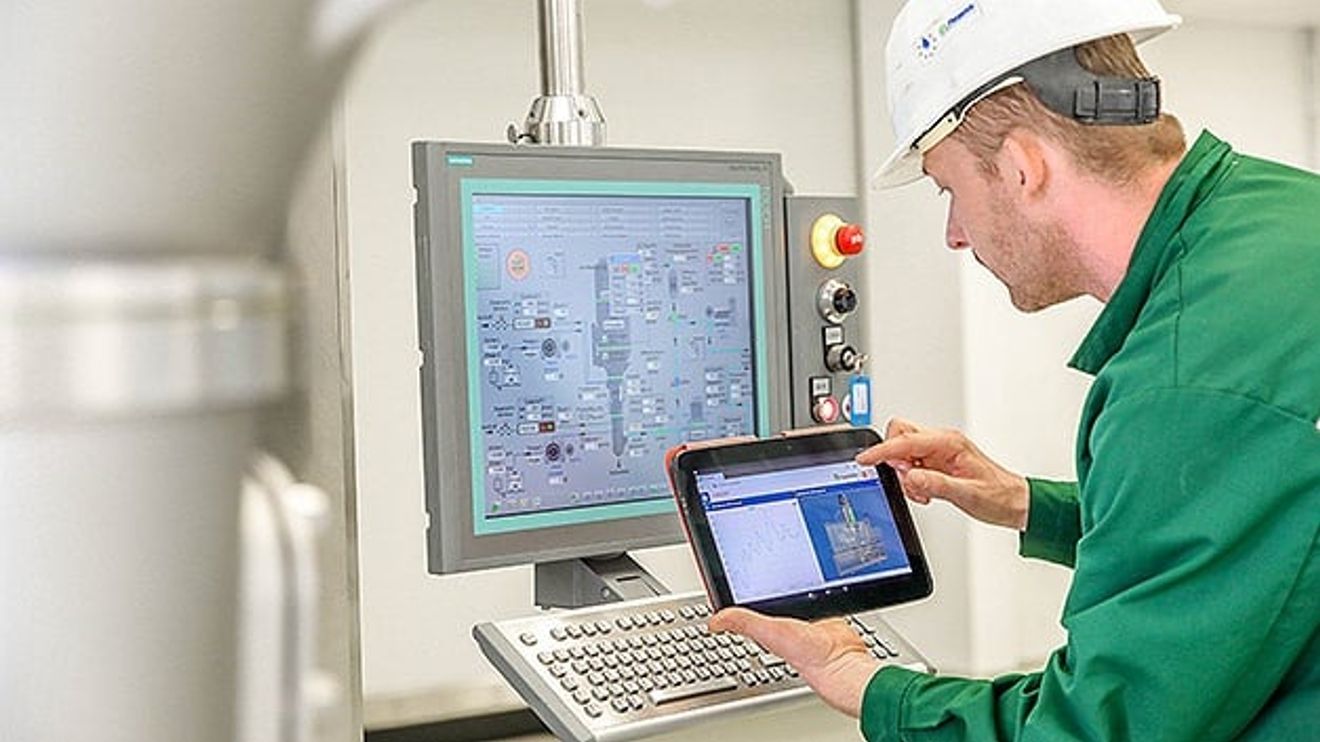
Digital assistance systems make process plants safer and more efficient.
© Viktoria Kühne / Fraunhofer IFFThe German Research Foundation(DFG) is investing a total of 4.5 million euros over three years in five research projects. One of these is the TwinGuide project, which is being carried out by the Fraunhofer Institute for Factory Operation and Automation IFF in Magdeburg and the Hamburg University of Technology (TUHH) together with IPT-Pergande GmbH in Saxony-Anhalt. The aim of the project is to develop an intelligent digital twin for process plants to make process engineering processes safer and more efficient. The development is being tested using a fluidized bed system for spray granulation as an example. With the help of the digital twin, the current status of the physical plant under consideration should not only be displayed in future, but its future behavior should also be predicted and the plant should also be reliably controllable.
Digital twin becomes intelligent
To date, digital assistance systems have enabled access to existing documentation such as CAD, e-plans, protocols and sensor data as status information for the plant. They provide plant operators with relevant information on the current situation, such as documentation, plant parameters or operating states. However, they can also issue warnings about faulty system statuses and at the same time provide predefined recommendations on how possible faults can be rectified. In these cases, however, it is usually already too late; the fault and possibly even a case of damage have already occurred.

The TwinGuide project's intelligent digital twin is being tested on a fluidized bed system for spray granulation at application partner Pergande Group.
© Viktoria Kühne / Fraunhofer IFFTo prevent this from happening, the TwinGuide research project aims to create a digital twin for process plants that will enable predictive control of the future development of the condition of a production plant. To this end, simulations running in parallel to the operation of the plant are to enable a prediction of process stability and product properties on the basis of its digital model.
Increased level of detail through data
The intelligence of the digital twin is defined by the fact that the underlying models lead to decision-making measures much faster than in real time thanks to extensive continuous (offline/online) data acquisition with a very high level of detail and a high degree of processing, so that predictions and operational optimizations are possible. In addition to the actual digital twin, a communication interface will also be developed to enable interaction between the simulation results and the digital process image. By directly linking the current plant data and the status evaluation with the simulation results, the latter are integrated into the plant operation in real time. This allows warnings for unsafe plant conditions to be issued to plant operators with corresponding action scenarios and recommendations.
The implementation in the process control system is carried out by the application partner, the Pergande Group, whereby the transferability to larger plants is to be demonstrated in addition to the use on a laboratory scale. The research partners expect that efficiency in the area of contract production can be increased by around 15 percent through higher plant availability.


You might also be interested in
The heart of Industry 4.0
Optimizing business processes, increasing efficiency and improving employee performance - the digital twin can do all of this. This makes it the 'secret weapon' of Industry 4.0.
 read more...
User organization Digital twin
IDTA starts work
The Industrial Digital Twin Association, or IDTA for short, officially begins its work. It sees itself as a user organization with an international focus for the digital twin in Industry 4.0.
read more...Modeling digital twins
In automation technology, cloud integration is still in its infancy - partly due to the high security requirements, but also because suitable software tools are not available to map real systems quickly and clearly in the cloud.
read more...Armin Wallnöfer, ABB Automation Products
"Digital twins are a powerful concept"
The digital transformation is opening up new opportunities for automation technology as a whole. Armin Wallnöfer, ABB Automation Products, explains the potential that Industry 4.0, Industrial IoT and the like hold for drive technology.
read more...Human-robot collaboration / cobots
New ISO standard for the measurement of collision forces
In collaboration with numerous international partners, robotics experts at the Fraunhofer IFF have developed a new ISO standard that shows how contact forces and pressures on cobots will be measured in a standardized way in the future. The ISO...
read more...Robotics&AUTOMATION 3/2021
Is an industrial robot without a cage really safe? What needs to be considered in the planning phase of human-robot collaborations? And what does a gecko have to do with robotics? The latest e-paper from Robotics&AUTOMATION provides the answers.
read more...Safe HRC from the planning phase
Without collision measurement and biofidelic measurement systems, it has not yet been possible to determine the maximum permissible speeds of a cobot. This is now set to change.
read more...Working safely with cobots
At the Fraunhofer Institute for Factory Operation and Automation IFF in Magdeburg, the European COVR project is researching and promoting the 'safety' aspect of collaborative robotics in practice.
read more...Secure cobot installations
When it comes to safety, cobots place high demands on the knowledge of their human colleagues. A digital service developed by European research institutions aims to help companies share knowledge and carry out safe cobot installations.
read more...