
SSV Software Systems
Model making of the twins
Digital twins require a rethink: physical interfaces and communication protocols are becoming less important. Model-based data interfaces for networking different twin categories within an IoT application are the current challenge.

For cloud operators, digital twins are a very important building block in the functional portfolio, offering huge growth potential with high customer loyalty. The leading US companies in this area, Amazon (AWS IoT TwinMaker), IBM (Digital Twin Exchange), Microsoft (Azure Digital Twin) and Oracle (IoT Digital Twin), therefore see numerous potential uses for the virtual representation of physical objects and systems. This is primarily due to the wide range of possible applications and the associated market potential. After all, this methodology can be used to create digital models of entire environments. Such environments can be individual drive elements, vehicles and machines, buildings or production processes, but also complete factories, factory premises, complex energy supply networks, railroad lines, sports stadiums and even entire cities (smart city). Much larger interconnected systems are also possible. It can be deduced from this that there are also different digital twins with regard to the respective application.
Groups of twin instances
IBM took up the topic of twins very early on and therefore already has extensive practical experience and now differentiates between four different twin categories with the current state of the art:
- Component twins/partial twins: these form the basic unit - digital twin for an entity - of complex digital twins and usually represent a functional component, such as the electric motor or frequency converter of a machine.
- Asset twins: An interconnected system of at least two component twins that interact with each other, such as the functional components of a machine drive train. Relatively large amounts of data are generated here, which can be used to examine the interactions and obtain usable information.
- System or unit twins: In this integration stage, asset twins are combined to form a functioning overall system that can be represented as a star-shaped graph, for example. Such a digital twin for a machine transparently reflects the communication and interactions between the assets, for example, and is generally suitable for automated optimization decisions or cognitive capabilities.
- Process twins: This category forms the macro level of detail for the collaboration of subsystems, for example for a complete production plant. In other words: a digital twin for a scenario. At this level, complex questions can be answered with the help of a digital twin: Are all subsystems synchronized? Do all systems have maximum efficiency or do delays in the system have an impact on other systems? Such scenario twins help to influence overall effectiveness and productivity.
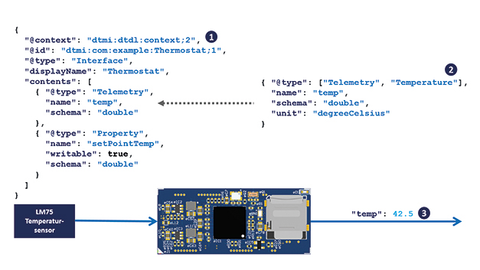
The data interfaces of an IoT hardware for a component twin can be modeled with a description language such as the Digital Twin Definition Language (DTDL): (1) A JSON object serves as a DTDL interface description. (2) The "telemetry" definition can be extended via a "unit" property with a semantic type annotation. (3) The IoT sensor data stream on the output side contains a data object that matches the model. The aim of using DTDL is IoT data plug-and-play to enable complex projects.
© SSV Software SystemsIn practice, a single physical object can be used for several twin variants. For example, the US car manufacturer Ford uses a total of seven different digital twins for every vehicle it produces. The range of applications extends from vehicle design through production and operation to the customer experience.
In the German Edge Cloud environment, a working group has formed that aims to advance digitalization in the field of industrial production with a network of three twins: a plant twin - i.e. a system twin - serves as a repository for all technical and electrical data, circuit and wiring diagrams, functional descriptions of components and the entire plant itself, as well as 3D models of the highest possible quality. A product twin is used as the second twin variant. It enables product configuration and is used from the customer's request through to delivery. It is created long before the actual product is manufactured and also contains 3D models. With this twin instance, sales partners and customers can simulate and test the product functions. These 3D models can be used to check form, fit and function (FFF). The third member of the group is the production twin. This process twin supports the product manufacturer in optimizing productivity by linking and evaluating sensor data from ongoing production operations with master data.
Suitable tools required
The views and activities of cloud providers suggest that an application with digital twins can become a highly complex structure. In practice, it is not just a matter of linking two or three component twins to form an overall data technology system and using it to obtain information, make decisions and take the resulting operational actions. Rather, applications with several thousand or even millions of individual digital twins are realistic, such as in the smart city example. In this respect, there is a need for universal and high-quality development tools, architecture concepts and data structures that do not create any (cloud) vendor lock-in.

When developing IoT solutions for automation, data quality, data usage and system connectivity must play a central role. One particular challenge is communication protocol-independent data plug-and-play across different application levels. Digital twins based on data models with highly developed semantic capabilities are a solid functional basis for avoiding data-related media disruptions.
© SSV SoftwareMicrosoft recognized this problem some time ago and developed the Digital Twin Definition Language (DTDL), a JSON-based description language that enables IoT data plug-and-play. DTDL is suitable for describing digital twin models of almost any complexity, i.e. from the simple component twin of a drive element to the highly complex scenario twin for a larger factory site with numerous buildings. DTDL is based on JSON-LD, a recommendation of the World Wide Web Consortium (W3C) for the global linking of data and can therefore be classified as a generally recognized industry standard. A fundamental DTDL building block are the metamodel classes, which are used to define the behavior of a digital twin and the associated physical object. The most important metamodel classes for describing behavior are Interface, Command, Component, Property, Relationship and Telemetry. DTDL also uses a JSON-based data description language so that, for example, a software development kit - as something like a "Digital Twin Integration SDK" - would be available as an accessory for each physical IoT data endpoint in the future in order to integrate it into an IoT application as a model using DTDL. DTDL also provides semantic type annotations, such as the meaning-based labeling of sensor data. This allows user interfaces, data analyses and other data usage tasks in an IoT application to infer the semantics and not just the schema of the respective data of a digital twin. For example, the output data of a temperature sensor can be annotated as "temperature" using the DTDL model.
Changed views and approaches
An application developer can decide for their individual needs what the digital twin for a solution looks like, what capabilities such a virtual copy has and how these are developed in each case (see autonomy, intelligence, learning ability and data accuracy in part 2 of this series). In the simplest case, only a few live data from various sensors are temporarily stored. Persistent design data from various CAD programs, technical manuals in PDF format, 3D models and numerous other data objects can also be added. All of this is then linked together via a website and can be accessed by human users directly on the machine via a QR code. In any case, this type of solution provides comprehensive device, machine or system documentation that is very helpful for ongoing operations. The market will decide whether this is sufficient in the global competition for digital capabilities. However, a data flow for automated decision-making with the help of AI algorithms for a system that acts as autonomously as possible is generally not possible with such a solution. Even if the real-time data from the sensors is accessible to an external MES via an application programming interface (API), this does not change much. After all, the MES would then have to be individually adapted to the real-time data image and this adaptation would have to be maintained manually over the entire life cycle.

The author: Klaus-Dieter Walter is a member of the management board at SSV Software Systems.
© SSV SoftwareThe really important aspects of an industrial IoT automation solution are likely to be data quality, data usage and the capabilities of the system network based on this. This requires data models with highly developed semantic capabilities based on open standards. Future applications should be designed as an open network of individual digital twins that also have a high level of cybersecurity.


You might also be interested in
The digital twin as an add-on
In the IoT world, digital twins are sometimes already included in the scope of delivery. With such a software extension as an accessory, every facet of a product, process or service can be mapped in terms of data and used in a variety of ways.
 read more...
IoT Hotspot - the highlights
The actual goal of the "Internet of Things" is quickly defined: it should automatically collect relevant information from the real world, link it and make it available in the network. - Doesn't sound like witchcraft! And yet: there are a few...
read more...The three twins
The goals of digital transformation in industry are clearly defined: more transparency, knowledge and speed. Now three digital twins - of plant, product and production - and their networking are making possible in practice what has long been...
read more...Digital Twin Consortium / OPC Foundation
The digital twin in production
The Digital Twin Consortium (DTC) and the OPC Foundation have now announced a collaboration to accelerate the development and adoption of digital twin technologies.
read more...The digital twin as an accelerator
The digital twin is primarily associated with industry. However, the digital blueprint can be more than just a means of analyzing systems and processes. On the whole, the technology is a key to greater sustainability and climate protection.
read more...Rosenberger joins the EBO MSA initiative
Rosenberger has joined the newly formed Expanded Beam Optical Multi-Source Agreement (EBO MSA). This industry initiative is developing open and interoperable standards for optical connectivity in next-generation AI data centers.
read more...Sales growth and future investments in anniversary year
In the past 2025 financial year, the Wago Group achieved an eight percent increase in turnover compared to the previous year. The company is also expanding its product portfolio and entering the smart home market.
read more...Jens Hunecke becomes a member of the Wago Management Board
Jens Hunecke will join the Management Board of the Wago Group as Chief Business Officer (CBO) of the Interconnection division on May 1, 2026.
read more...Asia strong, Europe weak
The Lapp Group achieved sales of 1.93 billion euros in the past 2025 financial year (October 1, 2024 to September 30, 2025). Driven by growth in Asia and America, the Stuttgart-based family-owned company is thus compensating for its decline in sales...
read more...