
RFID systems
Transponder hardness test in the rod rolling mill
RFID systems increase the degree of automation and enhance the process reliability of systems. In rod rolling mills, for example, all-metal versions ensure the correct allocation of stands, guides and rollers.

RFID systems used in rod rolling mills have to be tough - after all, temperatures of up to +120 °C, steam, acids and dirt deposits can damage the transponders and read/write heads. One way to meet these challenges is to use all-metal systems made of stainless steel. Friedrich Kocks, a company specializing in the development of rolled blocks, opted for one of these.
Bar steel can be used as a preliminary product for axles and shafts, rotationally symmetrical tools or precision turned parts. Production is carried out by reducing a billet in several stages. For this purpose, the bloom is first heated in a heating furnace and then descaled in a descaling plant. Only then does the reducing process take place in a steel forming line consisting of a roughing and intermediate line and the finishing line, which at Kocks is a reducing and sizing block (RSB). Such an RSB consists of three to twelve stand stations, whereby a 3-roll stand is used at each stand station. The 3-roll technology enables the twist-free rolling of quality steels, special grades, superalloys, sintered materials as well as non-ferrous metals and their alloys. Each stand requires a special roll set consisting of three rolls with a specific profile, which is determined by the insertion position of the stand in the rolling block. Depending on the size range to be rolled, the stands are equipped with a different set of rolls.
To ensure that the process runs smoothly, it is crucial that each stand with the correct set of rollers is positioned in the intended place in the rolling block. If this is not the case, incorrect rolling will occur or, in the worst case, the bar will get stuck in the system. This results in long downtimes and high costs.
Process validation with RFID

Each scaffold as well as the guide that leads the rod from scaffold to scaffold is equipped with an all-metal transponder.
© KocksWhereas the machine operator used to check whether the rolling block was loaded correctly, today this is done by an RFID system. At Kocks, each stand and the guide that leads the bar from stand to stand and prevents it from turning during rolling is equipped with an RFID transponder. Each stand position has corresponding read/write heads. The all-metal 125 kHz system from Contrinex is used. The robust all-metal transponders are integrated flush into the roll stands and are therefore hardly noticeable. They each contain a unique ID that is assigned to a stand. The read/write head reads this ID, which is written to a database by special PC software. The database contains the current stand data, which is assigned to the stands via the ID.
Software solutions developed in-house
In order to lose as little time as possible when switching to a different dimensional range, the stands to be replaced are prepared in advance for the next task. If incorrectly assembled stands are detected during the subsequent stand change, the roller receives a message via the corresponding user interface so that he can make the appropriate corrections.
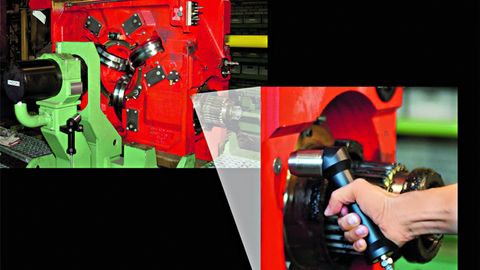
During scaffolding preparation, the scaffolding is read with a handheld reader and thus clearly identified.
© KocksKocks developed a hand scanner with an integrated read/write head to identify the stands so that everything fits together during stand preparation and errors can be ruled out before insertion into the rolling block. The scanner records the data from the stand transponder and forwards it to a PC. A special user interface shows the worker whether everything has been assembled and adjusted correctly. The IT specialists at Kocks developed the necessary software components for data evaluation, user guidance and user interfaces themselves.
The read/write heads are scanned cyclically and all changes to the system are recorded and written to the database. The applications are PC-based; a TCP/IP server is used to transmit the signals via the local Ethernet network (LAN) instead of a connection and evaluation via a programmable logic controller. The transponder currently only contains the scaffolding ID; however, Kocks has kept open the possibility of being able to write information to it in the future.
In protection class IP69K
The all-metal RFID data carriers and read/write heads made of V4A stainless steel are suitable for a temperature range between -40 and +125 °C. Kocks uses transponders of type 'RTL 0262-001' with a diameter of 26 mm and protection class IP69K. The transponders can be flush-mounted in metal and can be read and written through the metal. The memory capacity of the tags is 120 words of 16 bits each. These or entire memory areas can be read and/or write-protected using a password. The number of write cycles for this type of data carrier is 100,000, the number of read cycles is unlimited.
The RFID evaluation units are optionally available with interfaces to RS485, Profibus, Devicenet and Ethernet/IP. Kocks opted for a device for connecting four read/write heads and a serial RS485 interface in combination with a separate TCP/IP interface, which transmits the data from the evaluation unit to a PC.
Equipping the rod rolling mills with RFID systems has another advantage in addition to increased process reliability: the system can be used to record all process data on a stand-specific basis. Not only is the current status of the stands known at all times, but also which stand was used when, where and in what condition, or what tonnages it has rolled in a certain period of time. This enables the rolling mill operator to plan resources better, for example when servicing and maintaining the stands or procuring rolls.
Author: Oliver Schleicher is Managing Director of Contrinex Germany in Leinfelden-Echterdingen.


You might also be interested in
Hand and finger protection in mechanical presses
Contrinex has developed Ybes Extended Slim Type 4 safety light curtains especially for use in mechanical presses.
 read more...
For position or presence detection
Contrinex has developed what it claims are the smallest inductive miniature sensors available on the market with fully integrated electronics.
read more...Resistant to washdown and process fluids
Contrinex is expanding its range of photoelectric sensors with M12M and M18M devices in metal housings.
read more...Withstand even high-intensity magnetic fields
Contrinex has expanded its Weld-Immune series of weld-resistant inductive proximity sensors. The factor 1 sensors with 'Condet' technology detect objects in steel and aluminum without reducing the switching distance.
read more...Live measurement and data monitoring
Contrinex cloud-enabled smart sensors are suitable for live data monitoring.
read more...Generation change at Contrinex
Swiss sensor technology provider Contrinex is changing its sales and R&D management: Peter Heimlicher, founder of the company, stepped down from the Management Board on June 1, 2016.
read more...SensoPart and Cambrian Robotics
Partnership for 3D-Guided Robotics
Cambrian Robotics and SensoPart are jointly developing an AI-powered solution for 3D-guided robotic applications. The combination of vision sensors and AI is designed to simplify gripping and positioning processes.
read more...Expansion of the Sensor Portfolio
Infineon Completes Acquisition of ams Osram's Sensor Business
Infineon has completed the acquisition of ams Osram's non-optical analog/mixed-signal sensor portfolio. The business is expected to generate approximately 230 million euros in revenue in 2026.
read more...Technologies for precise data and analytics
From June 9 to 11, 2026, Sensor+Test once again brought together trade visitors from the fields of sensor technology, measurement, and testing in Nuremberg. With its focus on these core technologies and the wide range of application areas, the trade...
read more...