
Leuze
Sugar? Of course!
Südzucker has high quality standards - for the production process as well as for intralogistics processes. Safety aspects also play a key role - from retrieving the sugar sacks and buckets loaded on Euro pallets to loading the trucks.

Before a beet is turned into sugar, which is removed from the high-bay warehouse and loaded into trucks, it has to pass through numerous stages. It all starts with the weighing process: during a sugar campaign, several thousand tons of beet are delivered to Südzucker by regional farmers every day between September and January. These must first be weighed, their dirt content estimated and their sugar content determined. During unloading, as with all internal processes, 'safety first' applies: it must be ensured at all times that nobody is in the danger zone of the tiltable platforms when unloading the trucks. This is ensured by several safety light barriers installed by Leuze.
During a sugar campaign, the seven 'sugar towers' on Südzucker's factory premises are filled. They serve as silos and contain the entire supply until the next harvest time. The weighing process is followed by juice extraction, purification, evaporation and crystallization as well as the further use and recycling of the by-products animal feed, molasses and carbolime.
Storage and retrieval of bagged and bucket goods
The high-bay warehouse at the Ochsenfurt plant has 72,000 storage spaces. Seven aisles provide space for up to 6,000 Euro pallets, on which bagged goods and buckets are stored. The bagged goods are already firmly attached to the Euro pallet in the high-bay warehouse with stretch film to secure them during transportation. In the case of bucket goods, this firm connection is only made shortly before loading onto the truck. On average, the warehouse is completely turned over once in a maximum of four weeks.
Risk factor transfer station and material transport
Depending on the goods call-off, 10 to 25 sugar trucks leave the Ochsenfurt plant every day, whereby a maximum of two trucks can be loaded at the same time. This is done with the help of up to two electric pallet trucks working in parallel. When a truck docks, the warehouse logistics specialist retrieves the goods to be picked up directly from the high-bay warehouse via SAP. The ordered Euro pallets arrive at the end of the intralogistics process chain via roller conveyors - a five-lane gravity conveyor that is loaded with pallets by a cross conveyor.
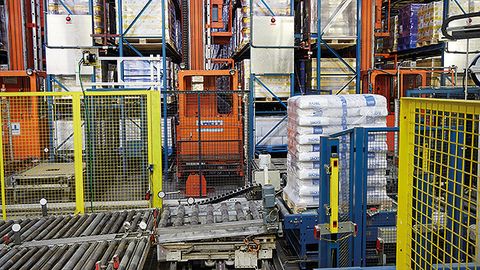
The five roller conveyors of the gravity conveyor are arranged close together. Euro pallets with transport securing devices are transferred directly to the gravity roller conveyor and transported to their transfer point. The warehouse logistics specialist determines which of the five lanes is used when entering the respective order. Euro pallets without a fixed bond are diverted to a separate film winder before they are made available. This is protected by safety light barriers from Leuze. There, these pallets are wrapped in film to secure them for transportation, so that they are then also firmly attached to their Euro pallet. The pallets arriving at the end of the slightly sloping transport system are stopped by mechanical brakes. Low-lift trucks pick up the pallets at the transfer point, transport them to the docked trucks and load them directly.
Traditional security concepts at their limits
In many multi-lane conveyor systems, a single muting light grid or a light barrier was used in the past to safeguard several adjacent conveyor sections simultaneously. However, this type of installation is not muting as required by DIN EN IEC 62046. This is because if the protective function of the safety light curtain is temporarily suppressed during active muting, people can easily enter the danger zone next to a pallet being conveyed out of it, for example from an adjacent conveyor line. In addition to cost considerations, however, there are often design reasons - as is the case at Südzucker - that make it difficult or even impossible to use several neighboring muting sections.

Two vertically aligned 'RSL 400' safety laser scanners from Leuze are used to safeguard access to the five-lane pallet retrieval system at Südzucker. Together, they form a vertical protective field that extends across all lanes.
© LeuzeAt Südzucker, even the more efficient alternative for access guarding, 'Smart Process Gating', which was developed by Leuze back in 2016, could not be used: This technology is based on the 'MLC 530 SPG' safety light curtains from Leuze, which make additional muting sensors superfluous. However, this system could not be used here at Südzucker, as the design of the multi-lane transport system does not allow several muting or SPG sections to be arranged next to each other.
New solution after safety check
A creative solution therefore had to be found, as both the area where pallets are transferred to the gravity conveyor and the danger zone behind it had to be safeguarded against access by people. At the same time, the safety solution should only release the lane on which the pallet is ultimately dispensed. In other words, the safety concept had to provide seamless safety for automatic processes while ensuring an efficient material flow and high system availability.
The solution: access guarding for the five-lane pallet retrieval system at Südzucker is provided by two vertically aligned safety laser scanners from Leuze. Together they form a vertical protective field that extends across all lanes. The safety system receives information from the system control as to which lane the pallet will be output from and adjusts the protective fields of the two safety laser scanners accordingly shortly before the pallet passes through. If the transverse transfer carriage transfers a pallet, this is reported to the system controller and a protective field is selected at the corresponding position in the size of the pallet. Once the pallet has passed through, the protective fields of the safety laser scanners are reset to their original size and thus completely 'close' the conveyor area again. This ensures seamless safety during the transport cycles.

The safety system does not require any additional signals, such as those from muting sensors, so there are no system-related design restrictions. The tamper-proof solution is suitable for retrofitting existing systems: the two safety laser scanners are controlled by their own pre-programmed safety controller, which is part of the protection concept, and integrated into the system via two-channel safety outputs. Necessary adjustments to the software of the small control unit and the configuration of the protective fields of the safety laser scanners are easy to carry out.


You might also be interested in
Safety thanks to radar
Safe 3D systems are used to monitor hazardous areas - even in harsh environments such as sparks, dirt and dust, for which optical sensors have not yet provided a reliable solution. A radar system is now set to change this.
 read more...
Safety in harsh environments
With the LBK radar system, Leuze is expanding its safety range with a safe 3D system for monitoring hazardous areas, even in environments with dirt, welding sparks, sawdust, smoke or moisture.
read more...Own business division for security technology
Sensor technology provider Leuze is now placing its safety expertise more firmly in the focus of its business activities with its own business unit.
read more...Protected against water jets and dust
The safety relays in the 'Tethys IP65' family from Zander Aachen include the Tethys IP65 SR safety relay and the Tethys IP65 KR safe coupling relay. Their housing functions as a mini switch cabinet and requires no additional protection.
read more...Solenoid interlock functionally extended
Schmersal has equipped the electronic solenoid interlock 'AZM40' with new accessories and new features.
read more...Security technology for today and tomorrow
Tailored to the needs of customers from various industries, EUCHNER develops and produces solutions that safeguard guards on machines. This minimizes hazards, protects people and makes processes more efficient at the same time.
read more...Germany is top 3 target for ransomware attacks
A recent report by the Var Group sheds light on the cyber security situation in Europe. The so-called Y-Report shows a significant increase in security incidents; the manufacturing industry is particularly affected.
read more...Risk reduction in hazardous environments
Monitoring pumps in industrial processes is more than just a protective measure for the pump unit. In addition to preventive maintenance and the recording of operating data, ignition source monitoring has become increasingly important, especially in...
read more...Components made from biomass-balanced plastics
Siemens Smart Infrastructure and BASF have presented the first electrical safety product that contains components made from biomass-balanced plastics.
read more...