
Safe pump monitoring
Risk reduction in hazardous environments
Monitoring pumps in industrial processes is more than just a protective measure for the pump unit. In addition to preventive maintenance and the recording of operating data, ignition source monitoring has become increasingly important, especially in hazardous environments.

Safety experts from TÜV know the scenario: pumps without sufficient stability can quickly overheat. This heat can lead to an explosion with devastating damage to production. The company may be left holding the bag for part of the damage if the liability insurance company can prove that the company was negligent. Unsecured pump units are therefore a high business risk. What's more, the management responsible is committing a criminal offense if it fails to comply with the legal requirements.
The jungle of standards
Only a few manufacturers cover the complete safety chain for measurement and control technology (MCR) with their products and solutions. However, safety in the production process is a top priority for companies. This is why there are numerous standards and regulations that must be interlinked. They all require consistent application of, for example, the Industrial Safety Ordinance and TRGS 725 (Technical Guideline for Hazardous Substances).
What sounds simple and logical at first glance becomes complex as soon as you enter the jungle of standards, directives, regulations, technical rules and manufacturer recommendations that must be observed when monitoring ignition sources: IEC/EN 60079-xx as a set of standards on explosion protection, DIN EN 50495 (safety devices for the safe operation of equipment with regard to explosion hazards) and DIN EN 14597 (temperature control and limiting devices for heat-generating systems) are relevant to this topic. The consideration of the DIN EN 14597 standard always includes a complete measuring, control and limiter system consisting of sensor, logic and actuators. For example, the following considerations are certified for the individual components:
- Response behavior of the sensor system
- Reactions (modes of action) of the evaluation electronics
- Reliability/lifetime of the actuators
In addition, IEC/EN 61508, EN/ISO 13849 as well as EN/IEC 62061 and EN/IEC 61511, TRGS 725 (technical rule) and possibly other product-specific standards are applied in the area of functional safety. While electrical explosion protection traditionally played a major role in safety precautions in the past, in recent years the focus has increasingly shifted to mechanical components as a potential source of ignition.
Different types of ignition protection
EN 50495, which was published in Europe in 2011, is central to the topic of ignition source monitoring. It stipulates that in explosion protection, potential ignition sources are eliminated or rendered ineffective by various types of ignition protection. It is necessary to effectively monitor unavoidable residual ignition sources using suitable safety devices. These devices must carry out the corresponding measures within the appropriate response time. EN 50495 distinguishes between simple type a safety devices (e.g. thermal switches, thermistors or temperature monitoring units) and complex type b safety devices - devices that are installed independently of the type of ignition protection equipment under control (EUC).
Examples include overload protection devices for electric motors with type of protection Ex(e) or external control devices for type of protection pressurized enclosure Ex(p). EN 14597 is also relevant; this European standard applies to electrical or non-electrical temperature control and limiting devices used to control and monitor the temperature in heat-generating systems by controlling the energy supply. It applies to ensure that the temperature in heat-generating installations does not exceed a predetermined limit (temperature class). The consideration of this standard always includes a complete measuring, control and limiter system consisting of sensor, logic and actuators. For example, the response behavior of the sensors, the reactions or switching behavior of the evaluation electronics and the reliability/lifetime of the actuators are certified for the individual components.
SIL-compliant temperature monitoring
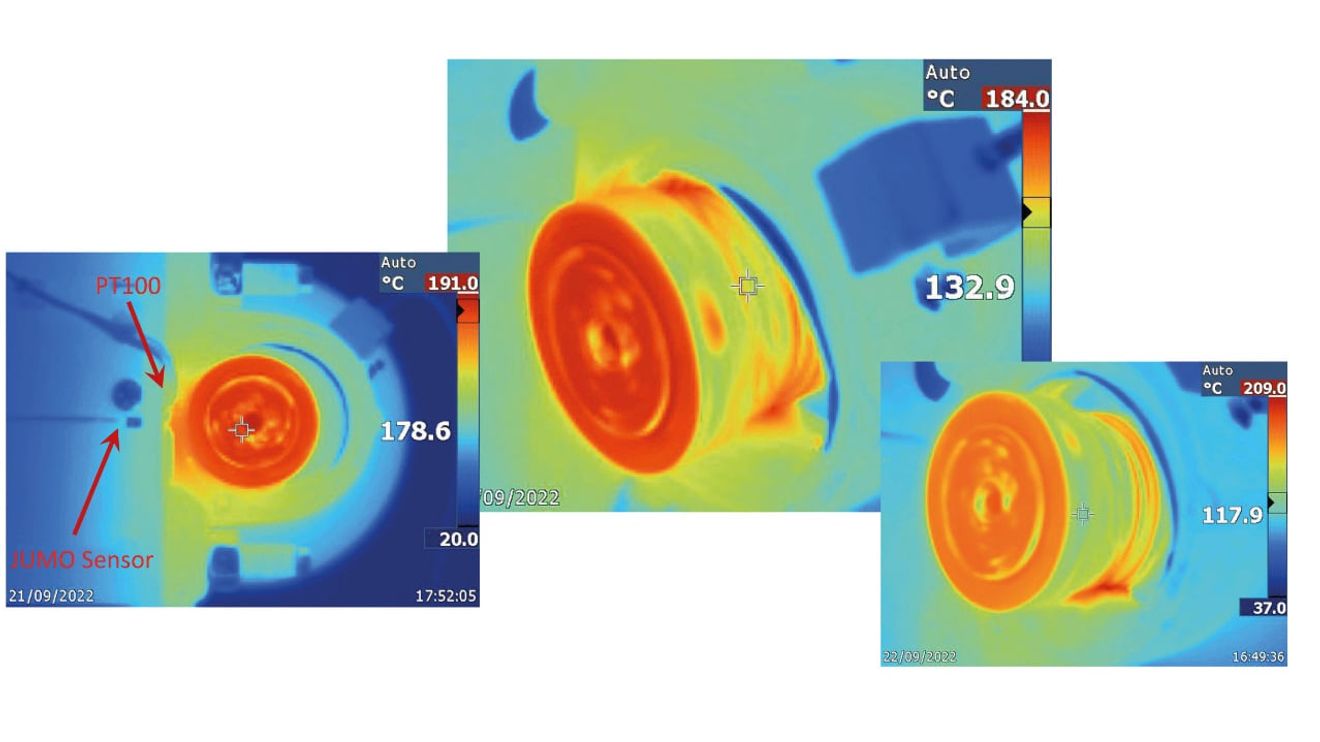
Temperature monitoring of the bearing of a deflection drum (The end face of the shaft was painted to achieve a better degree of reflection. Temperatures of the radial surfaces may therefore be distorted).
© JumoWhat does the complex interplay of rules and standards look like in a specific example? What options are there for users who need to plan SIL-compliant temperature monitoring on a heater or mixer?
The seemingly most obvious option of implementing this via a PLC or a 'normal' measuring transducer is ruled out by both EN 50495 and EN 14597, as neither PLCs nor measuring transducers generally have a certified type examination of their properties. As the SIL assessment by TRGS 725 is binding for every operator, both the prior description of the standards and an assessment according to SIL (Safety Integrity Level) or PL (Performance Level) must be carried out.
The SIL or PL classification is purely a calculation of the probability of failure of the components and does not imply that the shutdown function is working correctly or that it will lock after a malfunction. This means that the burden of proof is reversed in the event of damage. In order to implement a SIL-compliant solution with a PLC, more extensive documentation and programming applications are required. The investment costs required for this vary depending on the number of channels and the amount of software required. In addition, each application must be calculated and evaluated separately according to SIL/PL.

The author Matthias Garbsch is Industry Manager Explosion Protection & Functional Safety at Jumo in Fulda.
© JumoTo simplify this process, Jumo lists all of the company's SIL and PL products and services under the brand name 'Jumo Safety Performance' and offers a certified compact system for functional safety. The safety system consists of a sensor, logic and relay output for actuating the actuator.


You might also be interested in
AI Tool for Safety Engineering
AI Tool for Safety Engineering
Neuron Automation introduces the Smart Engineer. This T3-certified development environment for functional safety combines safety engineering, DevOps, and AI support up to SIL 3.
 read more...
Innovation partner for automation
Bihl+Wiedemann is a medium-sized, owner-managed company - founded in 1992 by Jochen Bihl and Bernhard Wiedemann in Mannheim. It develops and manufactures complete solutions for functional safety and data communication in machines and systems.
read more...Customized solutions for smart automation
In a world of increasing automation, functional safety is essential. Plant operators not only have to comply with legal requirements, but also ensure efficiency and availability. For more than 70 years, EUCHNER has been supplying customized...
read more...Manufacturing industry: top target of ransomware attacks
Ransomware tactics continue to evolve, targeting industries with low tolerance for downtime. Artic Wolf publishes figures on this.
read more...The top 10 articles in August 2024
The top 10 articles from Computer&Automation in August 2024. Readers were most interested in these reports.
read more...Protected against water jets and dust
The safety relays in the 'Tethys IP65' family from Zander Aachen include the Tethys IP65 SR safety relay and the Tethys IP65 KR safe coupling relay. Their housing functions as a mini switch cabinet and requires no additional protection.
read more...Flexibility with macro technology
With the Sigmatek 'SCP 211' safety CPU, it is possible on the software side to create customized macro libraries and parameter lists for safety applications.
read more...Solenoid interlock functionally extended
Schmersal has equipped the electronic solenoid interlock 'AZM40' with new accessories and new features.
read more...Innovation partner for automation
Bihl+Wiedemann is a medium-sized, owner-managed company - founded in 1992 by Jochen Bihl and Bernhard Wiedemann in Mannheim. It develops and manufactures complete solutions for functional safety and data communication in machines and systems.
read more...