
Three questions for ...
Trends in robotics
Under the title "Three questions for ...", computer-automation.de is publishing short interviews with the leading minds in the automation industry on a regular basis this year. This month, the focus is on robotics.
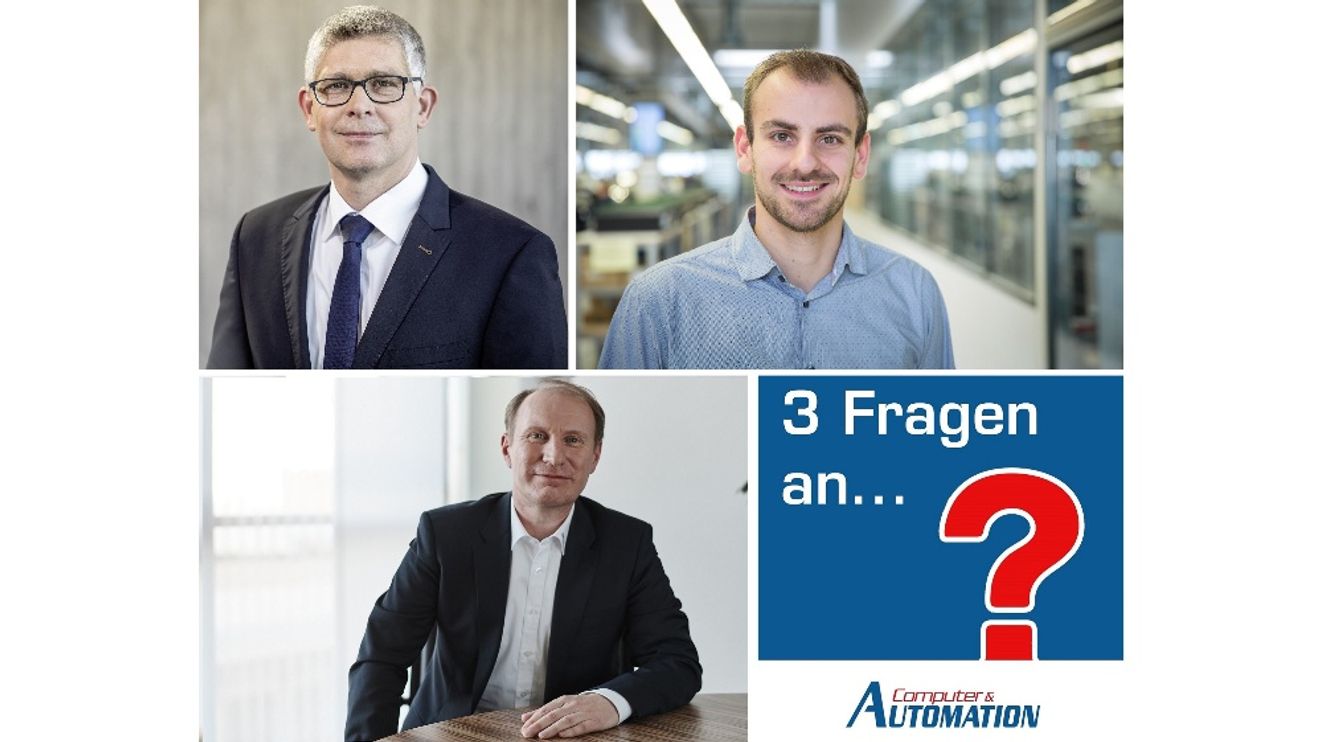
According to the IFR, two million new robots will be installed in production facilities worldwide by 2022. Three trends stand out in particular:
- Smart and simple robot integration
- Collaboration between humans and robots
- Digital robots
As part of our short interviews this month, we therefore want to ask automation experts directly which technologies they are already using.
The guests in our series are:
René Auth, Head of Global Production at Jumo
Dr. Lothar Seybold, CEO at Rafi
Eugen Raisch, Team Leader Operational Excellence & Digitalization at Keba
Jumo: "Human-machine interaction is an absolute necessity for the realization of smart factories"

As Head of Global Production at Jumo, René Auth is in the front row when it comes to making decisions about the use of technology on the extensive production lines. Reason enough to elicit a few details from him in a brief interview.
Do you already use robots in your company's production?
Auth: There are already numerous robots at Jumo. They are mainly used in sensor production, for example in the selection of sensor elements, the production of glass electrodes for sensors for liquid analysis or the production of temperature sensors. Robots can also be found in our development department, in laboratories and in many other areas.
How interesting is the robot leasing model for you?
Auth: All robots used at Jumo are highly specialized, individual one-off products that are usually integrated into complex special machines and interlinked systems. Leasing is therefore not currently an option for us.
Are you considering the use of cobots for your company?
Auth : Jumo had its first "cobot" in the development department's test laboratory. This is used for type testing temperature sensors. Among other things, it is used to record and optimize the heat dissipation error. This robot is permanently and reliably monitored in terms of force and travel and can be individually adapted to its tasks and environment. The robot controller can also be used to create virtual walls that the robot cannot leave. Cobots are now also being used in other projects. This is also the right approach, as human-machine interaction is an absolute necessity for the realization of "smart factories".
Rafi: "Robotics plays an important role in our automation and productivity enhancement strategy"

Dr. Lothar Seybold has held management positions at Rafi for over ten years and has been responsible as CEO and Technical Managing Director since the beginning of 2019, so he is familiar with all the details of his production lines. For us, he is the ideal person to talk to when it comes to the technical philosophy of production.
Do you already use robots in your company's production?
Seybold: We already use robots in many different applications. Robotics plays an important role in our automation and productivity enhancement strategy. We mainly use industrial robots from our customer Kuka, and we are very proud that we are able to develop and produce the "Smart-Pad" user interface for these leading products. The applications range from assembling and sorting to testing and calibrating.
How interesting is the robot leasing model for you?
Seybold: We typically buy our equipment. This also includes robots
Are you considering the use of cobots for your company?
Seybold : Of course we are also considering the use of cobots and are currently testing various scenarios. However, according to the current state of knowledge, the cycle time and therefore the output/performance are often far too low for our applications.
Keba: "Cobots have been with us since 2017"

If you look at Eugen Raisch's CV, which includes a degree in industrial engineering, electrical engineering and intralogistics as well as professional expertise in quality management and digitalization at Keba, he is naturally our first port of call when it comes to talking about the current use of robots in production.
Do you already use robots in your company's production?
Raisch: At Keba Germany, we have been using classic 6-axis articulated robots and gantry robots for several years now. The applications are in the automated handling of our appliance testing, machine loading and assembly.
How interesting is the robot leasing model for you?
Raisch: Robot leasing offers a good opportunity to introduce robots into the company. Particularly in a changing environment, robot leasing can be a very attractive way of implementing an application quickly and using it over a short period of just one year. This flexibility offers advantages, especially in the highly fluctuating project business. We are therefore interested in the robot leasing model, but are not yet using it.
Are you thinking about using cobots for your company?
Raisch : We have been using a cobot in coexistence without a safety fence since the end of 2017. Our experiences have been very positive, even if we don't have a truly collaborative use case with humans and cobots. On the other hand, cobots are of course very flexible and do not require a rigid fence when used correctly. Changes to the layout can be made very quickly, which is a big advantage for us.


You might also be interested in
Continuously measured
Safety PLCs are not always necessary to implement safety requirements in tank systems. In some cases, the use of safety monitors or limiters is also sufficient.
 read more...
Management change at the start of the year
Stäubli, a global provider of industrial and mechatronic solutions, is starting the new year with a new CEO.
read more..."Three questions for..." - in December
The company roadmap to TSN
Time Sensitive Networking - TSN for short - is in the process of establishing itself as a real-time Ethernet standard. What is the state of play in the industry? As part of the "3 questions for ..." series, we asked experts from companies about this.
read more...Supplemented by three modules
The Varitron automation system from Jumo is being extended by three modules: The 32-channel digital I/O module offers 32 channels, 17 of which are configured as digital outputs as standard.
read more...Reliable transmission of switching signals
The two-channel Ex-i isolating switching amplifier from Jumo was specially developed for the float switches of the 'Nesos' series, but also supports all proximity sensors according to the NAMUR standard.
read more...Cooperation between Nabtesco and Keba
Cycloidal gearbox supplier Nabtesco and controller manufacturer Keba are pooling their expertise to produce industrial robots "with the highest accuracy available on the market", according to the company.
read more...International Federation of Robotics
Best-selling service robot
According to the IFR, sales figures for service robots have risen by 32%. This corresponds to a market volume of 11.2 billion dollars. Further growth is expected.
read more...Yaskawa and Lorch welding technology cooperate
Yaskawa and Lorch Schweißtechnik announce a Europe-wide collaboration. The aim is to automate welding processes.
read more...Three questions for...Stormshield
"Industry 4.0 only via IT and OT security"
While IT is usually protected by security measures, the OT area is often neglected in many industrial companies. Uwe Gries knows that unsecured, intelligently networked machines and processes are open gateways for cyber attacks.
read more...