
International Federation of Robotics
Best-selling service robot
According to the IFR, sales figures for service robots have risen by 32%. This corresponds to a market volume of 11.2 billion dollars. Further growth is expected.
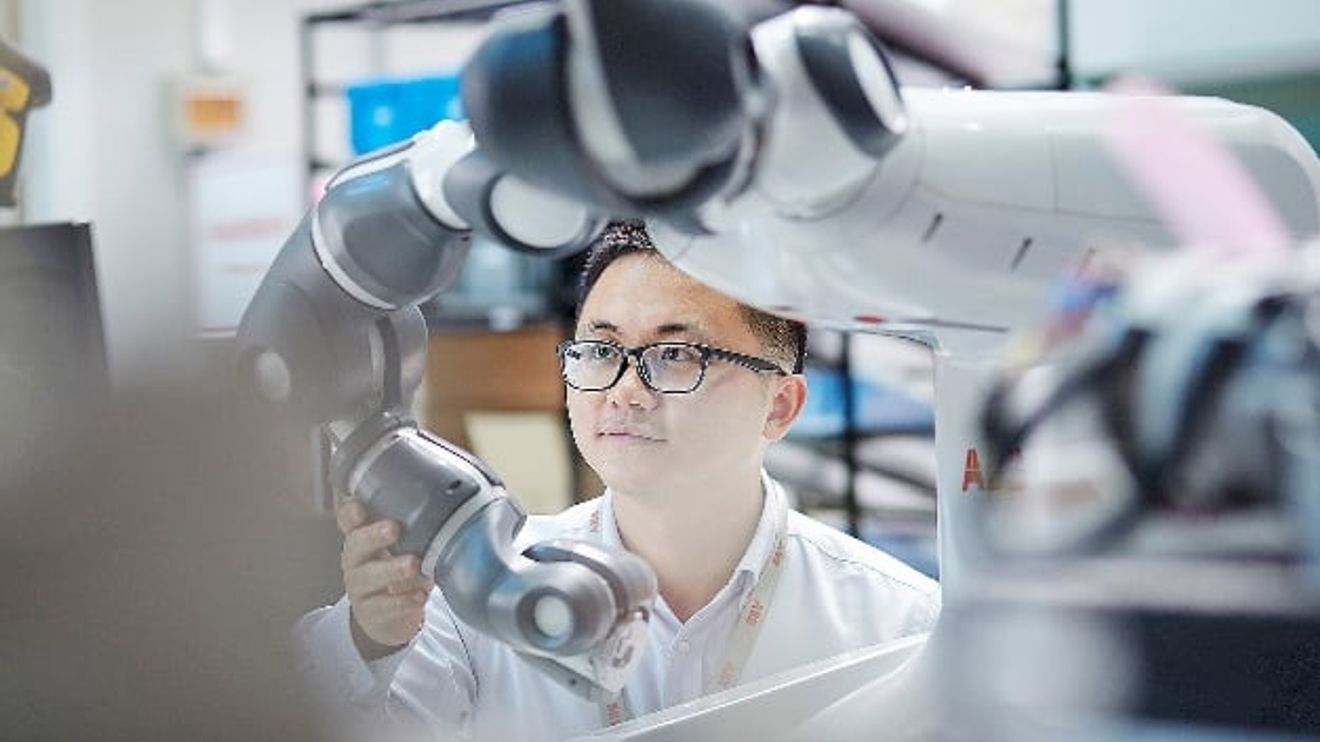
Service robotics is booming.
© IFRService robotics is booming, especially in the fields of medicine and logistics. This was reported by the International Federation of Robotics. According to the IFR, the global sales value of professional service robots rose by 32% to 11.2 billion dollars from 2018 to 2019. The COVID-19 pandemic is providing further market impetus: according to the 'World Robotics 2020 - Service Robots', demand for disinfection robots, logistics robots in factories and warehouses and robots for the delivery of goods to doorsteps, for example, has continued to rise.
Strongest growth in medical robots
With a market share of 47% in 2019, medical robotics is the most profitable segment for professional service robots. This is primarily due to robot systems used in surgery, which achieve the highest individual prices. Sales of medical robots as a whole reached a new record of 5.3 billion dollars - an increase of 28%. Incidentally, around 90% of medical robots come from American and European suppliers. The IFR anticipates further market growth by 2022: according to forecasts, sales could more than double to 11.3 billion dollars.
Professional service robots in logistics
The market value of logistics robots sold or leased rose by 110% to 1.9 billion dollars. Almost all of this turnover is attributable to logistics robots for indoor areas. Autonomous mobile robots initially only worked in warehouses, but thanks to digitalization they are now increasingly being used in production as part of an intelligent factory. The IFR expects the trend to continue and lead to further strong sales growth of 40% or more per year.
"Investing in manufacturing processes with service robots for logistics pays off quickly," explains Milton Guerry, President of the International Federation of Robotics. "Assuming 24-hour operation, the investment pays for itself within two to three years - often much faster. With a service life of 15 years, the operating costs are around 5% of the annual investment. At the same time, sophisticated systems often offer an operational availability of 98% or more."
RaaS models in vogue
Robotics-as-a-Service (RaaS) business models are in vogue. They are intended to help lower the hurdles for users and automate with robots. The advantage is that there is no need to invest in hardware. This means that companies are not burdened by fixed capital, fixed costs or additional personnel requirements. In non-manufacturing industries, the use of robotic logistics systems has been strongly driven by warehouse solutions for large e-commerce companies. There is also strong potential in hospitals, which operate their logistics with the help of professional service robots . Around 90% of the logistics robots examined in the professional service robot segment are produced in Europe and North America, and around 10% in Asia.
Robots for personal use
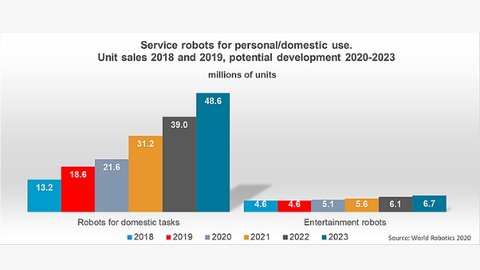
In the field of service robotics for personal and domestic use, household robots achieve the highest sales figures. These include vacuum cleaner and floor cleaning robots, lawn mowers and entertainment robots. The total number of service robots for personal and domestic use rose by 34% to more than 23.2 million units sold in 2019. The sales value increased by 20% to 5.7 billion dollars. Unit prices in the two main segments of robot vacuum cleaners and toy robots have been falling for years. Simple vacuum robots already cost less than 100 dollars today.
Three quarters of service robots for domestic use, i.e. vacuum cleaners, floor cleaners, lawn mowers and other household robots, were manufactured by American companies in 2019. Asian companies accounted for 19% and European companies for 6%.
Assistance robots for elderly or disabled people are also a growing market. The estimated sales value recently rose by 17% to 91 million dollars. National research projects in many countries are already focusing on this future market for service robots. In contrast to most entertainment robots, these assistants are genuine high-tech products. "We assume that sales of professional and personal service robots will continue to grow strongly," says Guerry.


You might also be interested in
New management for the robotics division's automotive business
Jörg Reger has been appointed Head of the global Auto OEM business line of ABB's Robotics division. He succeeds Michael Larsson, who is leaving ABB to pursue new professional challenges.
 read more...
SPS Connect 26.11. - 13:30 - 13:50
Simple parameterization - intuitive commissioning of robots
The standardized MOVIKIT® Robotics software module enables the control of universal robot kinematics in a simple and time-saving manner. This allows workers to create robot programs quickly: Without complex programming language - directly on the...
read more...SPS Connect 25.11. - 11:00 - 11:20 a.m.
AI at the Industrial Edge
Machine learning in increasingly extreme environments.
read more...Cooperation between Nabtesco and Keba
Cycloidal gearbox supplier Nabtesco and controller manufacturer Keba are pooling their expertise to produce industrial robots "with the highest accuracy available on the market", according to the company.
read more...Kuka reports rising order intake
Kuka reports a growing order intake in the third quarter: at 752.4 million euros, it was 20.4% higher than in the same period of the previous year. However, CEO Mohnen warns of "challenging months".
read more...Disinfection robot acts independently
In order to contain the spread of the coronavirus, the Stuttgart-based Fraunhofer IPA has developed a prototype of a mobile cleaning and disinfection robot that autonomously travels to potentially contaminated objects such as door handles and...
read more...Germany in 1st place for robots in Europe
With around 221,500 industrial robots, Germany is the most automated economy in the EU - the number increased by 3% (2019). This was reported by the International Federation of Robotics (IFR) with the publication of the World Robotics 2020 yearbook.
read more...Ralf Winkelmann appointed to the Management Board
Ralf Winkelmann is a new member of the board of the VDMA Robotics + Automation Association. The Managing Director of Fanuc Germany succeeds Helmut Schmid, formerly of Universal Robots.
read more...Trends in robotics
Under the title "Three questions for ...", computer-automation.de is publishing short interviews with the leading figures in the automation industry on a regular basis this year. This month, the focus is on robotics.
read more...