
Fruitcore
A robot called Horst
The aim when developing Horst was to create a robot solution that is simple both mechanically and in terms of software and that is specially tailored to the needs of small and medium-sized companies. What is behind this?
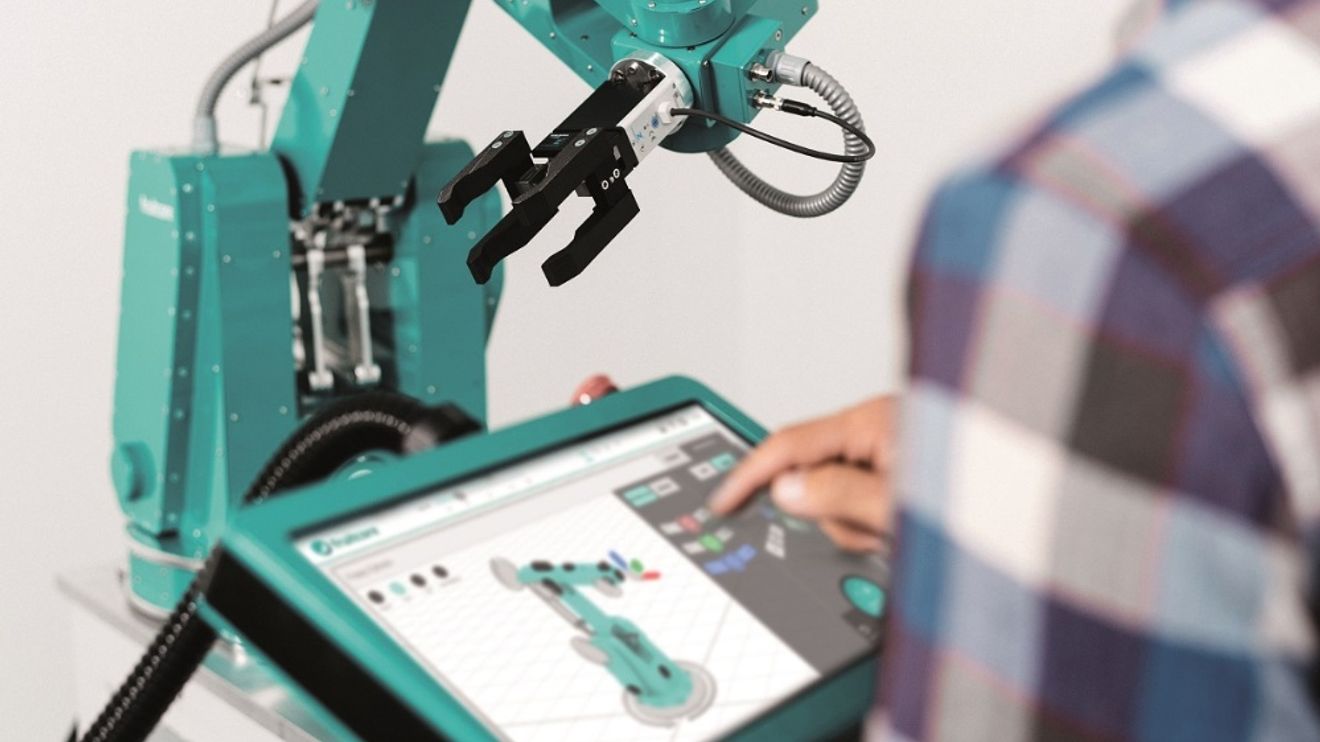
Giving robots a human name has been nothing unusual since the advent of cobots - in many cases, it helps to reduce the workers' fear of contact with their new 'colleagues'. In the case of the robot from the Constance-based company Fruitcore Robotics, the name 'Horst' may well contribute to this - in this case, however, the name of the 6-axis robot is simply an abbreviation for 'highly optimized robotic systems technology'.
Horst pursues a novel kinematic approach. The second and third main axes are driven by so-called four-bar linkages (VK). This means that movement and power are not transmitted directly to the robot axes by means of a drive unit - usually an electric motor and gearbox - as is usually the case, but indirectly via the four-bar linkages. This means that the drive shafts and the actual robot axis are not in the same position.
The four-bar link chains are arranged in such a way that, according to Fruitcore, they enable a high power transmission when the position of the robot requires it and the transmission ratio becomes smaller when the power is not required. The mode of operation of a four-bar chain can be seen by comparing it with gear drives: in a four-bar chain, the crank of the VK corresponds to the small gear wheel and the swing arm to the large gear wheel. The coupler connects the crank and swing arm. If the crank rotates uniformly, a non-linear rotary movement occurs on the swing arm. This means that the swing arm moves faster in some places than in others. The transmission of forces behaves in the same way. If the swing arm moves slowly (high gear ratio), more power is transmitted - if the swing arm moves faster (low gear ratio), less power is transmitted. Due to this operating principle, the transmission ratio of four-bar chains is not linear, in contrast to gear drives.
In addition, the rods of the four-bar link chains transfer some of the forces to the structure, which means high system rigidity combined with low mass. Because this mass does not have to be moved, Fruitcore says that the power of the drives can be used more efficiently and, overall, high performance data in terms of load capacity, range and dynamics can be achieved with Horst with comparatively small drives.
Set up in 30 minutes
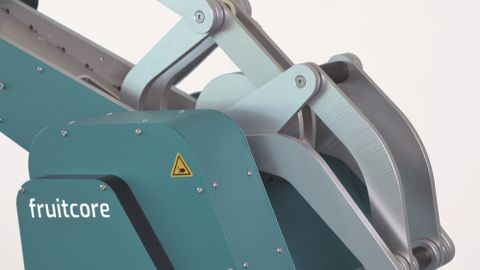
Horst's four-bar link chains are arranged in such a way that they enable a high power transmission when the position of the robot requires it, and the transmission ratio becomes smaller when the power is not required.
© FruitcoreThe robot is programmed using the horstFX software, which was specially developed for the 13.3-inch touchscreen supplied. The latter is also used to operate Horst. Fruitcore promises that users can set up and program it intuitively and without specialist knowledge in less than 30 minutes via a graphical user interface.
Connected components such as grippers and external machines are easily controlled via the graphical programming using the interfaces commonly used in the industry or via digital inputs/outputs. However, the software can be operated offline and away from the robot, for example on desktop computers. No programming knowledge is required for this. Graphically generated programs can be automatically converted into textual codes or into the JavaScript-based scripting language horstScript. With this fully-fledged robot programming language, all process parameters can also be configured and advanced users can use it to solve even highly complex programming tasks.
The graphical user interface has an intuitive design and is reminiscent of the operation of a smartphone. Programs can be created either live or by means of simulation. Once programs have been created, users can edit them at any time and move or delete individual blocks. It is also possible to import data for additional tools and 3D objects.
Without coding to the program
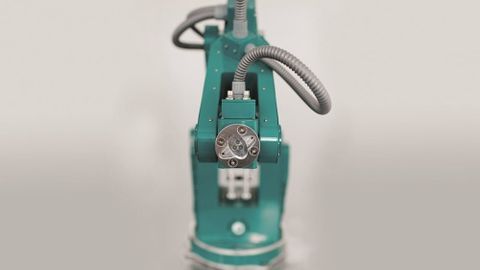
With a footprint of 380 mm x 380 mm, the compact industrial robot is very easy to integrate into processes.
© FruitcoreHorst also has a proprietary bus system with differential signals. The company has created its own mainboard for central control. The control system is based on a fast processor that controls the six axis joints in real time. Optical incremental encoders are used to ensure high positioning accuracy in the range of ±0.05 mm. All safety-relevant signals are evaluated and processed redundantly in accordance with performance level d (PL d). In addition, the in-house developed safety controller offers safe inputs and outputs for communication with safety systems such as light barriers or safety scanners.
According to the manufacturer, the investment costs for Horst are well below 20,000 euros, which should enable small and medium-sized companies in particular to make a simple and manageable entry into automation. The robot system can handle payloads of up to 5 kg and has a reach of 900 mm with a footprint of 380 mm x 380 mm. Horst's big brother is already being worked on in Constance. This will be able to handle even heavier loads and have a greater reach.
Potential applications for the robot include loading and unloading machines, stacking, sorting and packing products, handling turned, milled and punched parts, as well as pick & place applications.


You might also be interested in
Steer conveyed goods in any direction
The celluveyor conveyor and positioning system from Cellumation consists of small conveyor cells with omnidirectional drive wheels and offers conveyor technology new design and application options for the realization of complex material flows in...
 read more...
With the 'right touch'
Lightweight robots are becoming increasingly interesting for small and medium-sized companies when it comes to automating production and logistics tasks. The robots can be programmed without specialist knowledge and the acquisition costs are...
read more...Drive technology for robotics
Robots and cobots have to meet high requirements. This also applies to the components used in the articulated arm bearings or as range extenders. New bearings, precision gears and linear axis systems meet these requirements.
read more...International Federation of Robotics
With robots against corona
Robots are playing a crucial role in the coronavirus pandemic worldwide, for example in surface disinfection. IFR is therefore reporting increased demand for the mechanical helpers.
read more...VDI/VDE Innovation + Technology
The question of acceptance
The spread of service robots in the industrial environment is currently still limited. Whether the high growth rates forecast will materialize will largely depend on the acceptance of the people who are to work with these 'cobots'.
read more...Two become one
The current situation in robotics: Until now, two single-turn encoders working in parallel - plus gears for synchronization - have been required for speed monitoring and position control per robot arm. A new kit encoder from Posital can now do this...
read more...Warehouse robot picks over 500 items per hour
KHT has redesigned the function and design of the Indu-Store picking system. The warehouse robot processes each item automatically via integrated Auto-ID solutions.
read more...Cobots: Anatomically shaped hand
With the SoftHand, German Robotics presents an anatomically shaped hand for collaborative robots.
read more...Mobile robots: autonomous positioning
With the Locator software component from Bosch Rexroth, mobile robots determine their position independently; users require neither expert knowledge nor specific structural devices to commission the component.
read more...