
Posital
Two become one
The current situation in robotics: Up to now, two singleturn encoders working in parallel - plus gears for synchronization - have been required for speed monitoring and position control per robot arm. A new kit encoder from Posital can now do this single-handedly.
Hollow shaft encoders and multiturn for motor feedback - this combination did not work for a long time, or only with extreme difficulty. As a result, classic through-shaft encoders were almost exclusively available as single-turn solutions. It is precisely this gap that sensor manufacturer Posital is now closing with its capacitive hollow shaft kits: they have an integrated rotation counter that records and documents every single revolution. The counting electronics do not require an external power supply, maintenance-prone batteries or complex gears. This energy-autonomous operation is made possible by a Wiegand harvester that Posital has been using for years with solid shaft encoders, which converts rotational movements into electrical pulses and has now been made fit for the hollow shaft design.
Focus on robots
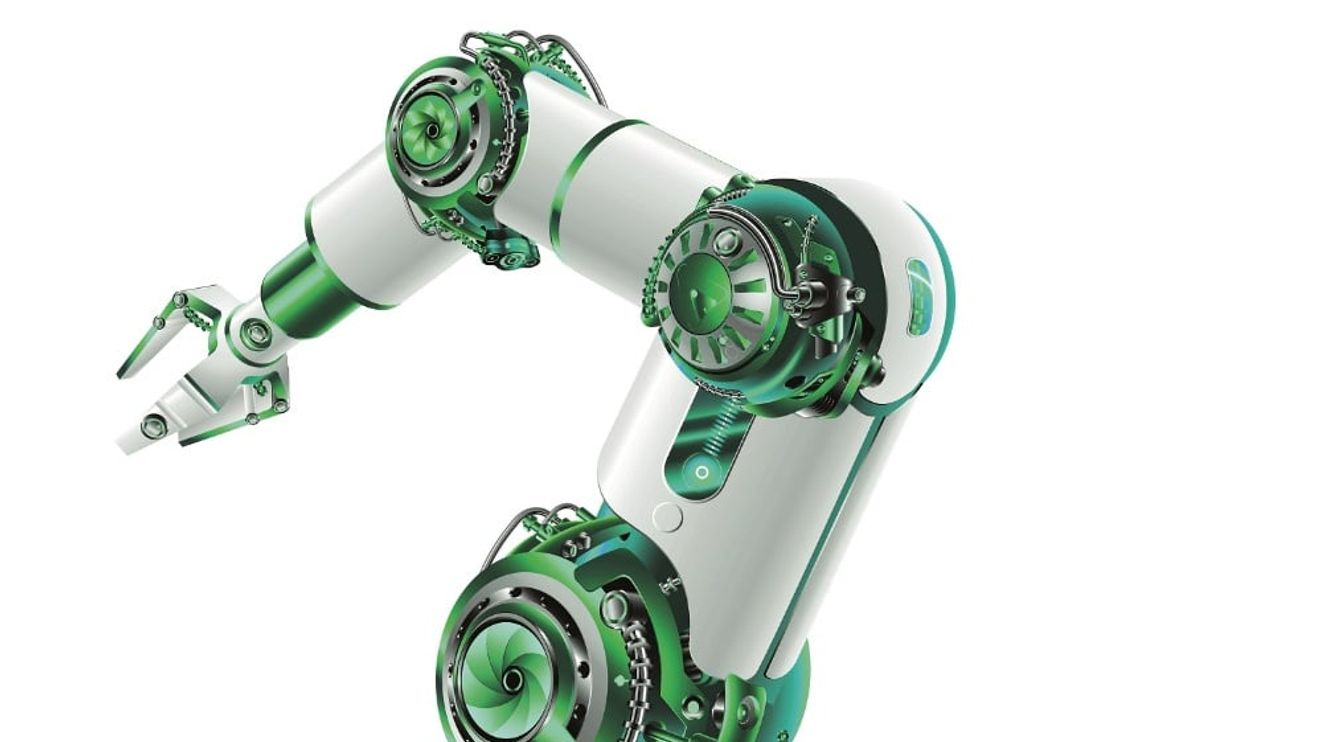
The preferred fields of application for the 'Hollow Shaft' kits include robots - from classic 6-arm articulated robots for industrial applications to significantly lighter and more agile cobots. The through-hole encoders are also useful in applications where direct mounting on the axis of a motor is required.
The performance of the hollow shaft kits in practice can be clearly seen in typical robotic applications where the kits are installed directly in the joints. From here, they monitor and control the three-dimensional motion sequences of the individual robot arms. The benchmark in terms of precision is very high here - modern industrial robots work with repeat accuracies of up to 0.1 mm.
Capacitive measurement technology
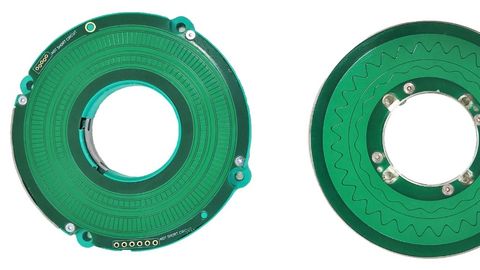
Rotor and stator: Capacitive measurement technology relies on differently designed conductive surfaces.
© PositalIn cobots and classic robots, the central bore of the hollow shaft kits (either 30 mm or 50 mm) is used to guide cables and media hoses inside the robot housing. The slim design with a depth of 17.8 mm and an outer diameter of 80 mm as well as the weight of just 110 g enable simple installation and quick commissioning - a few hand movements and screws are all it takes and the measuring system is ready for use without difficult calibration.
Capacitive measurement technology
While Posital has long been pushing for a system change from optical to magnetic measurement technology for rotary encoders, a different approach was chosen for the 'Hollow Shaft' series. As magnetic systems are very difficult to implement in hollow shaft designs, capacitive measurement technology was given preference. The key components of the capacitive kits are the conductive surfaces of the rotor and stator, which are designed with different patterns. They generate electrical high-frequency signals that are scanned and read out via ASIC processors. The current path and angle parameters are transmitted to the central controller as a unique position value via the SSI or BiSS C open source interfaces. As the entire surface is always scanned during scanning, the capacitive feedback kits are not irritated even by localized soiling.
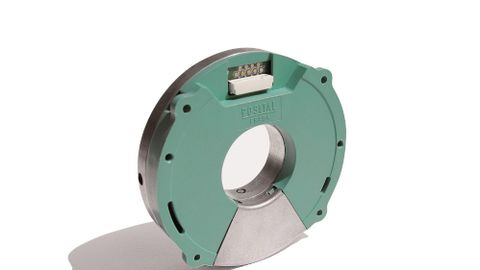
The hollow shaft kit with energy-autonomous multi-turn capability is particularly suitable for use in robotics.
© PositalThe core of the self-sufficient multiturn system is a special energy harvester, which is manufactured by Posital as an SMD mountable component. Pulses from a Wiegand wire provide the energy harvesting. While the classic Wiegand harvester operates in tandem with a central permanent magnet in solid shaft applications, a completely new setup had to be found for the hollow shaft design: Through field tests and intensive magnetic field simulation, a solution with four diametral magnets placed evenly in the rotor was developed at the company's R&D center in Aachen. The four magnets create a stable magnetic field that can be detected and used by the Wiegand sensor installed in the stator. With every 360° rotation of the external magnetic field, the hair-thin Wiegand wire embedded in a copper coil generates a voltage pulse. It supplies the counting electronics, which precisely records every single rotation. The multiturn counter has a 43-bit memory, which is designed for a measuring range of almost nine trillion revolutions.
Energy harvesting and the Wiegand effect - what exactly are they?
With energy harvesting, components harvest the power they need directly from their environment. The result is energy self-sufficient components - without batteries and maintenance-free. The topic has gained significant momentum as a result of IIoT and Industry 4.0 scenarios, which involve gigantic networks of sensors and actuators that are as energy self-sufficient as possible.

While piezo systems, thermal and kinetic processes have long set the pace in energy harvesting, the Wiegand effect, named after the US inventor John Wiegand, is still more of an insider's tip. The core of the Wiegand system, which was patented back in 1972, is a specially conditioned wire made of Vicalloy. At the end of a complex manufacturing process involving cold forming and tempering, it has a soft magnetic core and a hard magnetic sheath. The highlight of this combination is that when the Wiegand wire is remagnetized by an external magnetic field, an impulse is created that can be converted into voltage. For a long time, the Wiegand effect was used for magnetic access or security cards - a field of application that has long since been taken over by modern RFID technology.
Posital has been using the Wiegand wire to harvest low power energy since 2005, with energy-autonomous Wiegand sensors serving as pulse generators for the electronic rotation counters of the company's magnetic multiturn encoders. The decisive factor for the breakthrough in energy harvesting was the availability of low-power chips that require very little energy.
The Wiegand effect is pure energy harvesting. The magnetically induced energy comes directly from the rotation - and, unlike a dynamo, for example, even with very slow movements. This special effect is put into practice in compact Wiegand sensors, of which Posital produces a million a year. The 'mini power stations' fit on the tip of a finger as they are only 15 mm long. The yield of 7 V or 190 nJ is sufficient to constantly activate modern rotation counters and the associated electronics.
Posital is continuously working on increasing the energy yield of the Wiegand sensors in order to be able to serve further applications. Tests at the Aachen R&D center are currently reaching 10 V at certain points. This is close to a low-power output that would ensure wireless communication or radio solutions via the Wiegand effect.


You might also be interested in
Drives precisely synchronized
Manufacturing processes in the food industry are very complex and require intelligence in the machine. The example of a belt-synchronized cutting system shows what an automation system for the production of Maultaschen can look like.
 read more...
IP69K portfolio expanded
Posital has upgraded its portfolio of 'Ixarc' encoders and 'Tiltix' inclinometers with protection class IP69K.
read more...Vertical access to sheets
The magnetic gripper from Goudsmit Magnetics is used to automatically pick up, place or position steel objects or other ferromagnetic objects.
read more...With the 'right touch'
Lightweight robots are becoming increasingly interesting for small and medium-sized companies when it comes to automating production and logistics tasks. The robots can be programmed without specialist knowledge and the acquisition costs are...
read more...Flash survey on the use of robots in industry
The International Federation of Robotics (IFR) forecasts two million new robots in production facilities worldwide by 2022. What about you, is your company one of them?
read more...VDI/VDE Innovation + Technology
The question of acceptance
The spread of service robots in the industrial environment is currently still limited. Whether the high growth rates forecast will materialize will largely depend on the acceptance of the people who are to work with these 'cobots'.
read more...A robot called Horst
The aim when developing Horst was to create a robot solution that is simple both mechanically and in terms of software and that is specially tailored to the needs of small and medium-sized companies. What is behind this?
read more...Mobile robots: autonomous positioning
With the Locator software component from Bosch Rexroth, mobile robots determine their position independently; users require neither expert knowledge nor specific structural devices to commission the component.
read more...Fighting the coronavirus with robots
Within a week, Siemens and Aucma have developed an intelligent disinfection robot that will soon be taking up the fight against viruses in hospitals.
read more...