
International Federation of Robotics
With robots against corona
Robots are playing a crucial role in the coronavirus pandemic worldwide, for example in surface disinfection. IFR is therefore reporting increased demand for the mechanical helpers.
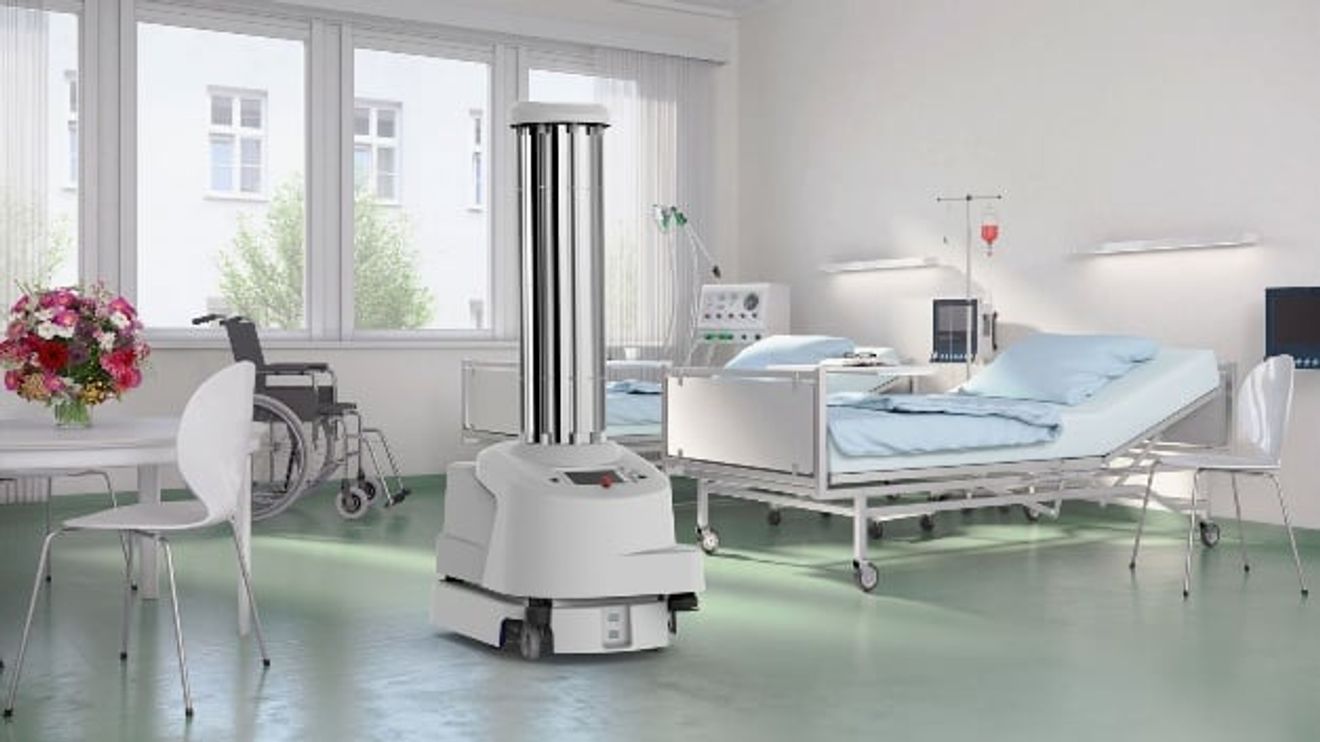
Robots are playing a crucial role in the global fight against the SARS CoV-2 coronavirus, especially in surface disinfection, for example in hospitals. According to a statement from the International Federation of Robotics, demand for the UVD disinfection robot from Danish manufacturer Blue Ocean Robotics has risen sharply since the outbreak of the virus. Chinese hospitals alone have ordered more than 2,000 of these robots. They were used in Wuhan. However, the robots are currently being used in more than 40 countries.
Disinfection robots in demand like never before
The UVD disinfection robots use ultraviolet light (UV-C) to kill pathogens. The robot has been honored with the IERA Award, an innovation prize awarded jointly by the IEEE and the International Federation of Robotics (IFR). "With our robots, we are helping to solve one of the biggest problems of our time: curbing the spread of viruses and bacteria and thus saving lives," says Claus Risager, CEO of Blue Ocean Robotics. "Demand for the UVD has skyrocketed with the outbreak of Covid-19 infections. Our existing customers are buying significantly more devices than before the crisis, but many new customers are also ordering UVD robots to combat coronaviruses and other harmful microorganisms."
Blue Ocean Robotics has recorded annual sales growth of more than 400% in the last two years. Robot moves autonomously The Danish robot moves autonomously through operating theaters and patient rooms, irradiating all critical surfaces with the optimal amount of UV-C light to kill viruses and bacteria. The more intensively the robot irradiates a surface, the more harmful microorganisms are destroyed. 99.99% of all viruses and bacteria in a typical patient room are killed within 10 minutes.
Areas of application also outside the hospital
However, the robots' areas of application are not limited to hospitals, but also extend to airports, schools and offices: "The UVD robot supports the cleaning staff in their work," explains Risager. For safety reasons, the devices work independently in the rooms and automatically switch off the UVC light as soon as someone enters the room. "The potential of robots to support us during the current severe coronavirus pandemic is enormous," says Dr. Susanne Bieller, Secretary General of the IFR. "They support us in healthcare, but also in the development, testing and production of medicines, vaccines and other medical devices and aids. Disinfection tasks - such as those performed by the UVD robot - or the safe distribution of hospital materials in quarantine zones without human contact - which the mobile robot Phollower from Photoneo performs, for example - are just two of many examples."
Autonomous mobile robots for transporting goods
The Phollower robot was developed under the working title Pathfinder. As a new-generation autonomous mobile robot, it is suitable for transporting and moving materials in warehouses, hospitals, hotels and factories. For example, it helps hospital staff to distribute medicines, linen and other materials to the respective workstations. It can carry a maximum of 100 kg and pull a maximum of 350 kg. It saves time and no adjustments to the premises are necessary; the robot can move anywhere, even via elevators, without difficulty.
Medical robots are already a well-established service robot market in their own right with considerable growth potential. Sales of medical robots rose by 50% to 5,100 units in 2018. This is according to the World Robotics report presented by the IFR.


You might also be interested in
Increasing acceptance of industrial robots
Flexibility and health protection are the most important advantages of robotics, 80% of industrial decision-makers are certain. This is the result of the Automatica Trend Index.
 read more...
Vertical access to sheets
The magnetic gripper from Goudsmit Magnetics is used to automatically pick up, place or position steel objects or other ferromagnetic objects.
read more...With the 'right touch'
Lightweight robots are becoming increasingly interesting for small and medium-sized companies when it comes to automating production and logistics tasks. The robots can be programmed without specialist knowledge and the acquisition costs are...
read more...Drive technology for robotics
Robots and cobots have to meet high requirements. This also applies to the components used in the articulated arm bearings or as range extenders. New bearings, precision gears and linear axis systems meet these requirements.
read more...Flash survey on the use of robots in industry
The International Federation of Robotics (IFR) forecasts two million new robots in production facilities worldwide by 2022. What about you, is your company one of them?
read more...A robot called Horst
The aim when developing Horst was to create a robot solution that is simple both mechanically and in terms of software and that is specially tailored to the needs of small and medium-sized companies. What is behind this?
read more...Fighting the coronavirus with robots
Within a week, Siemens and Aucma have developed an intelligent disinfection robot that will soon be taking up the fight against viruses in hospitals.
read more...IFR World Robotics Report 2024
Record number of robots in use worldwide
Over four million robots are in use in factories worldwide, reports the IFR in the current "World Robotics Report 2024" - a record number. However, sales of industrial robots have fallen.
read more...International Federation of Robotics
Beijing wants to use robots to drive growth
During the third plenary session of the Central Committee, China repositioned its economic policy and announced a technology-centered approach. Chinese robot manufacturers are strategically preparing for this.
read more...