
VDI/VDE Innovation + Technology
The question of acceptance
The spread of service robots in the industrial environment is currently still limited. Whether the high growth rates forecast will materialize will largely depend on the acceptance of the people who are to work with these 'cobots'.

Robots that increasingly interact with humans are on the rise, as current and forecast sales increases in the double-digit percentage range show. Technical developments are giving so-called service robotics an enormous boost in innovation: artificial intelligence (AI) is providing more autonomy and new sensor technologies are capturing their environment more intelligently. These and other cross-sectional technologies are increasing functionality and creating new fields of application.
Looking at the market forecasts for service robotics in the entire professional sector - including the manufacturing industry - the highest turnover to date has been achieved in logistics. Sales of automated guided vehicles (AGVs), for example, amounted to around EUR 3.2 billion worldwide in 2018 - an increase of 50% compared to 2017 (source: 'World Robotics 2019 - Service Robots' - IFR). This trend will continue in the coming years with similarly high increases.
There is also still great potential for automation in production, particularly in the areas of assembly and material processing, as the majority of the work performed there is currently still carried out manually. The reasons for this are the complexity of the tasks that require adaptive robot control and the currently insufficient flexibility of industrial robots. Service robots - especially cobots - offer this in areas where close collaboration between humans and robots is necessary or desired. According to the IFR, 14,000 cobots were sold worldwide in 2018. Estimates for 2020 are around 100,000 units.
Although this indicates strong growth - as in logistics - in absolute terms, there are still relatively few service robots in productive use compared to industrial robotics - only around 3% of installed units, according to the IFR. Why is that?
Cost savings and solutions
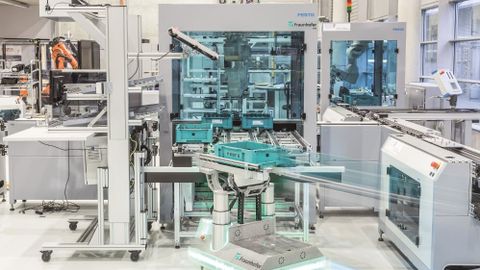
Mobile robot systems are a core element of flexible, versatile production. They are increasingly transporting finished parts or their components completely autonomously or bringing customer orders to a central packing station in warehouses.
© Fraunhofer IPA/University of Stuttgart, Rainer BezIn order to achieve rapid penetration, the acquisition costs and integration costs in particular must be significantly reduced and (intelligent) capabilities must be geared more towards specific user requirements. In particular, the simplified reuse of software components could lead to cost savings, especially in system integration, which currently accounts for the largest share of investment in service robotics solutions. At present, there is still a lack of machine-interpretable descriptions of functional and non-functional properties of hardware and software components, the interoperability of the various components and the integration of different interfaces and communication protocols.
However, all of this is a prerequisite for the efficient development of new components and the reuse of existing ones. The industry-related robotics projects SeRoNet and Robotop in the PAiCE technology program funded by the German Federal Ministry for Economic Affairs and Energy (BMWi) provide examples of possible solutions.
In addition to the technical and economic challenges that can be overcome in the foreseeable future, the acceptance of service robots by employees plays a very important role in their successful use in operations. These non-technical challenges with social and ethical implications in terms of physical and psychological integrity, changes to the world of work, liability and data sovereignty as well as self-determination and transparency are often given little or no consideration when considering the use of service robots. However, there are effective and successful strategies that can be used to achieve greater acceptance of cobots, as outlined below using two case scenarios from in-house logistics and production as examples.
In-house logistics scenario

Market potential in the five top-selling segments of service robotics. The year 2018 represents a preliminary estimate. The sales figures for the years 2019 to 2021 are based on an interpolation of the estimated total sales for the three years, assuming a constant annual growth rate in the individual segments (source: International Federation of Robotics 2018).
© Accompanying research PAiCE / LHLKAn autonomous vehicle with a gripper navigates through a warehouse. It drives to the items to be picked according to the order, loads them and takes them to the dispatch station, to the place of processing in the production chain or to a new storage location. This application covers many of the classic tasks of a warehouse operator. The service robot should be able to pick items safely from shelves without dropping them or knocking the shelves over. And it should navigate freely between employees through the system and deliver the workpieces to the appropriate areas of the production chain.
Challenge 1
Malfunctions or poor maintenance of the robot can lead to physical injury. An altered working environment and inattentive employees are also potential causes of accidents. If the autonomous picking system is used to transport workpieces to a production station, an increase in the target output could lead to stress. This in turn can lead to inattention and consequently cause injuries or psychological suffering due to overload. The service robot would thus achieve the opposite effect to that for which it was deployed: to relieve the strain on employees.
Strategies for overcoming

E-commerce in particular is a driver for the success of picking robots in intralogistics. This prototype demonstrator recognizes groceries on shelves, can pick them and assemble them for delivery.
© Fraunhofer IPA, Rainer BezWhen the workforce learns about the planned use of the service robot, questions arise with regard to occupational health and safety. Two colleagues with a keen interest in technical topics are therefore sent on a training course together with a safety officer. The two are trained as specialists in human-robot collaboration and receive training in topics such as maintenance and operation as well as occupational health and safety and the safety of collaborative robots in the industrial sector. They can contribute the knowledge they have acquired to the implementation process and become trusted advisors for colleagues in their organizational unit. In this way, skepticism due to fear of injury can be countered by introducing specialist knowledge into the implementation process, but also bottom-up through knowledgeable contacts in the operational business.
Challenge 2
Complex service robots often require a large amount of visual data. The black box problem with regard to the further processing of this data is central here. What happens to this data? What else happens to the movement data? Employees may also be afraid that the robot will not recognize them correctly in a confusing situation and that an accident will occur. This makes protection and a clear legal situation all the more important. Employees who are supported by robots in complex and safety-relevant work environments should feel protected against any eventualities.
Strategy to overcome
The management is required to address the issues surrounding liability and data protection and accordingly commissions a law firm to prepare a legal opinion. The legal experts assess the situation from the perspective of all relevant areas of law, from data protection to criminal law, and prepare the legal opinion. This also gives the company the security of being able to take recourse against the experts in the event of damage for which an employee is held liable but which was assessed differently in the expert opinion. The key information from the expert opinion can be prepared by the company's legal department together with the works council in a document that is then presented to employees via internal company media channels.
Production scenario
A collaborative robot gripper is to be used in the production of a medium-sized supplier company. This robot independently inserts workpieces into a CNC milling machine and removes them after processing. The worker, who previously performed these actions himself, carries out a quality check at the end of the process. In other words, he monitors the process.

Dr. Steffen Wischmann is deputy project manager of the PAiCE accompanying research and an expert in robotics and automation at the iit of VDI/VDE Innovation + Technik GmbH.
© VDE/VDI ITChallenge 1
In this scenario, the workers are to be relieved by the use of the service robot. However, if it works at a speed that is too fast for the worker, this can lead to reduced acceptance. This type of challenge becomes even clearer if the scenario is modified slightly: Instead of inserting components into a CNC milling machine, the cobot is used to provide tools for certain work steps. If this changes work processes or certain options are no longer available to employees, this can lead to reservations or even rejection.
Strategies for overcoming this
A 'living lab' can be used to counter a lack of acceptance resulting from
anticipated stress as a result of human-robot collaboration. This makes the future work design tangible for employees. The expectations arising from the Living Lab can be incorporated and implemented through an agile design of the implementation process. For example, employees are asked to work on the demonstrator for half an hour twice a week over a period of one month and then complete a short feedback questionnaire. The results are evaluated after the 'trial period of the robot' as part of a workshop with the employees from the operational business. Decisive feedback can then be implemented as part of the implementation process.
Challenge 2
In production, an unclear legal situation can be the cause of workers' low acceptance of the service robot. If defects or production errors occur during interaction with a service robot, employees must be clear about who is liable. These concerns become even more important if the robot supports the manufacture of products that are subject to certain material requirements for safety reasons - such as weld seams. After all, material defects can lead to accidents and injure third parties.
Strategies to overcome this
The management looks for precedents and example scenarios that shed light on legally relevant factors of human-robot collaboration. Researching information material, workshop reports, further training courses and presentations from science and industry can be just as effective as contacting the manufacturer. A simple and transparent presentation of relevant aspects of the legal situation for the workforce and the works council strengthens confidence in the decision to use service robots.
Further information
A detailed overview of all relevant challenges and a comprehensive practical toolbox can be found in the study "Acceptance of service robots: Tools and strategies for successful operational use". This was compiled by the accompanying research team as part of the PAiCE technology program funded by the Federal Ministry for Economic Affairs and Energy and is available
is available HERE.


You might also be interested in
New fields of application for simulation
Engineers currently visualize their simulated designs on 2D screens. However, as VR and AR technologies become faster and more accessible, designs will soon be able to be visualized in a 3D environment on an AR or VR headset.
 read more...
With the 'right touch'
Lightweight robots are becoming increasingly interesting for small and medium-sized companies when it comes to automating production and logistics tasks. The robots can be programmed without specialist knowledge and the acquisition costs are...
read more...Drive technology for robotics
Robots and cobots have to meet high requirements. This also applies to the components used in the articulated arm bearings or as range extenders. New bearings, precision gears and linear axis systems meet these requirements.
read more...Kuka with positive free cash flow
Kuka reports the first positive free cash flow in three years for the past financial year. The company is now "back on track", but must now face the obstacles posed by corona, says CEO Mohnen.
read more...Flash survey on the use of robots in industry
The International Federation of Robotics (IFR) forecasts two million new robots in production facilities worldwide by 2022. What about you, is your company one of them?
read more...Two become one
The current situation in robotics: Until now, two single-turn encoders working in parallel - plus gears for synchronization - have been required for speed monitoring and position control per robot arm. A new kit encoder from Posital can now do this...
read more...A robot called Horst
The aim when developing Horst was to create a robot solution that is simple both mechanically and in terms of software and that is specially tailored to the needs of small and medium-sized companies. What is behind this?
read more...Targeted preselection of the right system
With the intelligent calculation and design tool Gripping, Schunk simplifies and accelerates the engineering of handling systems.
read more...Trends in robotics
Under the title "Three questions for ...", computer-automation.de is publishing short interviews with the leading figures in the automation industry on a regular basis this year. This month, the focus is on robotics.
read more...