
Augmented and virtual reality
For more expertise in the field
Training courses using AR and VR technologies can prepare field technicians for real-life use in industrial plants. But where does it make sense to use it and what requirements are necessary?
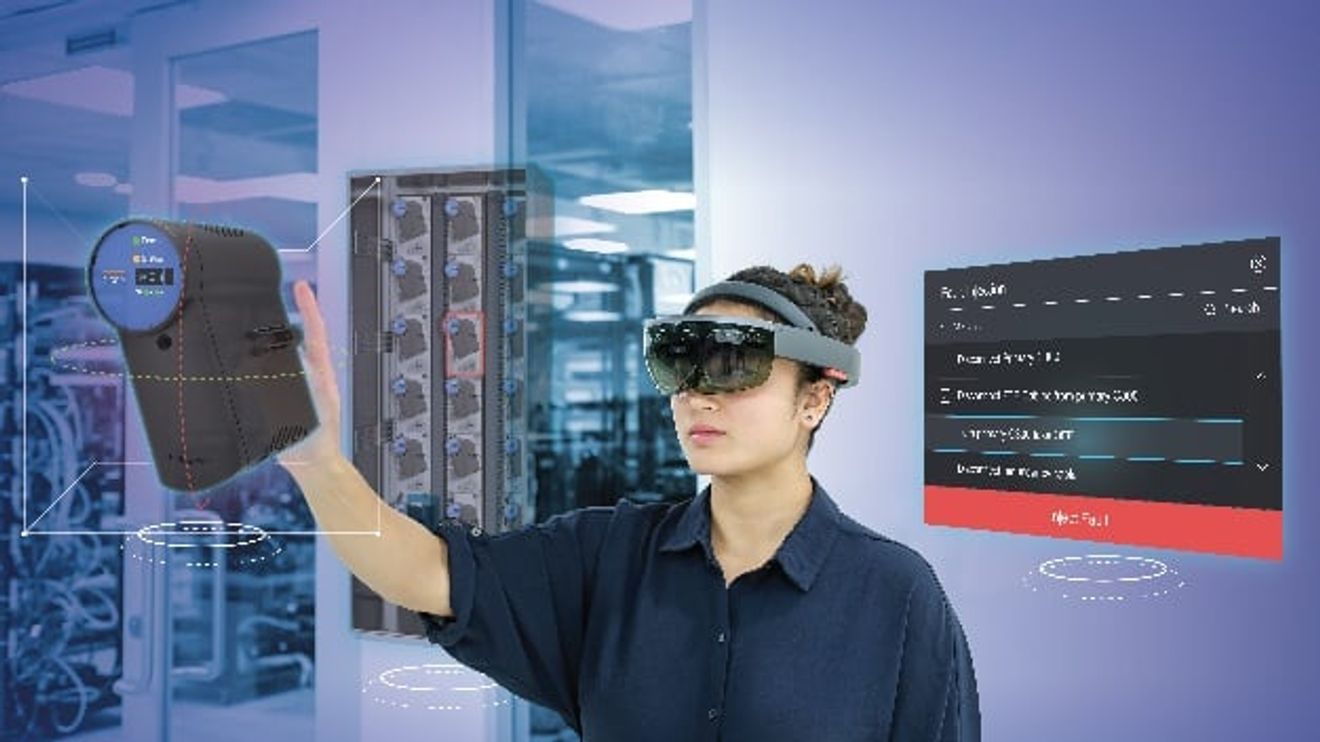
The scope of work for field technicians has grown. It includes old and modern as well as mechanical and electronic systems. Often, these systems include specific software solutions that require additional knowledge, even as the prospects for training and supervision diminish. So how to deal with the issues of efficiency, productivity and safety in the field when the specialists in the field may not be able to keep up with the pace at which detailed expertise on system, process and safety is required? And how can the looming skills gap be addressed when experienced staff are retiring and younger employees are not yet sufficiently trained to meet the requirements? Technical aids can help here - but it is important to choose exactly which of them will actually have an effect.
On closer inspection and in discussions with customers and their employees, it became clear that learning methods have changed over the years: Increasing complexity, for example, ensures that the importance of learning is growing. Field technicians have a broader spectrum to work on and at the same time there is less time available for face-to-face training or other interactions. The need for practical training will not disappear either, because "you can't learn to drive a car by reading a book." The same applies: field technicians also need to learn with their hands (hands-on). The so-called millennials - the generation after the turn of the millennium - demand quick access to information in all age groups. Instead of long-term storage and building up expertise over the years, they want to become experts immediately - true to the motto: "Tell me how to do it so I can get on with it."
More learning and deployment efficiency
Experience with employees in the industry has clearly shown that hands-on training is preferred over alternative methods such as passive observation of trainers or learning videos and reading a manual. There is also a need for shorter, focused instructions that can be accessed at any time. Virtual and augmented technologies are ideally suited to meet these specific requirements. They merge real and virtual worlds and create a new environment in which physical (real) and digital (virtual) objects coexist and interact. They also make it possible to make the learning process more flexible and shorter and to achieve results more quickly.
One example of this improvement in efficiency compared to conventional paper-based learning and training methods is provided by aircraft manufacturer Boeing, which uses AR-based training to improve the productivity and quality of complex manufacturing processes. In a test project, training participants were guided through the 50 steps required to assemble a 30-part section of an aircraft wing with AR support. The participants needed 35% less time compared to assembly using 2D drawings and written documentation. In addition, the number of employees with little or no experience who completed the task correctly the first time increased by 90%.
AR and VR technologies are increasingly finding their way into all areas of companies: Engineers in product development working from globally distributed locations on the same model of a car projected into space, marketing and sales using corresponding technologies to present products in different configurations, or service technicians using virtual step-by-step instructions to maintain and repair devices and machines in the field.
Main driver Service
According to IDC, total expenditure on AR and VR could reach around 215 billion US dollars in 2021. The service sector in particular is one of the main drivers of technological development and adaptation, as the instructions mean that every employee no longer has to have detailed knowledge of the machines to be serviced and the thick, time-consuming manuals and operating instructions are no longer necessary - a potential savior for the industry, especially in times of increasing skills shortages. In addition to the service sector, the training sector is another driver for AR and VR technologies. Here, it is above all the practical interaction that enables users to practise tasks better and commit them to memory than with conventional, passive learning methods - without having to compromise on safety. This is especially true for later use in areas with a high level of risk. It is also possible to train for use in remote or difficult-to-access workplaces such as drilling platforms under realistic conditions.
Digitized data and 3D models
Both approaches are conceivable for practical implementation: AR and VR content can be created by the companies themselves using special platforms or supplied by the manufacturers of certain devices, machines and systems. The latter option is particularly suitable for the operation of certain systems, as the manufacturer knows best which steps need to be taken during maintenance, disassembly or assembly. When it comes to the virtual mapping of processes - such as the control of industrial systems in control rooms or the response procedures in the event of a technical fault or incident - the user is also called upon. After all, they know their processes and workflows best.
However, regardless of whether the product is supplied, developed in-house or in collaboration, there is one basic requirement in each of these areas: digitized 3D data. Depending on the scenario, this can be 3D product data, for example when practicing the disassembly and reassembly of a motorcycle or a hand-held circular saw. In addition to the product data, the process steps need to be defined and mapped as step-by-step instructions. The same applies to maintenance scenarios for industrial systems and equipment. If complete training scenarios are to be developed in a virtual environment, 3D models of the rooms and systems are also required, for example a control room in which the training participants will later move around virtually.
All of this is currently easier said than done. One of the major tasks that digitalization entails is the migration of data and drawings that often still exist on paper to digital systems. Only once this basis has been created and all relevant process steps have been defined can AR and VR applications be developed and used.
Mature enough?
Industrial companies still have numerous hurdles to overcome if they want to keep their current and new field technicians at the highest level of competence. They have to purchase and maintain expensive control and safety systems - including hardware, software and infrastructure - just to provide their staff with qualified training. In addition, competence in specific critical situations is hardly measurable these days. AR and VR technologies as part of a training system help to reduce the training effort and also directly record the competence status of the respective candidates. What's more, they provide access to the information that field specialists need to carry out complex tasks on critical systems - on demand, anytime and anywhere. The technologies and platforms for implementation have long been available and can be used quickly - provided digital data and 3D models of products, systems, rooms or entire plants are available.
Although the ergonomic properties of the data glasses currently available make them less suitable for eight hours of continuous use - in warehouses or distribution centers, for example - they are certainly suitable for shorter service and training assignments. And: even continuous use is only a matter of time; firstly, because the data glasses are becoming smaller and lighter and secondly, because technologies are already available today in the form of so-called head-mounted displays (HMD), which are much more compact and project the data directly onto the user's retina.
Author:
Annemarie Diepenbroek is Senior Product Manager at Honeywell Process Solutions.
Implementation at Honeywell
Honeywell offers 'Connected Plant Skills Insight Immersive Competency', a cloud-based simulation tool that uses a combination of augmented reality (AR) and virtual reality (VR) to train plant personnel in critical industrial operations. The product has been designed to quickly bring new industrial employees up to the required level of knowledge through enhanced training - delivered in a contemporary form. The training simulation uses different forms of reality combined with data analytics to create an interactive environment for on-the-job training. A Microsoft Hololens and Windows headphones are used to play back the content.
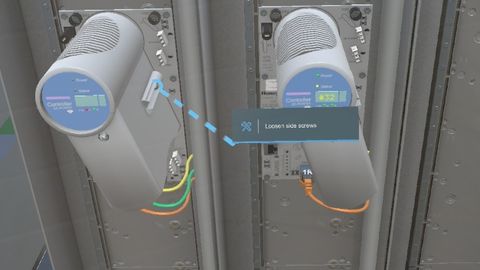
Maintenance of process-related components
Experion Process Knowledge System (PKS) is Honeywell's automation solution for the automation and management of continuous processes and batch plants as well as for safety and electrical control systems. With over 20 million I/O channels worldwide, the C300 controller is used in industrial plants around the world. The controller performs regulation and control functions with cycle times of up to 50 ms without interruption thanks to its redundant design. This redundancy also allows parts to be replaced or the firmware to be updated while the process is running. The training of maintenance personnel for the system is important and must ensure that the C300 continues to run uninterrupted even during preventive routine maintenance or fault diagnosis measures.
However, field personnel have limited practical experience to draw on for these tasks when required. Therefore, Honeywell has developed a fully simulated control system, including an augmented reality-based C300 controller with identical dimensions to the actual controller. This allows field personnel to run through the tasks in a secure environment. Fully integrated with the 'Experion PKS' software, this augmented reality solution enables field personnel to create and load automation strategies and interact with the virtual hardware in the same way as if it were the actual physical hardware. Using an interactive tool for training in a risk-free, realistic environment makes handling much more efficient and effective. Individual adjustments are possible through configurable scenarios and allow the trainer to adapt the learning content to the requirements at the respective location.
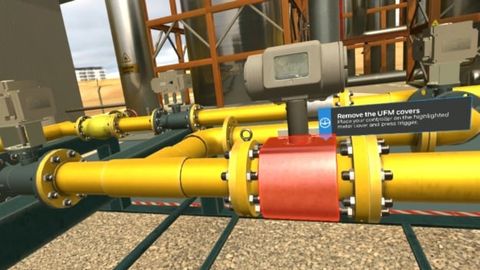
Flow measurement in VR
Multipath ultrasonic flow meters are now well established for flow measurement in large pipelines, especially for custody transfer of natural gas. There are several reasons for this trend - outstanding measurement accuracy, wide measurement range, good resistance to installation effects and cost-effectiveness. As good as these meters are, like all meters they are still affected by the conditions in their environment. A rare but important maintenance activity for the meter is the internal cleaning of one or more ultrasonic transducers due to increasing contamination by black powder.
To reduce downtime, the meters are supplied with a retractable fitting to replace the transducers during operation. This contributes to considerable savings, as the line does not have to be depressurized for maintenance. However, the field personnel have very little practical experience for this task. Honeywell therefore developed a simulated virtual reality for an operating pipeline based on a 'Q.Sonic' multipath ultrasonic flow meter to train field personnel in the practical execution of tasks in a safe environment. As a result, the respective activity in the field is carried out more quickly and safely.


You might also be interested in
The first steps towards digitization
Real-time transparency in the material flow: this was the goal set by Miba when it set out to digitalize its internal logistics processes. But how successful was the close link between ERP and MES in the end? - A field report.
 read more...
How will the IoT change companies in 2020?
How will network technology in companies change in 2020? Axel Simon, Chief Technologist at HPE Aruba, takes a look into the crystal ball
read more...Digital twin revolutionizes maintenance
As virtual representatives of real machines, digital twins open up new possibilities for maintaining and servicing complex industrial plants and systems. A project report.
read more...You can't do without Edge and Swarm
The IoT has changed the requirements for processing data provided by machine sensors and actuators. This needs to happen as quickly as possible - preferably where the data is generated. Edge nodes and swarm computing systems take on this task.
read more...Online machine data under control
Turning huge amounts of data into valuable information - how can this smart industry approach be implemented? Linking PC-based controllers with Matlab and a cloud-based IoT analytics service can be a viable approach.
read more...From modeling directly into the PLC
Despite digitalization and I4.0, the technical functions in a process plant do not become simpler if you break them down to the smallest detail. Nevertheless, the high level of difficulty can be overcome by combining the right tools in the right way.
read more...Where are the new business models?
The necessary new business models are repeatedly cited as the hallmark of an Industry 4.0 environment. But to date, very few companies have seen any of this. Schneider Electric now has a few models up and running.
read more...Why predictive maintenance?
Investments in predictive maintenance systems are worthwhile in order to proactively detect damage. Not only does this increase the service life of a machine, it also opens up new business models for machine manufacturers.
read more...First customer projects via BaSys 4.0
The BMBF project 'Basissystem Industrie 4.0' expired at the end of June 2019. Together with NetApp and Objective Partner, Fraunhofer IESE now offers Industry 4.0 solutions with support and adaptation to customer systems on the basis of this project....
read more...