
Google-Labster cooperation
Virtual reality for 3D laboratory
A cooperation between Google and Labster, a provider of laboratory simulations, has resulted in an app for virtual reality-supported laboratory simulation. Arizona State University will use it to offer a complete online degree course in biology.
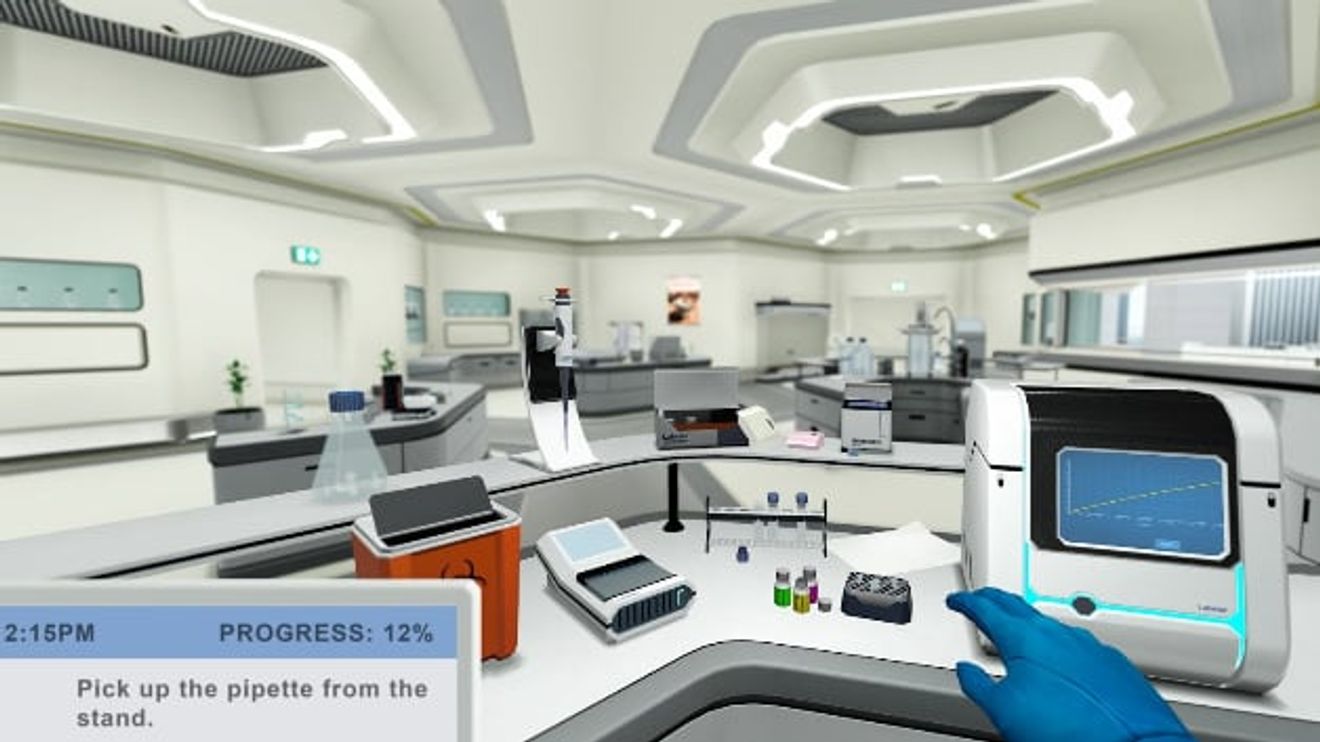
The VR simulations currently give students access to more than 30 differently equipped laboratories. They can carry out experiments safely and without major maintenance costs for the university. Additional functions such as a time-lapse or zoom function simplify long-term experiments. Unlike in a real laboratory, experiments can also be rewound in time in order to correct an error retrospectively.
Laboratory simulations in themselves are not new. Labster has been developing the software for this purpose for some time and it is used at US universities such as Harvard, Stanford and Berkeley, Trinity College in Dublin and Hong Kong University. Until now, however, these simulations have been limited to desktop PCs.
From the desktop to VR glasses
Thanks to the collaboration with Google, the software has been migrated to the Daydream VR platform. This allows students to use it in combination with VR glasses. It is compatible with the Daydream View (Google) and Mirage Solo (Lenovo) models.
The VR version was developed in cooperation with Arizona State University. It tested the virtual laboratory equipment and the teaching content. The university, which already offers various online degree courses, has announced a purely online degree course in biology for fall 2018. VR laboratory simulations for the fields of cellular and molecular biology and animal physiology will be integrated into the curriculum.


You might also be interested in
How user-friendly is virtual reality?
Finding out whether a virtual world is user-friendly used to require time-consuming manual tests with test subjects. But now there is a new technology that automatically detects many user-friendliness problems in virtual spaces.
 read more...
Mechanical engineering invests in these topics
The digital transformation is also in full swing in the mechanical engineering sector. This is the conclusion reached by the VDMA Software and Digitalization Association in its 'IT Report 2018', for which around 100 companies were surveyed on...
read more...For more expertise in the field
Training courses using AR and VR technologies can prepare field technicians for real-life use in industrial plants. But where does it make sense to use it and what requirements are necessary?
read more...Audi tests 'Virtual Reality Holodeck'
Audi wants to use virtual reality to assess the designs of new cars and thus reduce the number of time-consuming physical test models. The technology also offers potential in production.
read more...Facebook announces cheaper VR glasses
Facebook is planning to boost its virtual reality business with an aggressive pricing policy. The online network wants to launch a cheaper version of its Oculus VR glasses, which do not require a PC, at the beginning of 2018 - for 199 US dollars...
read more...ChatGPT in the industry - Part 8
Evaluate and improve code structures
Are gpt-4o and Google Gemini also suitable for evaluating code quality and code structures? Or would developers be better off using traditional software tools? Questions that are worth a closer look.
read more...Test digital simulation live
On September 26 and 27, students at Amberg-Weiden University of Applied Sciences will be able to find out how computer simulation can be applied directly to research and development projects. CADFEM and Ansys invite you to the big live simulation...
read more...Sabine Scheunert is Chairwoman of the Eurocentral Management Board
Sabine Scheunert has been appointed Chairwoman of the Executive Board Eurocentral at Dassault Systèmes. She is actively involved in promoting more women in STEM and IT professions.
read more...The e-paper of issue 05/2024
Strategies for the future are one of the topics covered in the current issue of Computer&Automation. Read about the reforms that associations are demanding from politicians, the opportunities offered by technologies such as ChatGPT and SPE and...
read more...