
M2M Hotspot
'Edge computing' in the Internet of Things
Contrary to many predictions, far fewer components and systems will communicate directly with a cloud in the future. Instead, 'fog computing' or 'edge computing' will enable the local integration of countless data points.

In the industrial IoT, a service-oriented intermediate layer is likely to emerge between the field level and the cloud under the generic term fog or edge computing.
© XtravaganT - fotolia.comAt times, it looked as if every 'thing' in the IoT would be connected to an Internet-based private/public/hybrid cloud in the future. It has since become clear that this concept will not work in many application areas for various reasons. In the Industrial Internet of Things (IIoT), but also in the Industry 4.0 environment, we can already see the change in approach: a service-oriented intermediate layer is being created between the field level and the cloud under the generic term fog or edge computing. It could even completely absorb the entire field level of a smart factory. The aim here is to make individual systems at the edge of the cloud, i.e. in the immediate environment (fog), more intelligent, equip them with special capabilities and have them perform special tasks. This allows the 'things in the fog' to communicate with each other directly or via an edge gateway.
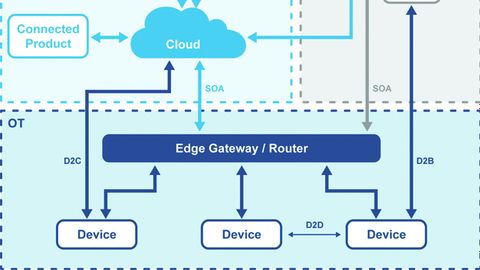
The communication relationships of an IIoT or Industry 4.0-based smart factory: In future, the individual systems will be grouped together in different communication domains.
© SSV Software SystemsTogether with mobile network operators, car manufacturers are already testing cloudlet concepts (mobile edge computing) for autonomous vehicles. Vehicles and traffic signs communicate directly with each other via the radio cell hardware as an edge gateway, without the individual data packets being routed to the internet via a cloud. IBM is even the first leading IoT cloud provider to change its strategy: for a few weeks now, Watson Analytics functions have been offered not only in the cloud but also in the Cisco edge router.
In the USA, the 'OpenFog Consortium', an association dedicated to this specific topic, has already been founded. The founding members ARM, Cisco, Dell, Intel, Microsoft and Princeton University want to further develop 'fog technology' together and disseminate it on the market. They are now also supported by GE and Schneider Electric and numerous other companies and organizations.
Diversity instead of hierarchical communication
Current communication structures in the industrial environment can generally be described as a hierarchical pyramid structure. At the bottom is the field level, above it a control level and, to top it all off, usually several management levels with different tasks. Functionally, it would have fitted in very well to simply add a cloud connection to the top of the pyramid and use the 'cloud' to make predictive analytics decisions or control intralogistics processes, for example.
In the medium term, however, Industry 4.0-based automation solutions will ensure that the hierarchical communication pyramid disappears completely. The three-dimensional RAMI 4.0 model can definitely not be implemented with the existing pyramid structure. However, simply connecting all pyramids with each other via the cloud will not help either. Instead, application architectures with individual communication domains will emerge, in which far-reaching autonomous decisions are also made.
Communication domains replace pyramids
The image illustrates an example of future communication relationships. The entire automation technology (sensors, actuators, controllers) is combined in an OT domain (OT = Operational Technology). At this level, there are various communicative cross-connections (D2D = Device-to-Device), for example OPC UA Pub/Sub via MQTT or IEEE TSN or RFC 1006 for older control systems. The MES and ERP software belonging to a smart factory can be found in the IT domain (IT = Information Technology).
All external components and systems from the Smart Factory perspective are part of a CT domain (CT = Cloud Technology). This is where you will find the partner ERP systems of a particular value chain, smartphone apps, but also products manufactured in the smart factory (see 'Connected Product' in the CT domain) that are used by users anywhere in the world. They now continuously supply operating and status data to the smart factory operator's ERP system via the internet. This data can be used to offer product users additional services, such as Opex-based offers and maintenance contracts for predictive maintenance, and to further develop the product in question based on real user data. To do this, the data must be forwarded to product marketing and development.
There are numerous connections between the individual domains. For example, individual devices are connected directly to MES, ERP and cloud applications or to each other via D2B (device-to-business) or D2C (device-to-cloud). The ERP systems of two companies that work together as value chain partners, for example, will be linked to each other via a B2B data connection (B2B = business-to-business) in the future.
Edge gateways as a link
From the perspective of the aforementioned 'OpenFog Consortium', the entire OT domain of a smart factory forms the 'fog', i.e. the low-level data fog. The module at the boundary between the OT and IT or CT domain plays an important role in this new model. This system, known as an edge gateway or edge router, has special tasks that were previously not available. Here are a few examples:
Sensor data integration: There will be a large number of sensors in an OT domain. Some of these are connected directly to controllers in order to supply actual values to PLC software. Others are used exclusively for machine and process monitoring or to create a process data image that is as complete as possible. An edge gateway forms the link between the sensor data and the data users. To store the sensor data, an edge gateway requires a suitable database for unstructured data (usually a so-called NoSQL database, for example MongoDB) with corresponding interfaces to enable other systems to access this data.
On-site analytics: The data collected at field level can be analyzed directly using mathematical prediction models, for example to automatically determine maintenance dates for individual mechatronic assemblies, machines and systems. This data can be accessed by ERP and MES via OPC UA, for example. Maintenance appointments and spare parts orders can also be entered from the edge gateway using appropriate SOA interfaces.
Vertical integration: In the future smart factory, machines are connected almost directly to ERP software. The intermediate host computer and MES software level is then no longer required. A PLC sends production feedback directly to the ERP or receives parts lists, recipes and work plans from it, for example.
Cloud connection: Ideally, communication between the OT and CT domains should take place exclusively via the edge gateway. This means that not only an inexpensive wireless sensor in the OT environment (e.g. a wireless MBus counter) can operate sophisticated cloud interfaces (e.g. an HTTPS-based REST interface with XML data structures) in the CT world. IT security requirements can also be effectively implemented using the diverse possibilities of an edge gateway.
In connection with vertical integration, an edge gateway can also take on the tasks of an SOA PLC, for example. The conceptual changes expected as a result of Industry 4.0 will lead to some major challenges with current technology. There is a particular need for action with regard to control systems and the way in which individual PLC systems in a plant or manufacturing cell are programmed and enabled to communicate with each other and with higher-level control technology (PLC orchestration in a manufacturing cell). The methodology currently used for this is outdated and no longer suitable for the communication relationships described.
Author: Klaus-Dieter Walter is a member of the management team at SSV Software Systems.


You might also be interested in
Internet of Things - from the sensor to the cloud
What are the building blocks of the Internet of Things? Which technologies, methods and standards are necessary for implementation? The 'Internet of Things - from sensor to cloud' congress provides answers.
 read more...
Parallel to SPS IPC Drives 2016
The 'Automation 4.0 Summit'
Since 2015, the editorial teams of WEKA FACHMEDIEN have been organizing the summit accompanying the trade fair in the Convention Center East of the Nuremberg exhibition grounds. The 'Automation 4.0 Summit' addresses four topics in the Industry 4.0...
read more...Data security solutions no longer sufficient
According to a recent study, a majority of companies believe that their current data security solutions will not be sufficient for the future. Action is needed now, as data loss costs companies almost 900,000 euros per year.
read more...International Federation of Robotics
The three top trends in industrial robotics
According to the IFR, two million new robots will be installed in production facilities worldwide by 2022. Three trends stand out in particular.
read more...Grid operators under pressure to act
The high investment costs for the expansion of the 5G network are causing problems for network operators. The technology consultancy BearingPoint assumes that network operators therefore need to reposition themselves - now!
read more...New series: Three questions for ...
What will 2020 bring?
Under the title "Three questions for ...", computer-automation.de is publishing short interviews with the leading figures in the automation industry on a monthly basis this year.
read more...Smart maintenance still a dream of the future
Maintenance is given too low a priority - this is the conclusion reached by Acatech and Fraunhofer IML in their survey on smart maintenance. Where do companies stand? And what should they tackle as a matter of urgency?
read more...The GAIA-X project
GAIA-X has been launched! That was the message at the digital summit in Dortmund on October 29. The aim of the large-scale digital project is to establish a European cloud for the secure digitalization and networking of industry.
read more...Campus offers for the industry
Deutsche Telekom is now announcing two campus network offers for companies. What's new is that SMEs will also benefit from the offers. And: there are edge cloud solutions for real-time data processing.
read more...