
M2M Hotspot
Suitable networks for the IIoT
New 'Low Power Wide Area' wireless technologies are predestined for the IIoT: they offer a wide range of options for wirelessly connecting any automation devices with the IT platforms - in some cases even without a SIM card or mobile phone provider.

License-free LPWA wireless technology enables significant cost savings to be made on SIM card fees. A single LoRa gateway with a SIM card is sufficient, for example, to enable many hundreds of sensors to transmit data to the cloud.
© SSV Software SystemsUntil recently, the world of wireless communication solutions for 'wide area' (long range wireless) connections in the industrial automation world was quite straightforward. You could get a mobile or M2M SIM card for the network of the desired mobile operator, plug it into a 2G (GSM/GPRS), 3G (UMTS/HSPA) or LTE mobile modem and get started. The decision criteria were straightforward. In addition to the operating costs due to the monthly subscriber fees per modem, the question "Do I still start with GSM/GPRS or do I go straight for LTE?" and the still inadequate network coverage and the associated antenna problems were certainly important.
Everything is different now. The disruptive developments in the license-free bands - for example LoRa and Sigfox for 868 MHz in Europe and 915 MHz in the USA - have made it clear that it is relatively easy to implement 'long range wireless' for the (I)IoT, even without mobile network operators, and above all much cheaper in terms of operating costs. In addition to insufficient 2G/3G/4G network coverage, LoRa and co. have also solved another problem: most IIoT applications only transmit very small amounts of data, such as the fill level of a container to an ERP system once a day. This does not require super-fast LTE, but in many cases the ability to operate a low-power transmitter for many years with a single battery. In this respect, the focus was on 'Kbps' (kilobits per second) instead of 'Gbps' (gigabits per second), i.e. 'low data rate' instead of 'high speed'. The whole thing was called 'Low Power Wide Area' (LPWA). The key points are long range (point-to-point connections over 10 km), low power (maximum battery life of ten years) and low data rate.
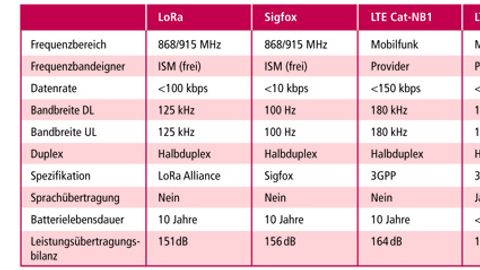
The LPWA radio interfaces can be divided into two groups: Some (for example LoRa and Sigfox) use license-free ISM frequencies. The others (NB-IoT) are integrated into the existing mobile radio infrastructure.
© SSV Software SystemsLoRa, Sigfox and other license-free LPWA approaches are now a real threat to the entire mobile communications value chain in the licensed frequency bands. Especially as they could ensure that established mobile operators are excluded from device/subscriber growth through IIoT applications. This would threaten their existence in the medium term, especially as there is practically no growth to be achieved with traditional mobile communications in industrialized nations. So action was taken remarkably quickly. The 3GPP (3rd Generation Partnership Project, a global cooperation of various standardization bodies for mobile communications) has adopted standards for the IIoT via specification release 13 with LTE-M or LTE-MTC (collective term for 'Machine Type Communication'), which are now available and being tested in practice.
If there are several automation technology elements such as sensors, actuators or controllers (the so-called OT domain - see article "'Edge computing' in the Internet of Things") on a larger factory site that need to transmit some status data to a cloud via radio from time to time, the license-free LPWA radio technology can achieve significant cost savings for SIM card fees. A single LoRa gateway with a SIM card is enough to enable many hundreds of sensors to transmit data to the cloud, for example. The devices can be operated for several years on a single battery due to their low power consumption.
New M2M and IoT standards
In the future, more and more systems will have a fully preconfigured LPWA wireless interface installed ex works and will establish initial wireless contact with the cloud or the respective manufacturer's ERP system during commissioning. The following standards, among others, play a role here:
LoRa: This is a low-power wireless network technology for license-free ISM frequencies - around 868 MHz in Europe. It works with low (adaptive) data rates. LoRa enables point-to-point connections between 2 km (in urban areas), 15 km (suburbs) and up to 40 km (in very rural areas). Users can set up the necessary infrastructure with the connection to the Internet themselves using their own gateways (e.g. LoRa-to-LTE). However, there will also be LoRa service providers who take on this task. In some countries, these are even the established mobile communications companies that offer their own IoT network access via LoRa technology. LoRa is backed by the LoRa Alliance, which has seen a very large increase in membership from various sectors.
Sigfox: also uses license-free ISM frequencies and is technologically very similar to LoRa. The entire Sigfox technology is being driven by a single company that was founded in 2009 and provided with extensive funding by investors. Together with partners, this company also wants to build the infrastructure required for Sigfox. However, with a turnover of just EUR 5 million in 2015 and 190 employees, this is likely to be very difficult.
NB-IoT (LTE Cat-NB1) - Narrowband IoT or LTE Cat-NB1: Based on 3GPP Release 13, this is a particularly low-power LTE MTC technology with a low transmission bandwidth (180 kHz) in LTE frequencies subject to licensing. It is likely to become the most important LPWA technology for established mobile network operators in Europe. NB-IoT does not require any new infrastructure, only software updates to existing network access points.
eMTC (LTE Cat-M1): Also a machine type LTE standard for LTE frequencies subject to licensing on the basis of 3GPP Release 13. Has a higher transmission bandwidth (1.4 MHz) than NB-IoT and is generally also suitable for voice transmission. eMTC is also expected to be widely supported by all major network providers in Europe. To use this MTC technology, it is usually sufficient to equip the existing mobile radio stations with software updates.
EC-GSM (EC-GPRS): Machine Type Communication in GSM frequencies subject to licensing. This technology is also based on 3GPP Release 13 and is roughly comparable to NB-IoT in terms of functionality and bandwidth (200 kHz). For the roll-out of this IoT radio technology, it should also be sufficient to install software updates in the existing mobile radio stations.
oneM2M Rel. 2 Specification: The oneM2M Partnership Project, a worldwide association for global M2M and IoT standards with over 200 members from the entire mobile communications value chain, adopted a new specification with the relevant LPWA communication protocols just a few months ago. According to this, numerous OT systems will probably communicate via HTTP, MQTT, LWM2M and Websocket in the future.
Author:
Klaus-Dieter Walter is a member of the management board at SSV Software Systems.


You might also be interested in
ODVA, OPC Foundation, PI and VDMA
Specification for interoperable energy management published
Precise energy consumption data is needed to achieve climate-neutral production. A consortium has now published a specification for interoperable and efficient energy management in industrial automation and process automation.
 read more...
Manage and secure assets
In today's fast-paced industrial environment, it is essential that production processes run smoothly and efficiently. However, one critical aspect that is often overlooked is the importance of PLC backup and restore procedures.
read more...OPC UA from the cloud to the sensor
OPC UA is also establishing itself as a standard for the exchange of process data between controllers. The next step is now to extend the concepts developed for the controller-to-controller use case for the controller-to-device and device-to-device...
read more...Update brings support for TIA V19
Delta Logic has updated the 'Accon OPC UA Server' software to version 1.4.0.0. The new features include support for TIA Portal projects of version V19 and for the latest firmware for CPUs of the Siemens S7-1200 and S7-1500 controllers.
read more...Automation meets innovation
SPS - Smart Production Solutions will take place in Nuremberg from November 12 to 14. Once again this year, organizers and exhibitors will pick up on the trends in the automation industry and present suitable solutions. The introduction of IT into...
read more...The e-paper of issue 9/2024
The hype surrounding AI is inspiring, but the reality requires a sober approach to the technology. Computer&Automation 9/24 looks at topics relating to AI & security, the EU AI Act, secure IIoT projects and OPC UA FX "From the cloud to the...
read more...The e-paper of issue 08/2024
How can data centers be cooled for AI? How successful is malware programmed with WormGPT? And how can virtualized control systems be integrated into production using TSN? Computer&Automation issue 08/2024 provides answers to these questions and...
read more...TSN in combination with EtherCAT
TSN is an important building block for convergent communication in flexible production. Mastering and integrating existing fieldbus technologies such as EtherCAT is an important part of the transition. An inventory of what is already possible.
read more...TSN - backbone for virtualized control systems?
It is currently a major vision: the virtualization of control systems. This and the next article in this series will address this topic. The decisive prerequisite and content of this article is the connectivity of the control system right down to...
read more...