
SICK
Simple implementation of IO-Link devices
How can the integration of IO-Link devices into control systems be simplified? An open software-based service for all IO-Link device manufacturers automatically creates function blocks and thus significantly reduces the implementation effort.

The integration of IO-Link devices into the individual control environment of a wide range of applications is easy thanks to the 'Function Block Factory' - no special IO-Link knowledge is required.
© SICKAnyone who wants to integrate IO-Link devices into control systems and access device parameters or collect diagnostic information is faced with the task of programming many acyclical requests and having to deal with a large number of different devices, parameters and complex data types. The manual data search and the high level of complexity mean that there is a corresponding risk of errors. The integration of IO-Link devices into control systems has thus far been a challenge that required special IO-Link knowledge.
Sick has found a way to simplify this. The 'Function Block Factory' (FBF) is an open web-based service for simplifying the integration of IO-Link device data into control programs. The software service not only provides function blocks, but also data structures that ensure that no effort is required to declare parameter variables. The FBF also ensures that time-consuming searches for parameters, their indices and data formats are a thing of the past. This saves development time and programming effort, eliminates errors and speeds up commissioning. The FBF concept was initially used internally and proprietarily for Sick's own IO-Link devices over a long period of time. As a result, the functionalities of the version that has been further developed and opened up to the market have been tested and are safe to use. Users can create their own function block libraries with the FBF, with individual parameters and functionalities as well as names and designations that speak for themselves. The tool currently supports ten automation systems and all IO-Link devices from all manufacturers on the market.
This openness becomes important, for example, when the same machine from one manufacturer is equipped with different automation systems for different customers - here the FBF simplifies the complexity of the task and speeds up implementation.
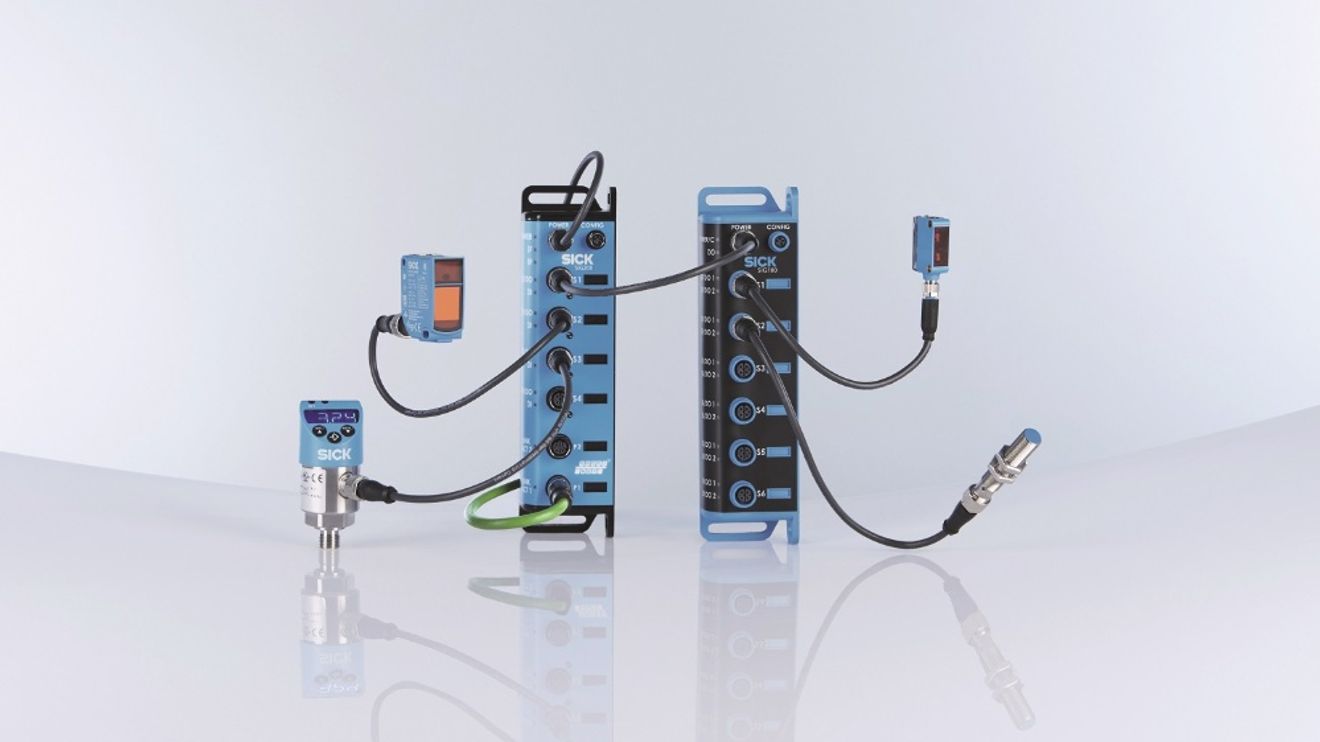
Programming effort minimized
Machine manufacturers, integrators and end customers use IO-Link devices because they expect their extended information, smart functions, diagnostic functions and the ability to solve applications in alternative ways to add value to their machines, systems and processes. For example, device parameters are read out of the control system in order to use them for diagnostic purposes in downstream applications such as condition monitoring. It is also often important to be able to parameterize IO-Link devices during operation, for example when changing production orders or implementing batch size 1 applications.
The FBF helps with the implementation of such tasks: the web-based service enables users to configure and create their individual function block library from the I/O Device Description (IODD) of an IO-Link device in order to reuse it as often as required in their PLC programs. This reduces the programming effort to a minimum. At the same time, errors in communication with IO-Link devices are avoided. The scope and content of the libraries can be individually defined and adapted at any time by freely selecting the available device parameters.

Peter Kamp is Head of Industrial Software Engineering in the Global Business Center Industrial Integration Space at Sick in Freiburg.
© SICKThe process data parser function, which is also generated by the FBF and is part of the library, makes it possible to specifically access each individual piece of information within the IO-Link process data without first having to find out about its structure and content from manuals.
The FBF is accessed via a browser on the Sick homepage either from the website of each Sick IO-Link product or from the service menu.
No need to look it up

The integration of IO-Link devices into the individual control environment of a wide range of applications is easy thanks to the 'Function Block Factory' - no special IO-Link knowledge is required.
© SICKEnumerators (enums) replace meaningless numbers with meaningful designations. This not only speeds up the development process because it is no longer necessary to look things up, but also makes the source code more legible and therefore easier for third parties to understand at a later date. Commissioning times are considerably reduced.
The subindex access function serves to reduce data load and communication time. Instead of complete, complex variables - referred to as records in the IO-Link context - it makes it possible to read out specifically defined sub-variables or change them using the write function. This means that the entire record does not have to be transferred back and forth, but only a fraction of it - the sub-variable. Auto-deselection allows all previously selected variables and parameters to be deselected again with just one command. This speeds up and simplifies the definition of new read ranges in the function block, for example, as not every single selection has to be deleted and one may be overlooked.


You might also be interested in
SPS Connect 24.11. - 10:40 - 11:00 a.m.
Virtual commissioning of sensors as digital components
How can sensors be easily put into operation as Industry 4.0 components? And how can data from different domains (mechanics, parameterization, I/O interface), which are combined in a digital data set, be used and made available?
 read more...
SPS Connect 26.11. - 14:10 - 14:30
Switch off at Safety - no thanks!
Today, safety-related control systems for machines and systems are designed in such a way that a safe state is assumed when faults are detected in safety-related components. This is achieved in almost all situations by switching off the power.
read more...SPS Connect 25.11. - 14:50 - 15:10
Intelligent and smart sensor solutions for factory automation
Intelligent sensors and encoders deliver more than just measurement data - diagnostics, efficient communication and smart tasks. Find out more about technologies that enable new solutions for your applications.
read more...Digital components integrated into the IP network
With the Smart I/O Controller with digital inputs and outputs from Microsens, users can easily integrate devices at the sensor-actuator level into the IP network.
read more...Taking IO-Link further
Automatically detecting all IO-Link devices in a machine, automatically downloading their device descriptions and parameterizing and monitoring them over their entire life cycle independently of the control system and fieldbus - a software tool...
read more...Forecast targets for 2019 achieved
Sensor manufacturer Sick was able to continue its growth in a challenging market environment and increased its sales by 7% in the 2019 financial year.
read more...Control systems: Communication in real time
Zander has added four new features to the ZX09 family of FPGA-based compact industrial controllers.
read more...Cloud services support numerous protocols
Mirasoft provides a cloud service for the automation industry with AnyViz. Controllers, devices and sensors are connected via one of the protocols such as OPC UA, Modbus, Siemens TCP, M-Bus, BACnet, Codesys or MQTT.
read more...Between analog and digital
When measuring with piezoelectric sensors, the charge amplifier is an indispensable link in the measuring chain. As automation progresses, this component undergoes its own evolution from analog to digital.
read more...