
Congatec
The requirements for the Edge
Embedded computers are now often used as edge computers. This is not just a buzzword, but the answer to increased requirements for IIoT-connected devices, machines and systems.

Edge computing platforms have to fulfill significantly more comprehensive tasks than their much less networked embedded predecessors. The Industry 4.0 trend means that IIoT-connected devices, machines and systems have to meet significantly higher, sometimes extremely heterogeneous requirements. For example, classic real-time controllers are increasingly to be connected via Industry 4.0 protocols such as MQTT, CoAP or OPC UA in conjunction with standard Ethernet-based TSN (Time Synchronized Networking). The aim is to generate a platform-independent, service-oriented architecture (SOA) for the tactile internet in order to connect smart I/Os, controllers, HMIs and loggers in the field as well as SCADA, cloud and ERM/MES systems with each other in real time.
More safety is a must
The resulting intensive networking poses security risks, which is why increased security functions must be integrated. This includes a unique forgery-proof identity and ensuring the proper functionality of a device by validating the installed software and updates. However, the use of cryptography for all network communication and the protection of information stored in the working memory are also a must. Not forgetting intrusion prevention and detection systems that analyze data traffic in parallel with the applications.
Edge analytics and IoT connectivity
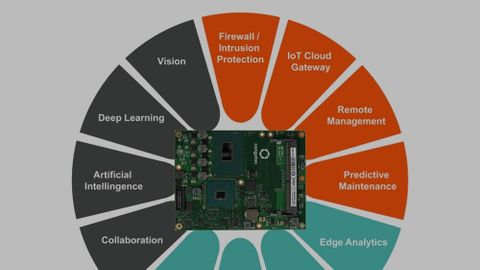
Embedded edge computers are subject to increasingly high, sometimes extremely heterogeneous requirements. With a 6-core computer-on-module, systems can run each of these tasks in one of the theoretically possible twelve virtual machines - assuming suitable hypervisor technology and a sensible allocation of interfaces.
© CongatecThere are also data analysis functions at the edge of the devices, machines and systems so that the manufacturer can offer predictive maintenance or additional paid services for its machines and systems. Only the most important data such as status and alarm messages are sent. If the local analytics are to include image data-based AI, the high computing power and processor-integrated graphics, for example in combination with the Intel distribution of the OpenVINO Toolkit, are a convenient bundle. It can be used to efficiently implement smart biometric functions such as face and gesture recognition, which are currently used in numerous retail, traffic monitoring and smart city applications as well as in industrial machine guidance. Once this edge analytics has been completed, suitable IoT gateways are required for data exchange, which can be designed for 3G/4G/5G or LPWANs such as LoRa, NB-IoT or Sigfox, for example, in order to send alarms to central clouds or connect the systems to agile subscription management and billing systems such as Zuora. In the field of smart robotics, the increased AI performance of the new platforms is also used to implement collaborative robotics applications using the situational awareness gained in this way.
Several heterogeneous tasks in one system
The aim is to provide all these functions in a single embedded edge computing system wherever possible. And since real-time communication via Ethernet also works via virtual machines, OEMs are happy if several interactive controllers can be combined on one hardware platform. This reduces hardware costs, as only one platform is required to control several autonomous, increasingly collaborative or even cooperative robots. Embedded system development has therefore become significantly more complex as a result of edge computing than it was just a few years ago, when stand-alone systems were still largely operated autonomously.
The hypervisor technology

Embedded vision with AI is a major field of development in embedded edge computing, for which Congatec offers a comprehensive ecosystem together with Basler.
© CongatecOEM customers are consolidating several previously separately operated systems on a single embedded edge computer in order to implement the diverse tasks at the edge as cost-effectively as possible.
With virtualization technologies, such as those offered by Congatec based on the RTS hypervisor from Real-Time Systems, this can be implemented particularly efficiently. The fact that Real-Time Systems is also a Congatec AG company facilitates the scalability of the solution, because the support of all current x86 platforms by the RTS hypervisor does not mean that every platform of an embedded computing supplier has been validated and tested in use together with the hypervisor. The same naturally applies to all other components and functions that OEMs require: Ideally, their interaction should already have been tested and validated.
Numerous proof-of-concepts have been implemented recently, which show that the Congatec platforms are capable of both the required individual functions and the interaction of the individual elements. For example, the company has already implemented time-synchronized networking on its SBCs and carrier boards and presented it together with the associated Intel IP at various trade fairs. An Intel Ethernet controller, which is often standard equipment in embedded designs, has already been used for this, which is of decisive importance for the promising future prospects of OPC UA communication via TSN based on open standards. In addition, numerous embedded vision platforms with integrated AI have already been presented in collaboration with Basler, a company specializing in machine vision.
Hardware settings tested for real-time capability

Computer-on-Modules and carrier boards can also merge in large series and thus become a full custom design.
© CongatecSuch functionally validated and comprehensively tested demo platforms can provide developers with an important foundation for their own developments. Appropriate in-house long-term tests for real-time behavior, which can also be provided by OSADL and validated externally, are standard, so that OEMs can obtain validated real-time configurations of the platforms without having to invest their own engineering effort. The interaction with the application itself still needs to be validated, but errors in the hardware settings can be ruled out from the outset. Such special configurations and corresponding tests are increasingly important because processor-integrated thermal management is sometimes at odds with deterministic real-time behavior. If the documentation of the real-time design is already part of the standard delivery, OEMs do not have to concern themselves with these details of the hardware configuration.
Remote management system for edge computers
Comprehensive RAS functions (reliability, availability and serviceability), which can be implemented with specific board management controllers (BMC) to enable out-of-service/out-of-band access to the systems for edge devices, are also important for distributed systems.
This ultimately enables highly efficient remote monitoring, management and maintenance functions to be implemented, as is also common in commercial data centers, in order to optimize the total cost of ownership (TCO) of distributed devices.
Computer-on-Modules with integrated edge functions

Congatec also offers the new 11th generation of Intel Core processors (codenamed Tiger Lake UP3) with hardware-related software support, including customized hypervisor and RTOS/GPOS images.
© CongatecAll these heterogeneous edge functions are included with Computer-on-Modules from Congatec if required. When using such modules, OEMs also benefit from extremelyhigh scalability for ideal balancing of application performance and closed-loop engineering. In addition, these modules come as application-ready platforms that save the developer an enormous amount of time compared to full-custom designs, even in terms of BIOS/UEFI and BSP design for all components. Depending on the application, up to 90 % less engineering work is therefore required if fully developed (eval) carrier boards can be made ready for series production with just a few modifications. It is also no longer a secret that computer-on-modules ensure the long-term availability of dedicated applications, as functionally identical, usually even more energy-efficient and cheaper new modules can be plugged in after the processors have been discontinued; this is thanks to advances in processor technology. Overall, however, it is clear that an embedded computing platform used at the edge must offer much more than this.
More than just ready for application

A lot of music is played here in software support, including the corresponding carrier board designs: Virtual machines, TSN-based real-time OPC UA, security and the root-of-trust built from the hardware, remote management at server level, video and general edge analytics with artificial intelligence. All of this requires many new functions that embedded edge computers must support beyond their inherent computing performance and interfaces and beyond OS support. It is therefore good that embedded computing suppliers are taking care of these hardware-related tasks - even without drifting into cloud-related areas for which there are specific IT and cloud specialists. Application developers working for OEMs thus receive needs-based solution platforms that can obtain all new IIoT-driven edge functions - which are increasingly becoming the standard for embedded edge computers in the industry - from a single source. This is the only way for them to be able to concentrate fully on developing their new applications and not have to struggle with issues that every embedded edge computer should offer today. Incidentally, management consulting, technology and outsourcing service providers increasingly value such application-ready platforms. New business models are therefore bringing other customer target groups for embedded computer technology to light.


You might also be interested in
Consolidation of heterogeneous systems
Tenasys and Real-Time Systems (RTS) present a PC-based software platform that enables the secure consolidation of heterogeneous systems with different operating systems, which also meets strict, deterministic application requirements.
 read more...
Carrier boards in the 3.5-inch form factor
Congatec launches the 3.5-inch carrier board conga-SMC1/SMARC-x86. The size-optimized 'Smarc' 2.1 carrier board is application-ready and can therefore be used immediately in small to medium-sized series.
read more...Investor acquires majority stake from founders
Deutsche Beteiligungs AG acquires the majority of congatec shares from the company's founders. The investor has already had good experiences with another embedded computing company.
read more...The Edge is modular
Industrial edge servers must be extremely flexible in order to integrate the broad spectrum of tasks. Virtual machines in particular are increasingly being used to consolidate a wide range of Industry 4.0 workloads.
read more...Cooled with heat pipe
Congatec presents a new 100 W ecosystem for embedded edge and micro servers. The computing core is a COM Express Type 7 Server-on-Module with 65 to 100 W power.
read more...SMARC modules with up to eight cores
Congatec is launching robust SMARC modules based on the Intel Atom x7000RE processor series (codenamed Amston Lake) and Intel Core i3 processor, which have been specially developed for industrial requirements.
read more...Next-generation AI computing for the edge
Congatec introduces COM Express Compact modules based on Intel Core Ultra processors. The new modules combine heterogeneous computing units such as CPU, GPU and NPU and are therefore particularly suitable for executing demanding AI workloads at the...
read more...New man in the management team
Congatec, a provider of embedded and edge computing technology, has appointed Dominik Reßing as its new CEO.
read more...The decisive factor is the performance class
It is not easy for developers to correctly evaluate the different form factors of the standardization bodies. Depending on the performance class, only a single standard is usually recommended for new system designs. However, there are also...
read more...