
Congatec
The Edge is modular
Industrial edge servers must be extremely flexible in order to be able to integrate the broad spectrum of tasks. Virtual machines in particular are increasingly being used to consolidate a wide variety of Industry 4.0 workloads.

Workload consolidation, which has so far been made possible primarily through the virtualization of servers in data centers, is no longer limited to well air-conditioned server cabinets. It is also increasingly required at the harsh industrial edge: Machine and plant manufacturers as well as industrial end users want to virtualize their Industry 4.0 applications on servers close to the machine and also consolidate the various distributed controllers located in a production cell on these edge servers instead of distributing the tasks across several dedicated systems. The advantage of this approach is that the overall performance of the combined computing capacities can be better utilized and costs can ultimately be saved.
It is not only the pure system costs that can be reduced in this way, but also the costs for maintenance and administration. Consolidation on redundant edge and fog servers also increases reliability and fail-safety. This is because with several distributed systems, the probability of one link in the chain and therefore the entire chain failing is higher. In order to be able to develop the edge and fog servers, which are extremely heterogeneous depending on the application, as efficiently as possible, OEMs need a powerful real-time hypervisor and the right multi-core platform for the application. As the hypervisor generally does not care which server platforms they run on, the first step is to design the hardware modularly in order to enable application-specific price and performance balancing in addition to load balancing. This hardware-based modular approach can already be found in numerous edge systems, from the smallest gateways to large industrial servers.
LPWAN gateway for LoRa
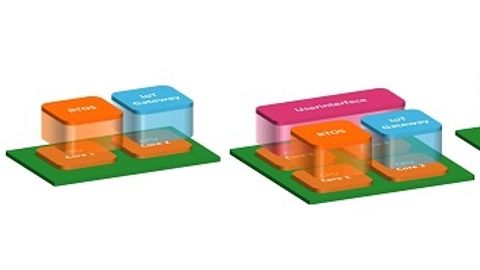
Consistently modular edge and fog servers offer real-time hypervisor support and are based on server-on-modules to enable application-specific price and performance balancing in addition to load balancing.
© CongatecIn the low-power segment, one example is the LoRa gateway from Expemb, which is used in a wide variety of LoRa scenarios and must therefore be able to implement a wide range of edge logic. In the factory, for example, LoRa is used for autonomous smart IoT sensors or for tracking load carriers in order to monitor and optimize the internal flow of goods.
Because the gateway has integrated Computer-on-Modules - in this case a Qseven module with Intel Atom processors - it offers a flexible hardware setup that can be flexibly equipped on both the hardware and software side to meet the most heterogeneous technical requirements for LoRa-based IoT applications. In addition to load balancing, application-specific price and performance balancing is also possible.
Edge server for smart grids
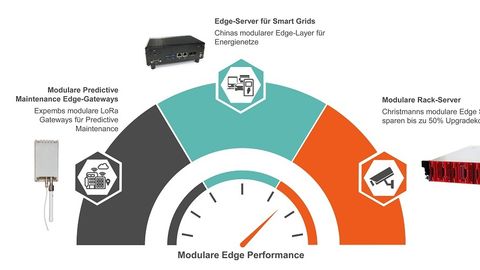
Several manufacturers have already developed their innovative edge server systems on a modular basis: from small LoRa gateways to smart grid edge servers and industrial rack servers.
© CongatecHigh flexibility is also required of box PC-based edge servers. In China, for example, an edge layer for a distributed smart grid management system is currently being rolled out in collaboration with Tencent's IoT partners for the energy market. Such an edge server design must be able to manage distributed energy generators and consumers in factories and industrial parks, for example. As the installed base is generally heterogeneous, the hardware also needs to be developed in a modular way. Computer-on-Modules according to the COM Express Type 7 standard are used here. The first systems use modules with Intel Xeon D15xx processors with up to 16 cores and 32 threads. Alternative configurations are based on Intel Atom C3xxx processors. With up to 16 cores, these processors are also ideal for all installations in which a wide variety of workloads need to be consolidated. However, whether a Xeon or Atom processor is used in the system makes a decisive difference in terms of both energy consumption and costs.
Modular rack servers for harsh environments
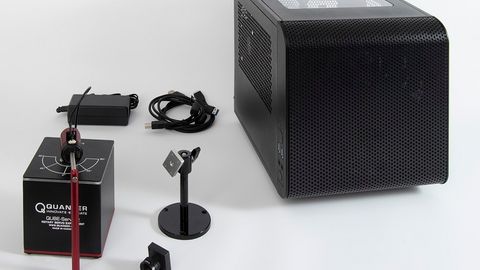
The 'Realtime Workload Consolidation Starter Set' from Congatec is based on a COM Express Type 6 module with an Intel Xeon E2 processor and the real-time hypervisor from Real-Time Systems.
© CongatecIn addition, significantly more powerful rack server designs can be built on a modular basis and investment costs can be reduced thanks to standardized Computer-on-Modules - whether for control computers in robotics, for production cells or even complex packaging and machine tools.
One example of such modular designs are the servers from suppliers such as Christmann, which were also developed on COM Express Type 7 Server-on-Modules and for which designs based on the upcoming COM-HPC-Module standard are also planned. In addition to their perfect suitability for the specific task, their high scalability for future performance upgrades speaks in their favor: the second server generation, which will certainly be required after three to five years due to rapid technological progress, should only cost around 50% of the initial investment, as in most cases only the processor module needs to be replaced. Christmann rackmount servers can be flexibly equipped with up to 27 CPU micro-servers to fully utilize the resulting significantly reduced TCO.
The three examples - from the LoRa gateway to the modular rack server - illustrate the advantages that Computer-on-Modules and Server-on-Modules offer for edge gateways and edge servers.
Realtime Workload Consolidation Kit

Without real-time hypervisor support, however, this is only half the battle. For this reason, it is also necessary for the hardware to have corresponding software support. This is why Congatec has developed an Intel-certified RFP (ready for production) kit for workload consolidation together with Intel and Real-Time Systems. Certified by Intel since March 2020, the kit targets the next generation of vision-based collaborative robotics, automation controllers and autonomous vehicles that need to handle multiple tasks in parallel - including situational awareness using deep learning-based AI algorithms.
The solution-enabled platform is based on a COM Express Type 6 module equipped with the Intel Xeon E2 processor and integrates three pre-configured virtual machines to demonstrate that even real-time applications can run on a virtual machine while restarting another application on the same system. To enable the platform to implement consolidation efficiently, it not only provides the basis for flexible networking via customized carrier board layouts. The kit also supports communication via Time-Sensitive Networking (TSN), which is essential for real-time processing in tactile internet environments with the upcoming 5G technologies and the introduction of 10+ GbE networks on the factory floor.
TSN support included
TSN technology comprises a number of standards, such as IEEE 802.1q for virtual LANs via Ethernet, Time Aware Shaping (TAS) standardized in IEEE 802.1Qbv for guaranteed minimum transmission latency or real-time synchronization via the Precision Time Protocol (PTP) defined in IEEE 1588. The Precision Time Protocol is responsible for time synchronization between the nodes. A master specifies the time.
The individual slaves synchronize their clocks down to the two-digit nanosecond range. This allows packets to be time-stamped and sent based on these synchronized clocks. As a result, PTP networks can synchronize down to this two-digit nanosecond range, whereby the travel times of the IP packets naturally also have an influence on the actual real-time behaviour of an application. With the Intel Ethernet interface I219, the clocks are synchronized purely on the basis of this standard component with the resulting advantages: Firstly, it is cast in hardware and secondly, no additional pro-prietary applications or further dedicated hardware are required. The 'Realtime Workload Consolidation Starter Set' can be ordered from Congatec and the Intel Marketplace.


You might also be interested in
Investor acquires majority stake from founders
Deutsche Beteiligungs AG acquires the majority of congatec shares from the company's founders. The investor has already had good experiences with another embedded computing company.
 read more...
Freely programmable interfaces
MC Technologies is offering a new version of its industrial-grade multifunctional gateways from the 'MC100' family for 4G mobile communications. The MC100 GPIO is Microsoft Azure certified and based on Linux.
read more...Load monitoring simplified
Lütze is upgrading the 'LCOS' bus couplers for universal application options so that the LOCC-Box-Net modules can now also be operated in addition to the electronic load monitors of the LCOS CCI family.
read more...Use of individual OPC UA address spaces
Information models define the available objects such as variables and alarms in accordance with the OPC UA standard. Version V1.20 of Softing's Datafeed Secure Integration Server now offers the option of loading certain models.
read more...Configure managed switch via browser-based web interface
The managed switches in Weidmüller's Advanced Line support protocols such as STP/RSTP or SNMP and can be configured intuitively via a browser-based web interface.
read more...Machine learning makes it necessary
Industrial IoT and edge computing play a key role in the digitalization of production. But why is machine learning so important in this context?
read more...The e-paper of issue 5 is available
Our latest issue 5 is now available as an e-paper. Read now what's happening in the automation industry in May.
read more..."Three questions for..." - the May edition
Corona: Change as an opportunity
People react differently to the coronavirus and its consequences. What is it like in everyday working life? In the new part of our "Three questions for..." series, we look at this topic and asked automation experts for their opinions.
read more...'Automation-first' versus 'cloud-first'
Automation is an important intermediate step on the way to a cloud-first strategy. A plea for a culture of automation.
read more...