
Congatec
Three innovations at embedded world
At embedded world 2021 DIGITAL, Congatec presented a starter set for COM-HPC, new low-power SMARC modules and a COM Express Compact module based on AMD Ryzen embedded processors.
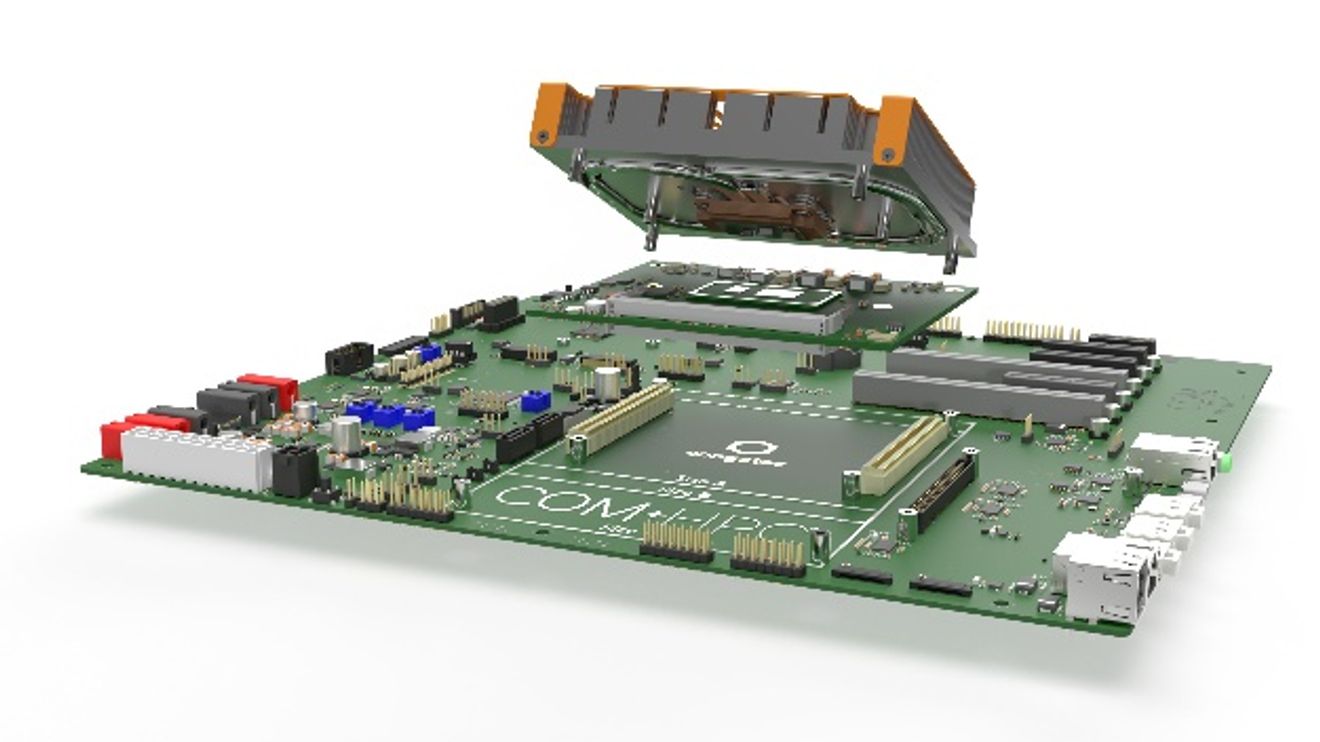
The heart of the COM-HPC starter set: the Conga-HPC/cTLU computer-on-module, which is available in various processor configurations. With the respective cooling solutions, they can be adapted to the entire TPD range of the 11th generation Intel Core processors, which can be configured from 12 to 28 W.
© CongtecThe COM-HPC specification was finally approved on February 24th and is available for download on the PICMG homepage. Almost simultaneously, Congatec is providing a starter set for the standard. The starter set for COM-HPC is optimized for modular system designs that use the latest high-speed interface technologies such as PCIe Gen4, USB 4.0 and ultra-fast up to 2x25 GbE connectivity as well as the integrated MIPI-CSI-Vision functionality. It is based on Congatec's PICMG COM-HPC Computer-on-Module Conga-HPC/cTLU, which is equipped with 11th generation Intel Core processor technology (codenamed Tiger Lake).
"This new high-end embedded module generation is aimed at system engineers who are developing broadband networked edge devices that are emerging as part of the development of the industrial IoT," says Martin Danzer, Director Product Management at Congatec. Target markets include medical technology, automation, transportation and autonomous mobility, as well as image processing-based inspection and video surveillance systems.
The various Ethernet configuration options of the starter set range from 8x 1GbE switching options and 2x 2.5GbE including TSN support to dual 10GbE connectivity. Congatec also offers AI support for MIPI-CSI-connected cameras from Basler, making IIoT and Industry 4.0-connected embedded systems more applicable. AI and inference acceleration can be achieved on the CPU using Intel DL Boost-based vector neural network instructions (VNNI) and on the GPU using 8-bit integer instructions (Int8). Also attractive in this context is the support of the Intel Open Vino ecosystem for AI, which contains a function library and optimized calls for OpenCV and OpenCL kernels to accelerate deep neural network workloads across platforms and thus achieve faster and more accurate results for AI inferences.
Embedded vision and AI
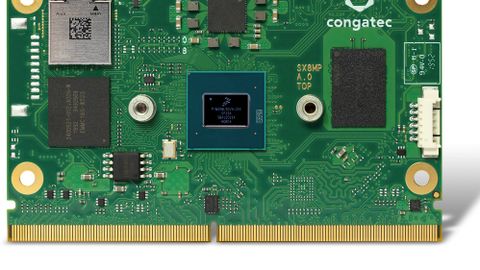
With the low-power SMARC 2.1 Computer-on-Modules, robust 2 - 6 Watt low-power platforms for vision and AI can be realized.
© CongatecCongatec also presented new low-power SMARC 2.1 Computer-on-Modules with NXP i.MX 8M Plus processor for industrial edge analytics, embedded vision and artificial intelligence (AI). With its machine and deep learning capabilities, the new ultra-low-power Conga-SMX8-Plus module enables industrial embedded systems to see and analyze their environment for situational awareness, visual inspection, identification, monitoring and tracking as well as gesture-based, touchless machine operation and augmented reality.
The technical highlights of the Arm Cortex-A53-based quad-core processor platform include the integrated Neural Processing Unit (NPU) for AI computing power and the Image Signal Processor (ISP) for parallel real-time processing of high-resolution images and video streams from the two integrated MIPI-CSI camera interfaces. The SMARC module ecosystem - such as application-ready 3.5-inch carrier boards and Basler camera and AI software stack support - complements the product launch for a fast proof-of-concept. Vertical markets for these credit card-sized low-power vision and AI modules are expected to be found everywhere from smart farming and industrial manufacturing to retail and from transportation to smart cities and smart buildings.
Energy-saving 24/7 systems
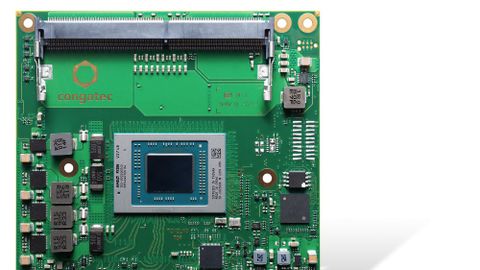
The energy consumption of the AMD Ryzen Embedded V2000 processors is very low compared to their computing power. The Conga-TCV2 computer-on-modules are therefore predestined for solar-powered stationary, mobile and autonomous systems
© CongatecThe Conga-TCV2 is also being launched on the market based on AMD Ryzen Embedded V2000 processors. With twice the performance of the previously launched AMD Ryzen Embedded V1000, the COM Express Compact Computer-on-Module module sets a new performance-per-watt benchmark, delivering its maximum performance improvement in 15-watt TDP designs. Compared to modules with AMD Ryzen Embedded V1608B processors, Conga-TCV2 modules deliver a performance increase of 97% (V2516) to 140% (V2718) with up to 8 cores. Thanks to the new 7 nm Zen 2 cores, single-core performance has also increased by between 25% and 35%. This makes the new modules a perfect candidate for performance increases in 24/7 connected and fanless embedded systems used on a wide variety of industrial edges. Typical applications include multifunctional industrial edge gateways, digital signage systems, gaming terminals and infotainment platforms. With up to 40% more GPU performance[2] for up to 4x 4k60 graphics at 15 watts and comprehensive GPGPU support, medical multi-display systems for imaging in the operating room as well as machine vision and machine learning systems are further target markets.


You might also be interested in
The requirements for the Edge
Embedded computers are now often used as edge computers. This is not just a buzzword, but the answer to increased requirements for IIoT-connected devices, machines and systems.
 read more...
The Edge is modular
Industrial edge servers must be extremely flexible in order to integrate the broad spectrum of tasks. Virtual machines in particular are increasingly being used to consolidate a wide range of Industry 4.0 workloads.
read more...SMARC modules with up to eight cores
Congatec is launching robust SMARC modules based on the Intel Atom x7000RE processor series (codenamed Amston Lake) and Intel Core i3 processor, which have been specially developed for industrial requirements.
read more...Next-generation AI computing for the edge
Congatec introduces COM Express Compact modules based on Intel Core Ultra processors. The new modules combine heterogeneous computing units such as CPU, GPU and NPU and are therefore particularly suitable for executing demanding AI workloads at the...
read more...New man in the management team
Congatec, a provider of embedded and edge computing technology, has appointed Dominik Reßing as its new CEO.
read more...The decisive factor is the performance class
It is not easy for developers to correctly evaluate the different form factors of the standardization bodies. Depending on the performance class, only a single standard is usually recommended for new system designs. However, there are also...
read more...Choose your cover photo favorite of the year 2022
Which cover picture did you like best this year? Take part in a short survey and optionally in the prize draw for great prizes.
read more...The top articles in October 2022
The top articles in October are outside the norm, showing the advantages of scalability, intelligent robots and the role of AI in control. In addition, the top article from September remains a perennial favorite. Read for yourself.
read more...Functionally secure with x86 multicore
Power-hungry sensor technology in applications with functional safety (FuSi) means that embedded computing platforms must also increase their performance - multicore processors are therefore increasingly coming into focus.
read more...