

Networking
The renaissance of the fieldbus
Will OPC UA in particular, in combination with TSN, replace fieldbuses? Andreas Huhmann, who is also a board member of SmartFactory-KL, questions this theory and makes a plea for the long-serving fieldbus.
I recently attended an IoT conference. Dressed in a suit and white shirt, I felt a bit like I'd stepped out of the past, but to be honest, I still felt really comfortable in the company of these enthusiastic and largely young people. As a speaker, I talked about the architecture of smart factories and the importance of IoT devices for Industry 4.0. In my presentation, I particularly emphasized the importance of production modules encapsulated with a management shell for highly flexible and therefore modular production facilities. My conviction that the architecture of smart factories can be implemented very well with fieldbuses within these production modules and is compatible with Industry 4.0 can be seen as a migration strategy to pure IoT-based automation. However, my thesis that fieldbuses will remain relevant for production tasks in the long term will be interpreted by some as conservatism.
A key experience
Another presentation on artificial 'urban trees' - large filter walls against particulate matter that are overgrown with mosses and automatically watered - showed a kind of IoT solution within a 'smart factory' that I described. As the manufacturers of these filter walls come from the IT world, it was obvious for them to build everything with devices such as Raspberry Pi and Arduino. This should ultimately result in great transparency in the application and enable global condition monitoring. The speaker described the steps taken to optimize automation. The extent of the problem of the availability of IT devices and self-made I/O modules and their software only became apparent very late in the project. The stakeholders also realized that the actual aggregation level is not a single valve for irrigation, but that the entire tree, i.e. this level, actually needs a management shell. And with all the problems, the IT-heavy players had to realize that their difficulties had already been solved in principle - by using a fieldbus! The players realized that high availability and a simple structure could ultimately be achieved using the established fieldbus - it is standardized, industry-adapted, highly available and, above all, easy to use!
The enthusiasm of the speaker, who was literally enraptured by the discovery of the fieldbus, told me that I was not so wrong with my theory about the future of the fieldbus in smart factory production modules. Because I maintain that the many new IoT applications that are emerging will generate additional growth in the fieldbus market. However, the prerequisite is that the fieldbuses must be prepared for the future - for example by defining a management shell in accordance with the RAMI reference architecture.

The fieldbus and smart factories
All of the production facilities that are being created as part of the fourth industrial revolution are characterized by a modular structure. The structure of these smart factories can be derived from requirements that are directly related to the fourth industrial revolution. In addition to the requirements of the market, which are essentially characterized by the end customer - individualization of products - and the operator of the plant - demand for changeability of the production plant - there is a third influencing factor, which can be described as a paradigm shift in automation. The universal use of information and communication technology and the introduction of services are the main technological drivers here. The result of market requirements and technological change are modular, service-oriented production plants, the smart factories. The definition of aggregation levels for the use of service-based architectures is expedient in order to find a solution that makes economic sense and is optimally tailored to the performance of the plant.

The Smart-FactoryKL technology initiative in Kaiserslautern operates the world's first Industrie 4.0 demonstrator which, in addition to the latest technologies - such as RFID for digital product memory and OPC UA for new services - shows the encapsulation of existing function-based automation in the form of an administration shell. The structure is based on a system architecture that can be transferred to other smart factories in the form of a general master plan. The aggregation at module level has an impact on the structure of the modules, or not. In the Smart FactoryKL, it has been shown that in most cases the structure can be implemented with a fieldbus - and 100% Industrie 4.0-compliant.
The fieldbus and Industry 4.0 applications

The importance of edge devices: They will increasingly take over the analysis of data close to the sensors.
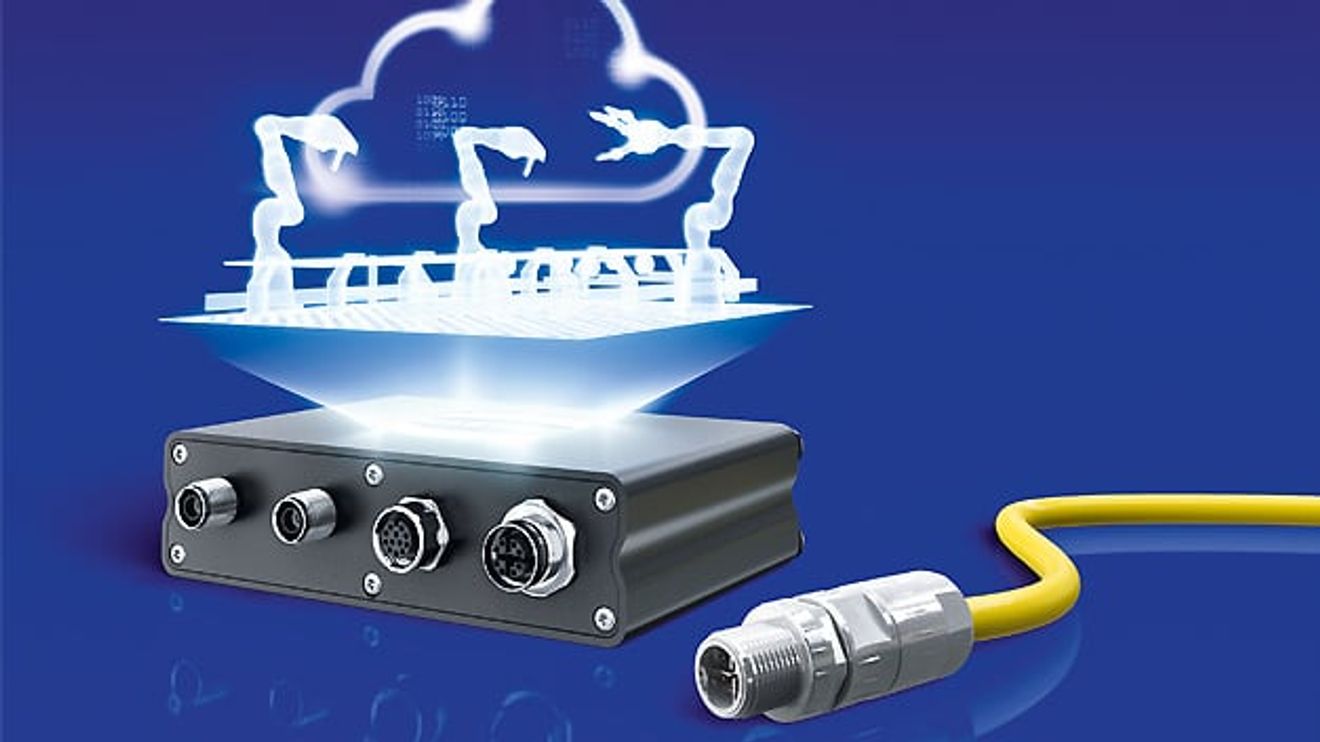
© HartingIn addition to aggregation at module level, sensor data is needed as a source of valuable information for additional services such as predictive maintenance. These can be obtained directly from sensor data using edge devices within the modules. This creates a complete IoT ecosystem. Edge devices - such as the Mica from Harting - can be used to generate information. On the one hand, this lends itself to existing systems, which is usually considered a brown-field approach. However, this approach, which was considered as part of the retrofit, should be evaluated much more generally, as has been shown in the SmartFactoryKL. This is because highly complex value creation networks of the future will always be characterized by a certain degree of heterogeneity. Industrie 4.0 should therefore be seen as the glue that holds everything together. This involves machines that are conventionally fieldbus-based and therefore do not initially provide any IoT interfaces, but also those that are generally IoT-based. There is a broad spectrum of possibilities in between. Edge devices that are used for services such as predictive maintenance, asset management, spare part management and energy management will therefore retain their relevance alongside the PLC optimized for automation.
Of course, the PLC will also be available with a bundle of services. However, it is not crucial that there is a universal device; it is much more important that the data from the field level is collected in a standardized way and that the various experts have a development environment in which they can work optimally and efficiently. In the automation environment, this will continue to be functionally oriented in the future and not service-oriented in most cases. And this will continue to be possible with the use of fieldbus technology, not least because a large part of the semantics often required for fieldbuses such as Profinet is already available thanks to the device profiles. An important task for the future will be to give edge devices in the production environment access to the fieldbus data, as it is obvious that they will also use the fieldbus. This means that future edge devices will speak fieldbus languages and understand their device description in the form of GSDML files.
The future of the fieldbus
All of the statements summarized suggest that the fieldbus will remain the basis for production, both for automation and for new Industry 4.0 IoT applications. However, this statement is also an appeal to the fieldbus user groups to focus more on the new applications, as the sensor data of the fieldbus is the food of the new Industry 4.0 applications.
Author:
Andreas Huhmann works as Strategy Consultant Connectivity & Networks at Harting and is a board member of Smart-Factory-KL.


You might also be interested in
The first steps towards digitization
Real-time transparency in the material flow: this was the goal set by Miba when it set out to digitalize its internal logistics processes. But how successful was the close link between ERP and MES in the end? - A field report.
 read more...
How will the IoT change companies in 2020?
How will network technology in companies change in 2020? Axel Simon, Chief Technologist at HPE Aruba, takes a look into the crystal ball
read more...Digital twin revolutionizes maintenance
As virtual representatives of real machines, digital twins open up new possibilities for maintaining and servicing complex industrial plants and systems. A project report.
read more...You can't do without Edge and Swarm
The IoT has changed the requirements for processing data provided by machine sensors and actuators. This needs to happen as quickly as possible - preferably where the data is generated. Edge nodes and swarm computing systems take on this task.
read more...Online machine data under control
Turning huge amounts of data into valuable information - how can this smart industry approach be implemented? Linking PC-based controllers with Matlab and a cloud-based IoT analytics service can be a viable approach.
read more...From modeling directly into the PLC
Despite digitalization and I4.0, the technical functions in a process plant do not become simpler if you break them down to the smallest detail. Nevertheless, the high level of difficulty can be overcome by combining the right tools in the right way.
read more...Where are the new business models?
The necessary new business models are repeatedly cited as the hallmark of an Industry 4.0 environment. But to date, very few companies have seen any of this. Schneider Electric now has a few models up and running.
read more...Why predictive maintenance?
Investments in predictive maintenance systems are worthwhile in order to proactively detect damage. Not only does this increase the service life of a machine, it also opens up new business models for machine manufacturers.
read more...First customer projects via BaSys 4.0
The BMBF project 'Basissystem Industrie 4.0' expired at the end of June 2019. Together with NetApp and Objective Partner, Fraunhofer IESE now offers Industry 4.0 solutions with support and adaptation to customer systems on the basis of this project....
read more...