
Cables / wires
The neural pathways of Industry 4.0
More and more sensors that generate more and more data, plus more and more high-resolution cameras - and all increasingly in moving applications: The demands on transmission technology are growing rapidly with Industry 4.0! Cables must not become a bottleneck.

Cables are the 'nerve tracts' that make Industry 4.0 possible in the first place. In the age of digitalization, enormous amounts of data have to be transmitted; and increasingly under difficult conditions, such as in robots, where the cables are constantly bent around tight radii and twisted. This means enormous stresses for conductors and braided shielding, which are essential for the transmission properties of data cables.
Up to now, communication systems with a data transmission rate of 100 Mbit/s have mainly been used in industry. In new installations, however, networks with gigabit performance are increasingly being installed, because when high-resolution cameras are used for quality control, for example, 100 Mbit/s may no longer be sufficient. Even if this is not yet necessary in many applications today, it is often a question of investment protection: data networks with more reserve capacity also allow the system to be expanded at a later date.

The insulation process is particularly important in order to guarantee the best properties. The insulation material is foamed with nitrogen, which reduces the dielectric constant and allows thinner cables with higher data rates.
© U.I. LappUntil recently, category 6A (Cat. 6A) cables were the measure of all things, as the bandwidth of up to 10 Gbit/s is sufficient for the foreseeable future. However, Category 7 cables, such as the so-called 'Etherline Torsion Cat. 7' from Lapp, offer further advantages beyond the pure bandwidth. This is the first torsion-capable and also Profinet-compliant high-speed cable for industrial Ethernet, which achieves data rates in accordance with Cat. 7 - i.e. 10 Gbit/s in the frequency band up to 600 MHz. This puts the user on the safe side when using high-resolution cameras.
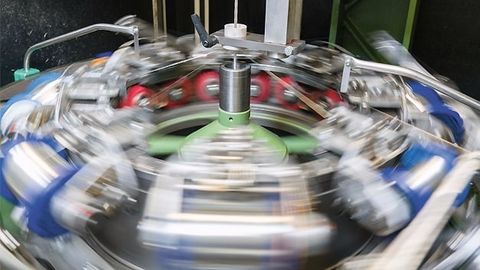
Effective shielding is essential for high data rates. For this purpose, fine tinned copper wires are braided around the cores of the cable.
© U.I. LappDue to the high frequencies, the reduction of interference by twisting the wire pairs is not sufficient for data transmission; instead, the individual wire pairs must also be shielded with a metallized foil. This reduces crosstalk between the pairs, i.e. mutual interference. Insulation also plays an important role for the highest data rates and frequencies. This is why the high-speed cable has so-called skin-foam-skin insulation of the individual cores. Three extruders apply three layers of insulation to the stranded copper wire. Extruders 1 and 3 create a smooth skin on the inside of the strand and on the outside of the insulator, while the layer in between is foamed with nitrogen gas under high pressure during extrusion. This reduces the dielectric constant of the insulation.
In addition to this physical method, there is another, more cost-effective way to produce skin-foam-skin insulation: a chemical method in which chemical additives are mixed into the raw material and outgassed when heated during the extrusion process. However, the size and distribution of the bubbles cannot be controlled as well as with the physical method. However, it is essential to achieve the correct size and even distribution of the nitrogen bubbles in order to maintain the function in the long term.
Why Cat. 7 at all?
But why should users use Cat. 7 cables at all? At first glance, they are not faster. However, they offer advantages through better values for crosstalk attenuation (NEXT) and the permissible frequency range. A higher frequency range has the practical advantage for the user that with a de facto transmission frequency of 417 MHz, there is more buffer for a 10 Gbit/s transmission - a Cat. 7 connection with a frequency range of up to 600 MHz is therefore less sensitive than a Cat. 6A connection with 500 MHz at the same maximum data rate of 10 Mbit/s. The NEXT limit value for Cat. 7 is 61.9 dB at 500 MHz and 60.7 dB at 600 MHz. For Cat. 6A, the limit value is 34.8 dB at 500 MHz and 33.6 dB for a frequency range of 600 MHz that is not specified in the standard.
This means that they are more forgiving of installation errors, for example, than Cat. 6A cables. Damage or ageing of the cables also has less of an impact. The full bandwidth can still be achieved and the applications can be operated with greater reliability.
In addition, the Etherline Torsion Cat. 7 has a robust and halogen-free PUR outer jacket. PUR is particularly abrasion-resistant and therefore ensures a long service life. To be suitable for use in robotics, a cable must also be torsion-resistant, i.e. it must not be damaged when twisted around its own axis. The shielding is particularly at risk here: the fine copper wires that make up the shielding braid, as well as the foil shielding of the individual wire pairs, break if the torsion is too strong - with the result that the intended data rates can no longer be achieved.
The torsion resistance of the shielding depends on the angle of the braid and the foil: they must not be too flat for moving applications. In the case of the cable in question, these angles were optimized after extensive testing so that it can be twisted 180° in both directions over a length of one metre, at least five million times, without the shielding losing its effectiveness. The cable does not require a filler. Filler cords are often used to achieve a uniformly round shape of the cable or to support a stable arrangement of the wire pairs in the cable. However, fillers also mean additional work during assembly, as they have to be cut off individually. With the new torsion cable, this task is performed by a polyethylene separating cross, which can be removed with a single cut. This makes it easier to assemble standard connectors such as M12 X-coded or RJ45 in the field.
Particularly noteworthy is the low characteristic impedance of ±5 % - the standard allows for around ±15 %. This improves the transmission properties over short distances, ensures successful certification of the transmission channel using a cable tester and reduces the risk of having to rework the installed cable connection. Last but not least, the cable is UL CMX listed, meaning it can be used in North America for applications inside and outside control cabinets, in moving machine parts and in robots for media cabling.
Particularly in sectors such as mechanical engineering, robotics, railroad technology and the food industry, the durability of the cables is also of essential importance. The standards known from Ethernet cables in the office, for example, are not sufficient in the factory, where they come into contact with oils and cleaning agents and are moved back and forth millions of times. In addition, the EMC load from drive systems is very high. In short, users expect installed cables to still function perfectly even after ten years and, in the case of the data cables mentioned above, still meet the Cat. 7 specification. Less robust cables, on the other hand, can lose their properties over time. Although this does not necessarily lead to short circuits, fine cracks may form in the insulation or shielding, which leads to increased interference during transmission and thus to a drop in the data rate.
Seamless quality management is therefore a must for data cables used in industry. At Lapp, for example, quality tests are carried out at every stage of cable production - from stranding, stranding and braiding to sheathing and labeling - either automatically using sensors or manually by appropriately trained employees. The data from the quality tests is then collected in the computer and can be traced at any time.
Author:
Irmgard Nille is a freelance journalist in Hamburg.


You might also be interested in
The first steps towards digitization
Real-time transparency in the material flow: this was the goal set by Miba when it set out to digitalize its internal logistics processes. But how successful was the close link between ERP and MES in the end? - A field report.
 read more...
How will the IoT change companies in 2020?
How will network technology in companies change in 2020? Axel Simon, Chief Technologist at HPE Aruba, takes a look into the crystal ball
read more...Digital twin revolutionizes maintenance
As virtual representatives of real machines, digital twins open up new possibilities for maintaining and servicing complex industrial plants and systems. A project report.
read more...You can't do without Edge and Swarm
The IoT has changed the requirements for processing data provided by machine sensors and actuators. This needs to happen as quickly as possible - preferably where the data is generated. Edge nodes and swarm computing systems take on this task.
read more...Online machine data under control
Turning huge amounts of data into valuable information - how can this smart industry approach be implemented? Linking PC-based controllers with Matlab and a cloud-based IoT analytics service can be a viable approach.
read more...From modeling directly into the PLC
Despite digitalization and I4.0, the technical functions in a process plant do not become simpler if you break them down to the smallest detail. Nevertheless, the high level of difficulty can be overcome by combining the right tools in the right way.
read more...Where are the new business models?
The necessary new business models are repeatedly cited as the hallmark of an Industry 4.0 environment. But to date, very few companies have seen any of this. Schneider Electric now has a few models up and running.
read more...Why predictive maintenance?
Investments in predictive maintenance systems are worthwhile in order to proactively detect damage. Not only does this increase the service life of a machine, it also opens up new business models for machine manufacturers.
read more...First customer projects via BaSys 4.0
The BMBF project 'Basissystem Industrie 4.0' expired at the end of June 2019. Together with NetApp and Objective Partner, Fraunhofer IESE now offers Industry 4.0 solutions with support and adaptation to customer systems on the basis of this project....
read more...