
Infrastructure
Connectors for Industry 4.0
What makes the passive installation component connector an intelligent infrastructure component? - A look at the development of an often misunderstood machine component.

The industrial connector was developed in the middle of the 20th century in response to the need in mechanical engineering to be able to separate different machine segments. This basic function was primarily needed on the control cabinet so that it could be disconnected from the machine once it had been assembled. The control cabinet itself emerged with electrical automation - in other words, with the third industrial revolution - and became the 'home' of the control system. Thanks to decentralization through the fieldbus, the number of interfaces increased significantly. The connector remained primarily in the hands of the machine and system manufacturer - even if the user increasingly formulated their requirements in the course of maintenance.
In the age of Industry 4.0 and the associated major changes brought about by smart factories, which ultimately result in the modularization of machines and systems, the connector is now undergoing a fundamental transformation: while decentralization was a structural change in assembly and installation technology driven by the manufacturer of machines and systems, modularization is a change initiated by the operator due to increased flexibility. It primarily affects the operator of the machine, who wants to reconfigure his system as easily as possible. This task no longer falls within the remit of the automation engineer or maintenance technician; instead, it is the operator who wants to use their system via plug-and-produce. As an integral part of a smart infrastructure, the industrial connector needs new, intelligent functions. Ultimately, the smart factory connector itself will become smart. It is no coincidence that international standardization committees have founded a standards working group for this purpose.
The path to the smart factory

The 'Smart Factory KL' set up in Kaiserslautern is the reference for analyzing future requirements for connectors. Industry 4.0 technologies are implemented and tested in this demonstration plant.
© HartingAll changes in production were and are based on increasing efficiency. Not least as a result of lean production, everything that disrupts the actual production process has been dispensed with. With reference to the first three industrial revolutions, mass production became increasingly detached from the actual recipient: While it was still common in a craft business for the right material for the product to be manufactured to be selected in the workshop together with the customer, modern production is in many cases completely decoupled from the customer. Today, in the course of the 4th industrial revolution, all participants are once again united in a - virtualized - world. This world is the Internet, and its future information space is the cloud. Manufacturing, which also has a virtual representation, is the smart factory. It interacts with all participants and thus offers approaches for new services. The modularization of the factory helps to combine the efficiency of mass production with the requirements for maximum flexibility for the individualization of products.
The effects on the industrial connector caused by the modularization of production systems are shown in detail below. In order to understand the current development step towards the smart connector, it is necessary to look at the development phases of the industrial connector in detail.
1950 - 1980: Centralization
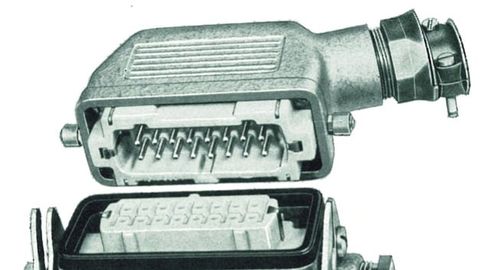
The 'Han' industrial connector from 1967 is considered a classic among the interfaces on the switch cabinet that replaced the fixed connection.
© HartingThe introduction of electric drives in machines also makes their supply and control necessary. Control and supply functions are combined in a central control cabinet, which later also houses the PLC. The industrial connector makes it possible to separate the control cabinet and mechanical areas of the machine from each other. The machine is assembled, tested, dismantled, loaded and reassembled at the customer's premises. Industrial connectors eliminate wiring errors and simplify and speed up assembly at the user's premises. All sensors and actuators - designed in extra-low voltage - are routed to the central control cabinet. Connectors for drives are also required. Ideally, the number of plugging cycles is three: plugging after assembly at the machine manufacturer, plugging during commissioning at the customer and the final unplugging at the end of the machine's life cycle. The 'Han' industrial connector from Harting fits into this period.
1980 - 2010: Decentralization
Thanks to the introduction of the fieldbus, all signals no longer have to be hard-wired into the central control cabinet. Sensor data can now be recorded decentrally and actuators can also be switched on. This leads to decentralized installation technology, which is characterized by IP67 devices on the one hand and decentralized, smaller control cabinets on the other. Data, power and individual signals must be transmitted to these decentralized control cabinets - which often contain entire function groups and are therefore a precursor to the modularization discussed today - preferably in a pluggable design.

The modular design of the 'Han-Modular' industrial connector offers a scalable interface for all lifelines (power, data, signal) of a modular system.
© HartingThe real benefit of decentralization is the simplification of installation and relates to the machine manufacturer's phase in the life cycle. In addition to combination connectors, this results in the 'Han-Modular' from Harting, with which a decentralized control cabinet, but also an entire functional unit such as a robot, can be made pluggable in one interface.
The user of these connectors remains the specialist for the automation and electrical installation of the machine. This means that the overall handling of these connector families is also comparable with the classic 'Han' industrial connectors of the previous period.
2010 - 2030?: Modularization
In contrast to decentralization, the current modularization is driven by a new intention that is related to Industry 4.0. The 'smart factories' of the future will be much more adaptable than today's factories. Mass customization' is the production of batch size 1 according to the standards and efficiency of mass production. This goal can only be achieved if production can be adapted to individual requirements in the shortest possible time. The structure in the form of modules with standardized interfaces is therefore obvious.
Such a module must be supplied with all lifelines, as is the case with 'Han-Modular', for example. Additional requirements arise when the connector is no longer part of the installation, but of the standardized infrastructure:
- When creating the installation, it is first of all important to dimension the connector interface in such a way that all connections necessary for the operation of the installation module are established. In the data area, these are connections for Gigabit Ethernet as well as for the 400 V, 24 V and compressed air supply. In the 'Smart Factory KL' demonstration system, safety information is also transmitted separately via signal contacts.
On the module side, the interface is mounted on a decentralized control cabinet, for example. A clear standardization of this interface is necessary for the companies responsible for the modules.
- Other requirements for the connectors are on the agenda for system operation: in a smart factory, for example, there is no classic commissioning that ends with a fixed system configuration. In principle, a smart factory is constantly being recommissioned or reconfigured even during operation. This means that all possible configurations cannot be tested during conventional commissioning. This has implications: The reconfiguration must be simple and safe to implement. It cannot be assumed that specialist personnel specially trained for this purpose will be available. The reconfiguration must therefore be supported by integrated management. Since adding and replacing a module always implies plugging in the connector, the connector takes on a central, new significance.
The integrated new basic functions can be categorized as follows: a) functions for simple docking and undocking and b) functions for high-availability operation.
Docking and undocking

The 'Han-Modular Infrastructure Box' is the intelligent T-piece of the 'Smart Factory'. It offers all the functions for docking and undocking modules and provides the data for services such as predictive maintenance and energy management.
© HartingWhen undocking, the first step is to identify the correct connector, which must be accompanied by a visualization. The second step is to unplug the connector - but this is only possible if the system is in a suitable state. For the modern connector, this means that it must know its status through communication with the system. And it should only be possible to plug it in if the operating status allows it. From the perspective of personal safety alone, pulling under load must be prevented. This means that either a device for de-energizing the plug or an active release is required. These functions are not necessary for decentralization, as maintenance is trained to prevent plugging under load. Active locking, visualization and communication are functions that transform the connector from a passive installation component into a smart infrastructure component.
Docking and undocking management is one of the services implemented in the connector called 'smart Han'. Its other services include energy management, for example. Another service is added for safe operation, which should be seen in the context of asset management: it is crucial for the operation of a system that the correct module is used for docking, which can be used sensibly in the production process and at the same time does not overload the infrastructure. This requires identification of the module, which can take place directly in the connector. And the module should only be supplied with power once the identification process has been completed.
Smart modularization

The 'smart Han Port' user interface enables diagnostics and active performance management in the modular 'Smart Factory' system.
© HartingIn the 'Smart Factory KL', a decentralized IP65 structure of the infrastructure with 'infrastructure boxes' was tested in a first step. The aim was to map all functions in a highly integrated manner in a T-piece. The infrastructure box enables a flexible system structure in line topology. However, a centralized infrastructure setup in a star topology is still often found today, which requires connection boxes on parts of the building. These connection ports therefore represent the decisive migration step from today's passive distributions to a smart infrastructure.
In the medium term, it can be assumed that the functions of the I40 connector will become the standard, which will be set by user groups such as Smart Factory KL and incorporated into international standardization. In the working group for connectors with additional functions set up by the VDE, discussions to date have shown that the connector, which is transforming into an Industry 4.0 component, will be given a management shell in accordance with RAMI, the reference architecture model of the I40 platform. This involves the standardized integration of smart connectors in applications in order to enable new services. The specific design of the smart connector will remain manufacturer-dependent. Harting, for example, presented the study of a highly integrated wall bushing for control cabinets at the Hannover Messe 2016. The starting point was the infrastructure box, from which the 'smart Han' functionalities were derived. A key feature - in addition to functions such as electronic switching, consumption measurement, web server, database, OPC UA and DO/DI/PLC interfaces - is in particular the safety for people and systems, even in the event of incorrect operation, thanks to integrated plug and locking detection.
Author:
Andreas Huhmann works as Strategy Consultant to the Management Board of Harting in Espelkamp.


You might also be interested in
Internet of Things - from the sensor to the cloud
What are the building blocks of the Internet of Things? Which technologies, methods and standards are necessary for implementation? The 'Internet of Things - from sensor to cloud' congress provides answers.
 read more...
Parallel to SPS IPC Drives 2016
The 'Automation 4.0 Summit'
Since 2015, the editorial teams of WEKA FACHMEDIEN have been organizing the summit accompanying the trade fair in the Convention Center East of the Nuremberg exhibition grounds. The 'Automation 4.0 Summit' addresses four topics in the Industry 4.0...
read more...TSN and OPC UA in the industry
Is OPC UA in conjunction with the real-time Ethernet variant TSN "the" communication standard for Industry 4.0-based manufacturing? The speakers at the "Industrial Ethernet TSN" congress on September 27 in Stuttgart will get to the bottom of this...
read more...The first steps towards digitization
Real-time transparency in the material flow: this was the goal set by Miba when it set out to digitalize its internal logistics processes. But how successful was the close link between ERP and MES in the end? - A field report.
read more...How will the IoT change companies in 2020?
How will network technology in companies change in 2020? Axel Simon, Chief Technologist at HPE Aruba, takes a look into the crystal ball
read more...Digital twin revolutionizes maintenance
As virtual representatives of real machines, digital twins open up new possibilities for maintaining and servicing complex industrial plants and systems. A project report.
read more...You can't do without Edge and Swarm
The IoT has changed the requirements for processing data provided by machine sensors and actuators. This needs to happen as quickly as possible - preferably where the data is generated. Edge nodes and swarm computing systems take on this task.
read more...Online machine data under control
Turning huge amounts of data into valuable information - how can this smart industry approach be implemented? Linking PC-based controllers with Matlab and a cloud-based IoT analytics service can be a viable approach.
read more...From modeling directly into the PLC
Despite digitalization and I4.0, the technical functions in a process plant do not become simpler if you break them down to the smallest detail. Nevertheless, the high level of difficulty can be overcome by combining the right tools in the right way.
read more...