
Industry 4.0
Where does the mechanical and plant engineering sector stand?
Around six years of discussions about Industry 4.0 are now behind us: Where does the industry stand today? What challenges still lie ahead? Dr. Hans Krattenmacher, Head of Development for the Electronics division at SEW-Eurodrive in Bruchsal, gives his opinion.

"There is still a great need for discussion, especially when it comes to networking," says Dr. Hans Krattenmacher from SEW-Eurodrive.
© SEW-EurodriveDr. Krattenmacher, what is your definition of Industry 4.0?
Dr. Krattenmacher: For me, Industry 4.0 is a collective term for many trends, some of which have been around for a long time. At SEW, for example, we got involved in the topic back in 2005 - only it was called something else back then. At that time, we asked ourselves the question: What will intralogistics look like in the future? The background to this was the realization that intralogistics had been working in a similar way for 30 years. Although the technology on the component side had changed time and again - i.e. faster inverters, faster controllers, bus or Ethernet communication instead of binary communication - the fundamental way in which things were conveyed had remained the same. At some point, the intralogistics experts realized that in order to be able to react to the increasing need for flexibility in production, they would have to structure their intralogistics differently. This means, among other things: We need to move away from the rigid or stationary conveyor technology that has been common up to now towards mobile, self-organizing concepts. Another trend results from the increasing individualization of products in all areas of our lives. One example: refrigerators used to be 'white goods' that came off the production line. Although this is still largely the case today, we know of a very large manufacturer in China where fridges can now be configured - in terms of height, width, color and so on. This means that there is a much greater variety of products - similar to what is already common practice in the automotive industry. This makes it increasingly difficult for manufacturers to predict which product will actually be successful. As a result, they have to be able to react much more quickly to changes in the factory, which ultimately leads to completely different principles. Against this backdrop, another core trend of Industry 4.0 for me - then as now - is the modularization of factories based on the Lego principle. It determines a lot of things.
Finally, there are also topics such as the 'Internet of Things', 'Big Data' and 'Cloud'. The really interesting thing is that they all lead to similar results in terms of how automation solutions need to be structured in order to work. In other words: strict modularization or segmentation of the systems, which in turn are self-configuring and can be networked largely independently of the infrastructure. In a nutshell: the path to networking automatically forces factories to modularize.

Various studies repeatedly emphasize that SMEs in particular are not sufficiently prepared for Industry 4.0 - do you agree with this?
Dr. Krattenmacher: I'm afraid you have to agree with that. If we look at mechanical and plant engineering, we are currently seeing considerable shifts in value creation. In other words, the value that the end customer perceives and is prepared to pay for will increasingly move away from the amount of steel and hardware used towards the application solution - which is often synonymous with software!
This is certainly a change that we will all have to come to terms with. In the consumer sector, we are already further ahead here - see marketplaces such as Airbnb and Uber, for example: one doesn't own a single hotel, the other doesn't own a single cab or driver - but both have an enormously high financial valuation based on their online platform alone. If we are not careful, why shouldn't we face a similar situation? In other words, at some point it will no longer be our 'substructure' - i.e. the machines and systems - that make up the value that is paid for, but instead a superordinate platform that ensures the construction, operation, availability and ultimately also the maintenance of an entire logistics center, for example.
In this respect, I would say that although we are prepared in certain areas when it comes to industry and digitalization, we are not yet on the way to this all-encompassing approach. And the smaller a company is, the less those responsible are aware of what is coming their way. Smaller machine and plant manufacturers in particular urgently need to think about this: What does my module have to look like so that it can play a part in the big smart factory or so that it can be connected to it? There needs to be a lot more speed here!
How is this supposed to happen - given that medium-sized mechanical engineering companies in particular are still strongly characterized by mechanics and software experts are in short supply, not to mention special IT expertise?
Dr. Krattenmacher: That is correct. In this respect, automation technology providers are called upon to show these companies how they can cover the topic of Industry 4.0 even with few resources. Incidentally, the rapid increase in complexity in recent years is not just to do with Industry 4.0. Where previously two simple contactors were sufficient for safety-relevant applications, for example, functional safety suddenly had to be integrated into the control system. Even before that, the switch from binary to bus communication had to be mastered and then network communication was added. Although all this has brought many convenient functions, it has not reduced complexity, but increased it further.
In the future, we will be talking about topics such as predictive maintenance, condition monitoring and energy management. This increases the complexity to a level that a small machine manufacturer with perhaps a single PLC programmer can no longer keep track of. Against this backdrop, we at SEW have already made a start with our products in the electronics sector in the past, for example by removing functions from the PLC and integrating them into our drive technology in advance. Similarly, we now see it as our duty to reduce complexity for users as far as possible when it comes to the Smart Factory.
Where do you see the most urgent fields of action in this context - not only for SEW, but also for suppliers of automation components as a whole?
Dr. Krattenmacher : One task that everyone faces is the question of how to actually set up the networking of the modular factory. Again, a comparison with the consumer world: if you buy a WLAN printer today, it has everything it needs to be able to integrate itself into a network: It knows what it is called, can communicate this to the network and download the necessary drivers itself if required. As a rule, everyone on the network can then access the printer immediately. The security problem is also partially solved. In industry, we are still a long way from such a network structure.
However, when Industry 4.0 dissolves the classic automation pyramid in favour of an integrated or cross-level network structure - and we are definitely talking about that - things like data storage or engineering access will have to be completely reorganized. There are approaches in this regard, but there is still no clarity.
What do you think are the most promising approaches?
Dr. Krattenmacher: In terms of horizontal connectivity - i.e. from manufacturing module to manufacturing module - OPC UA could actually establish itself as the standard. The issue of vertical connection of products is less clear. There are many initiatives here, such as Ethernet TSN. However, a clear distinction must be made as to whether we are talking about TSN at the transport layer - traditionally level 2 in the OSI model - or the project planning level, which is somewhere between levels 5 and 7. There will still be a lot to discuss, especially with regard to the latter. I fear that many manufacturers will find it difficult to position themselves differently than in the past, simply because of tradition. It must also be clear to everyone that standardization is fundamentally desirable and right. But if, in the end, every manufacturer has to do the same thing anyway, users will no longer have different products on the market, which could ultimately mean more standstill than progress.

"Smart Factory cannot be implemented at the 'green table' - you have to test it in practice," says Dr. Hans Krattenmacher from SEW-Eurodrive.
© SEW-EurodriveIf not everything is clearly defined even on the supplier side - for example in terms of connectivity or software interfaces: How are users supposed to implement Industry 4.0 in their factories?
Dr. Krattenmacher: This task cannot be accomplished at the 'green table' alone. So many questions arise in the course of implementation that can only be answered if you try it out yourself and learn as you go - just as we were able to do in our own factories with the support of the management. You don't have to fool yourself: Not everything works right away the first time. But that's simply part and parcel of plunging into something completely new. However, those who dare to do it anyway are usually one step ahead. Pushing the topic away in the hope that it will take a long time is certainly not a solution!
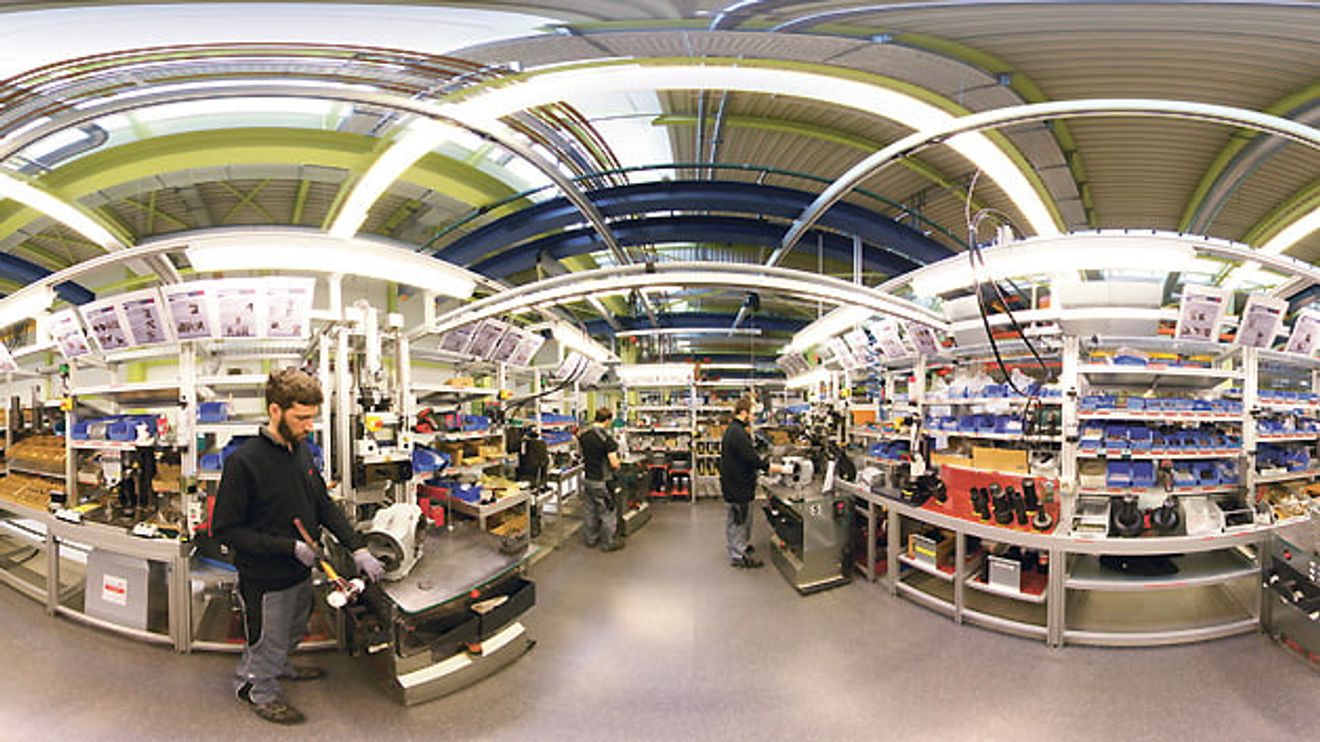
During the last Hannover Messe in particular, a number of visitors approached us with the question: Who can advise us on how to set up a factory based on the principles of Industry 4.0? This confirmed our decision to expand our Industry 4.0 consulting approach. Our advantage here is that we can not only show power points or white papers, but also take those seeking advice to our own 'Industry 4.0 showcase factory' in Graben and demonstrate our ideas of the modular factory in real operation. At this stage, this has nothing to do with selling components or software.
Keyword components: Will the pure component manufacturers fall by the wayside if everything happens in software in the future?
Dr. Krattenmacher: They will not fall by the wayside. Fortunately, there is still a crucial difference in industry compared to the consumer world: factories will continue to run for 10, 15 or 20 years, not just two. For this to be possible, the long-term availability of components will always play a role.
If the two - the software and the hardware - can be cleverly combined, manufacturers can ultimately protect their hardware via the software. Take a look at this very large manufacturer with bitten apples, for example, who manages this brilliantly. Its business models are primarily software-based, but at the same time linked to its hardware.
How do you manage this balancing act at SEW?
Dr. Krattenmacher: One thing is clear: we want to continue to produce and sell geared motors in the future. We are faced with the challenge of developing new concepts in order to ultimately safeguard existing business models on the one hand, but also to identify new business models on the other. The first prerequisite for this is that we prepare our product portfolio for the smart factory - in other words, we are talking about the digitalization of electromechanics.
We first took this step with Movi-C, our new modular automation system. In other words, we have initially introduced a digital data channel between the inverter and motor - not to be confused with the encoder interface! There is a data node in the motor itself, which gives free rein to the world of ideas. This means, for example, that an electronic type plate can be stored in this data node, via which the motor - and now we are back to the comparison with the printer - can be put into operation completely automatically within a few seconds. This node is also equipped with all the necessary IT and data communication structures to make quality or system data stored in the node available to any participants via the network. We will consistently apply this approach to our entire product portfolio over the next few years.
Is this 'digital channel' between the motor and the inverter an open or standardized interface?
Dr. Krattenmacher: It is currently still proprietary. Simply because there is currently no standardized solution that meets our requirements in this regard. In other words: If we want to guarantee over 20 years or more that the data can be read out and always transmitted correctly, the only way to do this today is with the solution we have developed ourselves. From the inverter to the control technology, however, we will rely on standardized interfaces.
Finally, back to the starting point - the change in intralogistics in particular. SEW has been working on mobile assistance systems for some time now. When will these be available on the market?
Dr. Krattenmacher: We are currently in the final stages of series development for the next generation of vehicles. First of all, we will be equipping our two new factories with them, namely Graben and the electronics factory here in Bruchsal. At the same time, the first customer projects are already underway. In short, we will definitely be able to deliver in 2018 and continue to build up our project sales at the same time. The same applies to this topic: we will continue to learn from practical field applications, optimize the solutions accordingly and gradually expand them according to the modular principle.


You might also be interested in
The first steps towards digitization
Real-time transparency in the material flow: this was the goal set by Miba when it set out to digitalize its internal logistics processes. But how successful was the close link between ERP and MES in the end? - A field report.
 read more...
How will the IoT change companies in 2020?
How will network technology in companies change in 2020? Axel Simon, Chief Technologist at HPE Aruba, takes a look into the crystal ball
read more...Digital twin revolutionizes maintenance
As virtual representatives of real machines, digital twins open up new possibilities for maintaining and servicing complex industrial plants and systems. A project report.
read more...You can't do without Edge and Swarm
The IoT has changed the requirements for processing data provided by machine sensors and actuators. This needs to happen as quickly as possible - preferably where the data is generated. Edge nodes and swarm computing systems take on this task.
read more...Online machine data under control
Turning huge amounts of data into valuable information - how can this smart industry approach be implemented? Linking PC-based controllers with Matlab and a cloud-based IoT analytics service can be a viable approach.
read more...From modeling directly into the PLC
Despite digitalization and I4.0, the technical functions in a process plant do not become simpler if you break them down to the smallest detail. Nevertheless, the high level of difficulty can be overcome by combining the right tools in the right way.
read more...Where are the new business models?
The necessary new business models are repeatedly cited as the hallmark of an Industry 4.0 environment. But to date, very few companies have seen any of this. Schneider Electric now has a few models up and running.
read more...Why predictive maintenance?
Investments in predictive maintenance systems are worthwhile in order to proactively detect damage. Not only does this increase the service life of a machine, it also opens up new business models for machine manufacturers.
read more...First customer projects via BaSys 4.0
The BMBF project 'Basissystem Industrie 4.0' expired at the end of June 2019. Together with NetApp and Objective Partner, Fraunhofer IESE now offers Industry 4.0 solutions with support and adaptation to customer systems on the basis of this project....
read more...