
Jumo
Use in hazardous areas
Especially in chemical or process engineering processes, additional heating is required to maintain or increase the temperature in order to optimize the complex processes of modern industrial plants. But what needs to be considered here?

The basic physical property of resistance heating makes it possible to use electric heating exactly where it is needed, and only when additional heating is required. Existing systems or process sequences can also be retrofitted with flexible electric heating with little technical effort.
This is where the Heidelberg-based company Winkler comes into play. The company plans, designs and builds flexible electric heating systems. In addition to standard solutions, special customer-specific heating solutions have also been implemented, particularly for explosion-proof heating systems. This product area, which is particularly characterized by guidelines, regulations and standards, has grown enormously in recent years; products used here require a so-called system certification. This means that the operator of a potentially explosive system no longer has to have the supplied heaters additionally approved, as this has already been carried out in advance by the manufacturer (Winkler). Meaningful documentation is also included in the scope of delivery. This is an important part of the explosion protection document to be kept by the operator of the system in accordance with § 6 of the Hazardous Substances Ordinance (GefStoffV) 'Information determination and risk assessment'.
Ex-relevant components
As part of a conformity assessment procedure in accordance with Directive 2014/34/EU and an ignition hazard assessment, the ex-relevant components installed in the heaters were also subjected to a special selection process. Winkler installs certified Pt100 resistance temperature sensors from Jumo with an EC type examination certificate in the explosion-proof heaters. These Pt100 resistance temperature sensors are an important safety component of the heating system, as the built-in resistance heating conductor would exceed the maximum permissible temperature without appropriate regulation and limitation. Such an excess temperature would not only damage the heating itself, but would also become a dangerous source of ignition.
According to EN 60079-14 Chapter 13 'Electrical heating systems' Annex F 'Installation of electrical trace heating systems', safety devices such as sensors for temperature detection must be provided for controllers and limiters to prevent high temperatures that could potentially become sources of ignition. This is referred to as a monitored design (Annex F 4.3), which requires a temperature control device to limit the surface temperature. This temperature limiter must work independently of the temperature control and switches the heating system off permanently before the maximum permissible surface temperature on the heatsealing band is exceeded. Manual restarting is only possible once the operator of the system has ascertained what caused the safety device to respond and that the corresponding maximum temperature of the hazardous area is no longer exceeded.
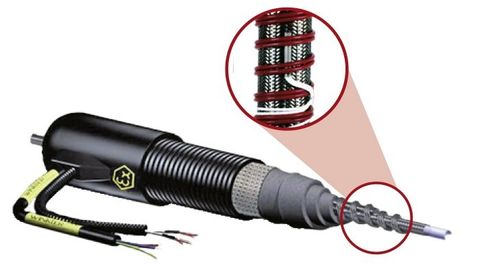
The temperature sensor must be positioned at the hottest point in the process.
process. This hotspot is, for example, between the heating conductor and the object to be heated in a heated hose. When the resistance of the heating conductor is heated by applying a voltage, the PT100 resistance thermometer reacts with a change in resistance, which is evaluated in a corresponding control and monitoring device operated in or outside the hazardous area and, depending on the design or programming, initiates appropriate measures. This not only allows the operating temperatures of the process to be regulated, but also prevents ignition sources in the heating system caused by uncontrolled excess temperatures.
Safely monitored

In addition to professional installation and correct positioning of the resistance sensors in the flexible heating system, appropriate process stability is also crucial. This mainly depends on the evaluation unit used. One option is the safety limiter/monitor with ATEX approval 'safetyM STB/STW' from Jumo. It can be used to implement a compact single-channel safety controller with selectable redundant input signals for standard signals and temperature sensors, which is particularly suitable for smaller applications such as special machines and individual applications with a low signal density and number of signals.
The 'exTherm-DR' two-point controller with Ex II approval from Jumo is also designed for use in electric heating systems. Corresponding type-tested sensors can be connected directly to the intrinsically safe Ex (ia) measuring input for resistance thermometers, thermocouples or current unit signals, so that the use of a barrier is no longer necessary. In addition to the 'controller' relay output, the device also has a second relay output for limit value monitoring.


You might also be interested in
Reliable transmission of switching signals
The two-channel Ex-i isolating switching amplifier from Jumo was specially developed for the float switches of the 'Nesos' series, but also supports all proximity sensors according to the NAMUR standard.
 read more...
IO-Link technology included
With the 5028A charge amplifier, Kistler is launching a charge amplifier that can output analog signals from piezoelectric sensors as digital measurement data using IO-Link technology.
read more...The self-sufficient fault detective
How can operators of existing interlinked machines and systems create a holistic data picture of the technical behavior and environmental variables of their production lines? One approach is a mobile sensor system developed by Fraunhofer IOSB-INA.
read more...Can be used in fresh and salt water
Thanks to the latest optical technology of fluorescence quenching and digital signal processing, the 'Digiline O-DO S10' from Jumo enables long-term stable measurements of oxygen and temperature.
read more...Sensor & Vision 2020 dossier - simply smart
Our dossier on the latest trends in sensor technology and industrial image processing is now available as an e-paper or for download. Many exclusive reports, application examples and new product lines are waiting for you.
read more..."Three questions for..." - the May edition
Corona: Change as an opportunity
People react differently to the coronavirus and its consequences. What is it like in everyday working life? In the new part of our "Three questions for..." series, we look at this topic and asked automation experts for their opinions.
read more...Additional managing director at Jumo
The managing partners of Jumo, Bernhard Juchheim (69) and Michael Juchheim (51), have appointed Dimitrios Charisiadis (52) as the third managing director with effect from January 1, 2020.
read more...Products of the year - The e-paper special
"Products of the Year 2023" goes interactive: the new e-paper including video news is here! The winners of the readers' poll have been chosen and in our interactive special edition you will find all the winning products at a glance and exclusive...
read more...Measurement technology - The winners
Whether it's heat, pressure or flow, measurement technology allows the system operator to keep an eye on everything. The winning products in the 'Measurement technology' category show which measuring principles can help with this.
read more...