
Industry 4.0
The NIKI 4.0 project
German small and medium-sized enterprises have so far been very cautious when it comes to Industry 4.0. The NIKI 4.0 project aims to enable these companies to experience the first Industry 4.0 benefits in their own real production.

The aim of the NIKI 4.0 science project can be described in very simple terms as "Industry 4.0 to try out". The three research partners involved in NIKI 4.0 - short for "Non-disruptive kit for the evaluation of Industry 4.0" - are Hahn-Schickard, Offenburg University of Applied Sciences and the FZI Research Center for Information Technology. They want to develop a simple, low-cost and risk-free toolbox of software and sensor technology for SMEs, which are often still sceptical about Industry 4.0, in order to make the benefits of networked production tangible. The actual production systems and machines remain unchanged and the manufacturing processes are not initially affected by the additional data acquisition. The aim is to enable SMEs to try out a part of Industry 4.0 in their own production in an uncomplicated way and assess its added value.
Skeptical middle class

Among other things, the NIKI 4.0 project uses augmented reality on smartphones to make machine data comprehensible.
© FZINetworked production offers great potential for process improvements and cost reductions - from production planning to the maintenance of a production plant. Networking and the associated data exchange are drivers for process improvements both within production and along the entire value chain - for example with suppliers and customers.
Nevertheless, small and medium-sized German companies have so far tended to hold back when it comes to Industry 4.0 because they fear high investment and conversion costs. With the project results from NIKI 4.0, it should now be possible to experience the first Industry 4.0 benefits in their own real production. The NIKI 4.0 system only provides information about machine statuses and does not intervene in the regulation and control of the systems. Such actuator technology would only be the next step for SMEs towards becoming an Industry 4.0 company.
I4.0-capable quite simply
Existing production systems are to be made Industry 4.0-capable at low cost using sensor technology and information couplers. At this point, Hahn-Schickard contributes specific expertise and develops sensors for data collection. The researchers rely on battery-operated sensors in order to be able to dispense with disruptive cables for both energy and data transmission.
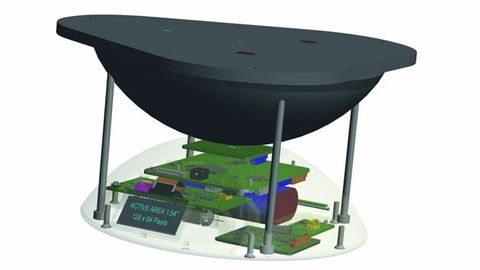
Schematic representation of an environmental sensor developed by Hahn-Schickard, for example for measuring wind and wind direction, temperature, air pressure and brightness.
© FZISince a production system is influenced by various factors on the one hand and there are a number of possible measured variables that are suitable for deriving statements about production on the other, various sensors are being developed in NIKI 4.0 - for example, an environmental sensor that makes it possible to measure air pressure, CO2 content, temperature, humidity, air flow, light intensity and infrared content at one point in a production environment. Another group of sensors measures directly on the machine; among other things, sensors for recording the current (measuring terminals) and sensors for recording the relative position are being developed or further developed for this purpose.
However, NIKI 4.0 is not only concerned with the collection of new data, but also with the utilization of existing data: Many medium-sized companies have machines that already produce data and can communicate via a Profibus system, for example. Most of these possibilities are currently underutilized. A Profibus sniffer is designed to help read this data and analyze it in NIKI 4.0.
Offenburg University of Applied Sciences is responsible for IT communication in NIKI 4.0 and is also implementing the wireless communication and sensor networks in the project. The gateway is the core element of data exchange in the NIKI 4.0 kit. It collects and stores the data and translates it into OPC UA-compatible data models. In addition, the gateway serves as an interface for visualizing information so that mobile end devices can access the data stored in the gateway or in the backend via a direct wireless connection. One challenge here is that the radio should not interfere with or influence existing technology in the production halls, while at the same time being as insusceptible as possible to interference from other radio technology in production. Together with the FZI Research Center for Information Technology, the Offenburg scientists are also working on intelligent data analysis and data aggregation.
Intelligent visualization
In NIKI 4.0, the FZI is responsible for the intelligent visualization of the various measured variables from the industrial plants. In future, both values from the retrofitted sensors and measured values from the system itself will be made available using the OPC UA protocol. The researchers are developing an Android app for mobile devices and a browser-based desktop display in order to access the data via a standardized interface. The merging of data and reality on mobile devices using augmented reality makes it easier for the user to assign digital data and physical machines in the immediate vicinity of the machine. Visualization supports the employees of a company in various use cases of the intelligent production of the future. Visualization thus makes a decisive contribution to the generation of new knowledge, which arises here from the combination of machine processing and human insight. One example is the use of data to create forecasts on the future condition of the machine and prevent unplanned downtime through targeted preventive maintenance - the keyword here is 'predictive maintenance'.
The data collected via the NIKI 4.0 toolbox is also interesting for employees outside the immediate vicinity of the machines, for example for a plant manager who wants to analyze current production and machine data and plan operations. The development of a suitable visualization and user interface is planned for these users. In summary, the NIKI 4.0 kit consists of sensors, a Profibus sniffer, a communication gateway and the visualization of the collected data using augmented reality. As an open source platform, NIKI 4.0 also provides a basis for individual extensions and adaptations. It will be published under the Apache license 2.0 on 'GitHub'.
An application example
The sensor information is particularly relevant in environmentally sensitive production processes or systems. Injection molding processes, for example, are prone to errors caused by wind or draughts as well as fluctuations in ambient temperature.

The FZI is responsible for the intelligent visualization of the various measured variables. This provides 'new knowledge' through interaction with and interpretation by the user and facilitates model design.
© FZIThanks to the measurement and intelligent visualization with NIKI 4.0, skilled workers will in future be able to easily interpret disruptive air effects and indications of their source and derive the correct actions for troubleshooting.
Various companies have expressed an interest in NIKI 4.0. They are actively supporting the scientists through a project committee made up of 16 companies. They are active in the subject areas covered by the project and mainly come from SMEs in Baden-Württemberg. The 16 committee members advise the research institutes in all phases of the project with their knowledge of everyday production and contribute case studies.
The first project milestone was reached on October 14, 2016: the requirements survey was completed and an initial, more detailed system architecture was implemented as a prototype. Using a demonstrator, all project participants discussed the further implementation and planned the next five project phases.
Authors:
Sascha Alpers is a research associate in the Software Engineering research department at the FZI in Karlsruhe;
Johanna Häs is Department Manager Corporate Communications and Media (CCM) at the FZI in Karlsruhe.
Key data on NIKI 4.0
The project "Non-disruptive kit for the evaluation of Industry 4.0" started on 1 February 2016 and will run until 31 May 2018. The project partners were commissioned by the Baden-Württemberg Foundation as part of the research program "Industry 4.0: Exploring and exploiting design potential for SMEs in Baden-Württemberg". The project sponsor is the German Aerospace Center. More information on the project can be found on the project website.


You might also be interested in
The first steps towards digitization
Real-time transparency in the material flow: this was the goal set by Miba when it set out to digitalize its internal logistics processes. But how successful was the close link between ERP and MES in the end? - A field report.
 read more...
How will the IoT change companies in 2020?
How will network technology in companies change in 2020? Axel Simon, Chief Technologist at HPE Aruba, takes a look into the crystal ball
read more...Digital twin revolutionizes maintenance
As virtual representatives of real machines, digital twins open up new possibilities for maintaining and servicing complex industrial plants and systems. A project report.
read more...You can't do without Edge and Swarm
The IoT has changed the requirements for processing data provided by machine sensors and actuators. This needs to happen as quickly as possible - preferably where the data is generated. Edge nodes and swarm computing systems take on this task.
read more...Online machine data under control
Turning huge amounts of data into valuable information - how can this smart industry approach be implemented? Linking PC-based controllers with Matlab and a cloud-based IoT analytics service can be a viable approach.
read more...From modeling directly into the PLC
Despite digitalization and I4.0, the technical functions in a process plant do not become simpler if you break them down to the smallest detail. Nevertheless, the high level of difficulty can be overcome by combining the right tools in the right way.
read more...Where are the new business models?
The necessary new business models are repeatedly cited as the hallmark of an Industry 4.0 environment. But to date, very few companies have seen any of this. Schneider Electric now has a few models up and running.
read more...Why predictive maintenance?
Investments in predictive maintenance systems are worthwhile in order to proactively detect damage. Not only does this increase the service life of a machine, it also opens up new business models for machine manufacturers.
read more...First customer projects via BaSys 4.0
The BMBF project 'Basissystem Industrie 4.0' expired at the end of June 2019. Together with NetApp and Objective Partner, Fraunhofer IESE now offers Industry 4.0 solutions with support and adaptation to customer systems on the basis of this project....
read more...