
Fraunhofer IPA
Sensors from the printer
Together with the Baden-Württemberg companies Arburg and Balluff, Fraunhofer IPA has achieved a breakthrough in the 3D printing of individualized sensors.
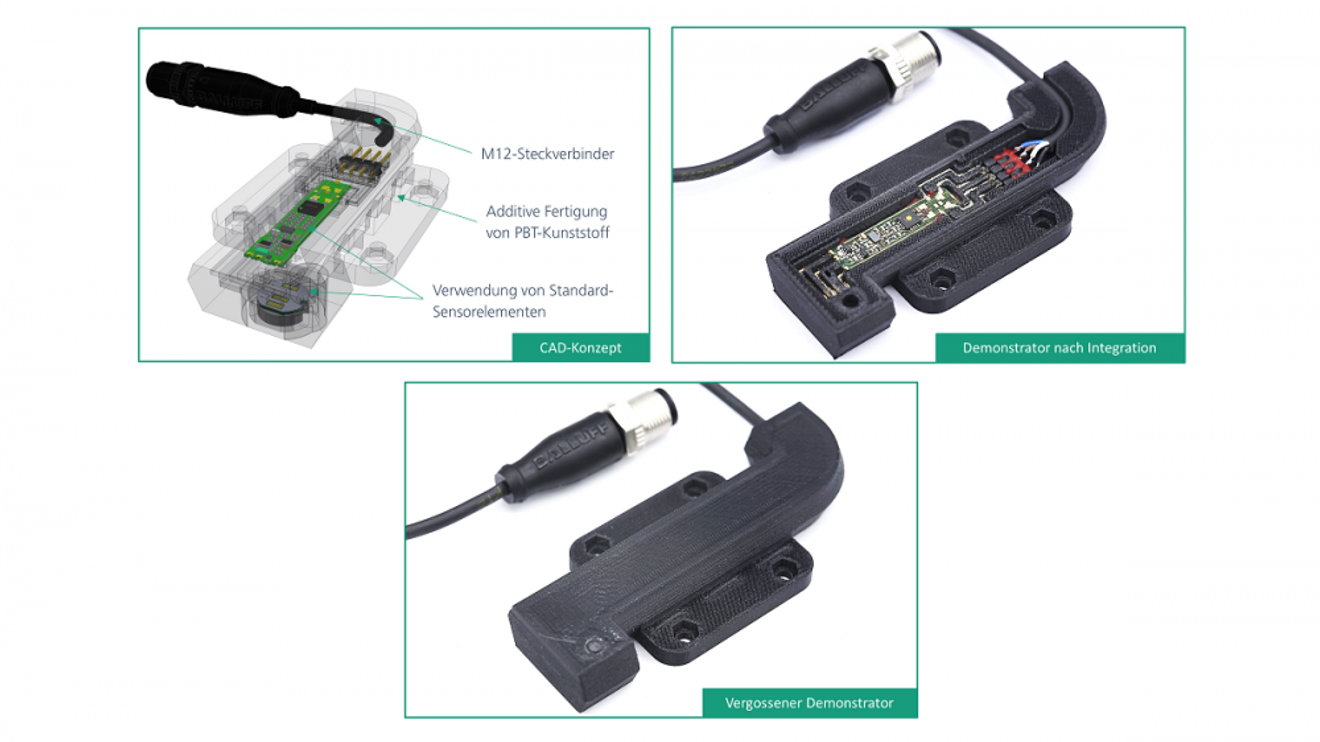
Sensors in individualized form are interesting for tasks in automation technology, as they can be used in many different ways. Inductive proximity sensors in cylindrical metal housings, in which a coil, a circuit board and a connector are installed in a rigid constellation - a standard component with a fixed geometry - are available and used in large numbers. However, to date there have been no inductive proximity sensors with a housing shape that fits into a specific environment, such as a robot arm gripper finger. This is now set to change thanks to the collaboration between a research team from the Center for Additive Manufacturing at the Fraunhofer Institute for Manufacturing Engineering and Automation IPA, Arburg, a system manufacturer for plastics processing, and sensor and automation supplier Balluff.
The basic idea was to print the housing of a sensor out of plastic so that it could be produced in any shape. A plastic with high dielectric strength and flame-retardant properties was required for this housing. The experts chose the semi-crystalline plastic polybutylene terephthalate (PBT), which is used as a standard injection molding material for the production of electronic housings. However, this type of material had not previously been used for 3D printing.
The plastic was fed as granulate into the so-called 'freeformer', Arburg's industrial additive manufacturing system. This has a material preparation unit with a special plasticizing screw. Once the standard granulate had been melted, tool-free freeforming followed: A high-frequency pulsed nozzle closure discharged tiny plastic droplets, which could be precisely positioned with the help of a movable component carrier. In this way, three-dimensional components with cavities were created layer by layer in the freeformer, into which components could be inserted during the printing process. To make this possible, the freeformer automatically interrupted the construction process in the respective layers so that it was possible to integrate the coil, circuit board and connector with a precise fit. A dispenser was then used to produce the silver conductor tracks inside the housing in a separate system. Finally, it was necessary to overprint the cavities with the freeformer and cast them with polyurethane.
In this way, the team produced more than 30 demonstrators of the individualized sensors in order to then test them extensively: for example, the components had to withstand temperature changes and vibrations, be waterproof and pass an electrical insulation test. By optimizing the design and manufacturing process, the tests were successfully completed in the end.
The research project 'Electronic function integration in additively manufactured components' ran for one and a half years. Stefan Pfeffer, who was responsible for the project at Fraunhofer IPA, is currently researching in cooperation with Arburg how conductive plastics can also be used in the future to open up further fields of application.


You might also be interested in
The digital value stream analysis
A research team from Fraunhofer IPA is digitizing value stream analysis together with the Stuttgart-based software provider Ifakt. This should enable this optimization method to be carried out in the future with significantly less effort and almost...
 read more...
Intelligent sensor detects leaks
To simplify the search for leaks in compressed air systems, a researcher from Fraunhofer IPA is working with Sick to develop an additional leakage service for an intelligent flow sensor. Self-learning algorithms evaluate the measurement data.
read more...Sensor systems for extremely harsh environments
In the lead project 'eHarsh', eight Fraunhofer Institutes have developed a technology platform for the construction of sensor systems that can withstand extremely high temperatures and pressures - for example for monitoring the inside of turbines...
read more...Operational safety in mobile machinery
With the DS5, BD|Sensors is launching a compact pressure switch on the market that is primarily intended for use in mobile machinery such as cranes, excavators or harvesters.
read more...Use in hazardous areas
With the IS-TH1, i.safe Mobile is launching a hand-held barcode scanner for use in hazardous areas and industrial environments in the non-hazardous area.
read more...Low code for service robots
Launched in 2017, the SeRoNet project aims to significantly simplify the design, development and use of service robots. With 'xito.one', an open IT platform is currently being created for users, solution providers, robotics and component...
read more...Back on course for growth
The Balluff Group's total sales in the first quarter of 2021 amounted to €127 million, once again matching the high growth in the first quarter of 2018, the strongest quarter in the company's history in terms of sales.
read more...The e-paper for the special issue
SENSOR & VISION 2021
From 5G to AI: The new e-paper presents smart solutions that manufacturers have to offer in the field of sensor technology and image processing. Take a look at the latest special issue and find out all the trends at first hand.
read more...AMK Arnold Müller is now part of Arburg
The Arburg entrepreneurial families Hehl and Keinath have taken over the Drives & Automation division of the AMK Group with AMK Arnold Müller. In future, this will operate under the name AMKmotion.
read more...