
Fraunhofer
Sensor systems for extremely harsh environments
In the lead project 'eHarsh', eight Fraunhofer Institutes have developed a technology platform for the construction of sensor systems that can withstand extremely high temperatures and pressures - for example for monitoring the inside of turbines and deep boreholes for geothermal energy.
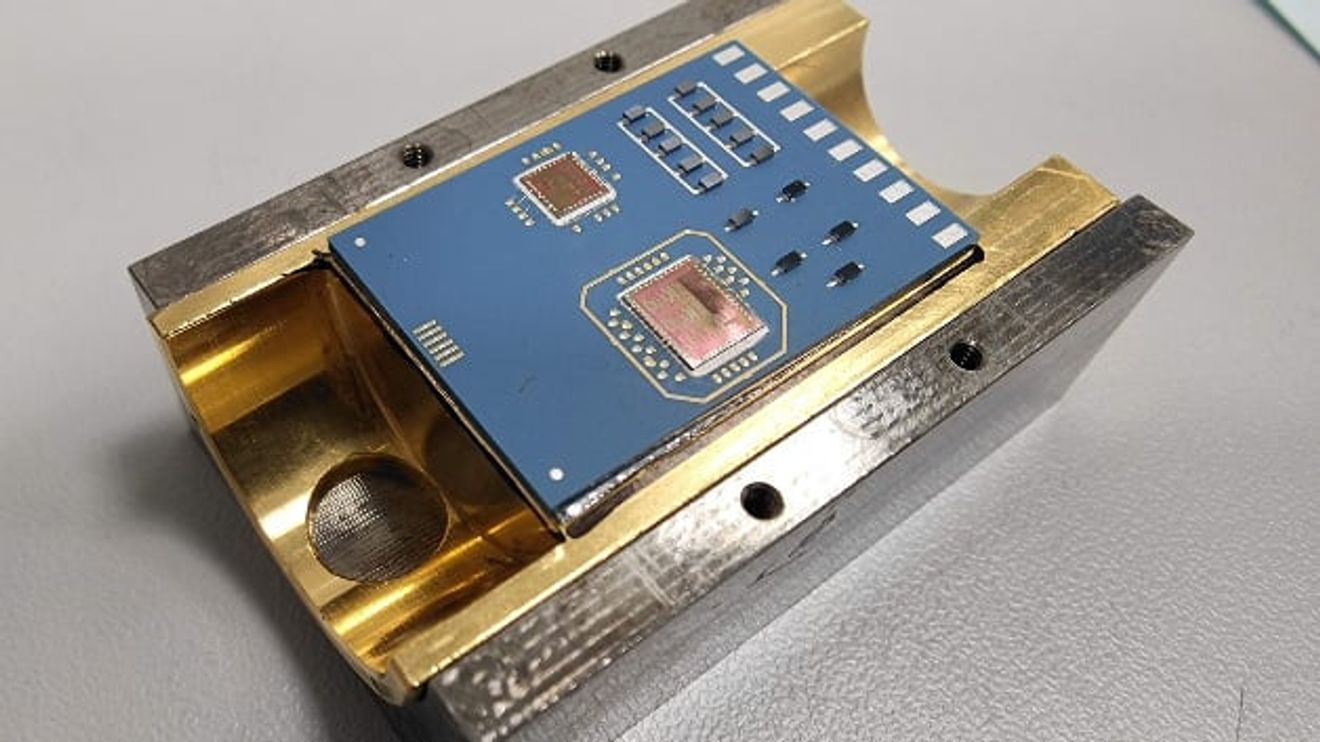
Ceramic printed circuit board with high-temperature-capable integrated circuits.
© Fraunhofer IZMIn extremely harsh environments, conventional sensors can be destroyed within a short space of time - this includes the inside of power plant or aircraft turbines or boreholes in the ground where high temperatures and pressures prevail. Aggressive gases, liquids and dust also damage sensors. Eight Fraunhofer Institutes have therefore joined forces in the eHarsh project to develop particularly robust sensors for extremely harsh environments for the first time. "We have a lot of detailed knowledge in the various institutes," says eHarsh coordinator Holger Kappert from the Fraunhofer Institute for Microelectronic Circuits and Systems IMS. "We are familiar with heat-resistant ceramics, can test material properties and produce robust microelectronic circuits. However, none of us were able to produce such a sensor on our own. It was only through the interaction and combination of many individual technologies that we have now succeeded." The team initially focused on applications with high temperatures and pressures - the aforementioned turbines and boreholes. The aim was not only to install robust pressure and thermocouples in the turbines and boreholes, but also the electronics for evaluating the measured values. "The advantage of on-site electronics and signal processing in the sensor is the higher quality of the sensor signals," says Holger Kappert. "It would also make it possible to network sensors better in future and save on expensive cabling."

This would be particularly interesting in aircraft engines because it would reduce the weight. Such engines are complex. Air flows, electrical voltages and power must be precisely regulated depending on the flight maneuver. With the help of small, robust sensors directly in the engine, measuring the condition of the engine and controlling the combustion process could become even more precise in the future - for example, in order to use fuel more efficiently.
The sensor housing is made of metal, while the sensor elements are made of ceramic that can withstand temperatures of up to 500 °C. The electronic inner workings can withstand temperatures of around 300 °C. One challenge was to join the various components together in such a way that they do not separate from each other even when repeatedly heated and cooled, when the materials expand and contract to different degrees. Among other things, circuit boards made of heat-resistant ceramic and conductor tracks with an admixture of tungsten, which is also used for the filaments of light bulbs, are used.
The sensors are not only heat-resistant, but can also withstand pressures of up to 200 bar. This means that such sensors can be used in pumps for geothermal energy in the future. In geothermal energy, buildings are heated with hot water from the ground. The pumps are located deep down in the borehole and must be able to withstand both the heat and the pressures. Thanks to the new sensors, simple, permanent monitoring is now possible.


You might also be interested in
Monitored with the help of 5G
In networked manufacturing systems, processes and distributed systems should be able to exchange their data reliably and without delay in order to protect systems. A research project is investigating how 5G sensor technology can help with collision...
 read more...
Preview of the EMO 2017
After a four-year break, the Hannover Exhibition Center will once again be dedicated to metalworking from September 18 to 23, 2017. The 'central theme' of EMO 2017 will be a digital one.
read more...Research institutes work together across borders
The French research institute Leti and the Fraunhofer Group for Microelectronics are expanding their collaboration. The aim is to develop technologies that will be needed in future applications in IoT, augmented reality, automotive and healthcare.
read more...SensoPart and Cambrian Robotics
Partnership for 3D-Guided Robotics
Cambrian Robotics and SensoPart are jointly developing an AI-powered solution for 3D-guided robotic applications. The combination of vision sensors and AI is designed to simplify gripping and positioning processes.
read more...Expansion of the Sensor Portfolio
Infineon Completes Acquisition of ams Osram's Sensor Business
Infineon has completed the acquisition of ams Osram's non-optical analog/mixed-signal sensor portfolio. The business is expected to generate approximately 230 million euros in revenue in 2026.
read more...Technologies for precise data and analytics
From June 9 to 11, 2026, Sensor+Test once again brought together trade visitors from the fields of sensor technology, measurement, and testing in Nuremberg. With its focus on these core technologies and the wide range of application areas, the trade...
read more...Increased revenue and expanded production capacity
The Fraba Group, a manufacturer of sensors for industrial motion control, looks back on a successful 2025, during which both revenue and the number of employees increased.
read more...From sensor to intelligent system
Sensors, measurement technology and artificial intelligence are merging to form intelligent systems. From June 9 to 11, 2026, Sensor+Test in Nuremberg will showcase the most important trends in a changing industry.
read more...Technology and innovation center opened in Chengdu
Balluff has opened a technology and innovation center at its production site in Chengdu, China. The aim is to provide even more targeted support to local and international customers with solutions and expertise.
read more...