
Fraunhofer IPT
Monitored with the help of 5G
In networked manufacturing systems, processes and distributed systems should be able to exchange their data reliably and without delay in order to protect systems. A research project is investigating how 5G sensor technology can help with collision control in machine tools.
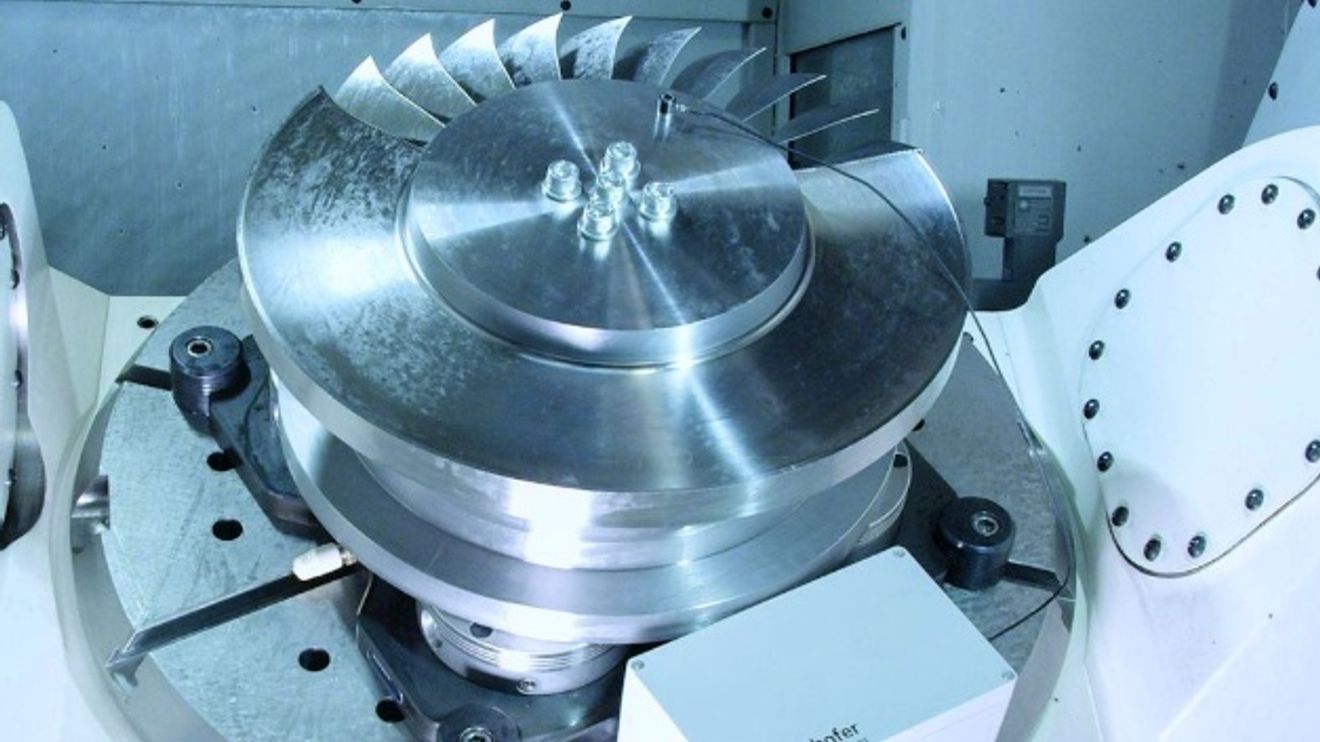
In order to demonstrate, test and further develop the potential of 5G for production, the Fraunhofer IPT is working with partners in the '5G-Smart' project to test 5G-capable, industrially deployable sensors and wireless modules and test them in its own machines and systems using specific production tasks. This should make it possible to record process data with latencies of just a few milliseconds, evaluate it in real time and optimize the process monitoring of the entire industrial process chain. Engineers can thus record process statuses and machine conditions in good time and pass them on to the machine via control commands, which reacts within short reaction times to ensure that the components are manufactured in the required quality and production time. A first 5G test environment was created in May 2020 with the '5G-Industry Campus Europe'.
This ecosystem for researching, developing and testing 5G technology for industrial applications covers around 1 km2 of RWTH Aachen University 's Melaten campus and a total of 7,000 m2 of hall space. On this site - the largest 5G research infrastructure in Europe - a wide range of application scenarios can be researched - from 5G sensor technology for monitoring and controlling highly complex manufacturing processes, mobile robotics and logistics to cross-location production chains.
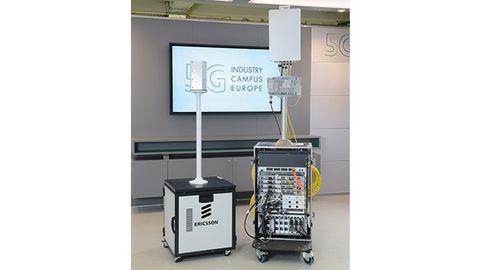
Another goal is to test the use of modern edge cloud systems for fast data processing in order to exploit the further potential of 5G for fully networked and adaptive production. Together with the project partners from the Machine Tool Laboratory WZL and the Research Institute for Rationalization (FIR), the Fraunhofer IPT will be developing applications and solutions for digitalized and networked production over the coming years. The partners for setting up the 5G infrastructure are the mobile communications equipment supplier Ericsson and the IT Center at RWTH Aachen University. The project is being funded for three years by the Federal Ministry of Transport and Digital Infrastructure (BMVI).
Collision control of machine tools and components

5G acoustic emission sensor for monitoring tool wear and tool breakage. The sensor is attached directly to the workpiece and continuously records a signal (see waterfall diagram) and sends a frequency spectrum to an AI model that classifies the data with regard to tool wear.
© Fraunhofer IPTMastering manufacturing processes such as the milling of highly complex components means, above all, being able to quickly detect deviations in the movement of the tool and react within a few milliseconds. This can be achieved with machine-integrated sensor technology in conjunction with 5G, as this mobile communications standard is able to transmit the acquired data quickly and reliably. This enables the machine tool to react to changes in the process before a component is damaged. The 3rd Generation Partnership Project (3GPP), a global cooperation for the standardization of mobile communications technologies, is developing a new standard for future 5G products for this very responsive connection - the so-called 'Ultra Reliable and Low Latency Communication' (URLLC).

Niels König is head of the Production Metrology department at the Fraunhofer Institute for Production Technology IPT in Aachen.
© Fraunhofer IPTIn order to be able to react even faster and more reliably to changes in the production process in the future, the Fraunhofer IPT and the mobile communications equipment supplier Ericsson are testing the URLLC functions in the collision detection use case. Ericsson is supplying the Fraunhofer IPT with a modular 5G test system that meets the required URLLC functions in this use case. The test system operates in the millimeter wavelength range (mmWave), a 5G spectrum with frequencies between 24 and 28 GHz, which can be applied for from the German Federal Network Agency with immediate effect. In contrast to stationary 5G systems in the 3.7 to 3.8 GHz frequency range, 5G systems in the millimeter wavelength range are new in production and have hardly been tested to date. However, the larger spectral range allows higher data rates of more than 10 Gbit/s and latencies <1 ms, meaning that time-critical applications in particular can be implemented reliably.

Praveen Mohanram is a research associate in the Digital Infrastructures department at the Fraunhofer IPT in Aachen.
© Fraunhofer IPTWith collision detection, a structure-borne sound sensor, which is attached directly to the workpiece or integrated into the machine spindle, detects a collision of the tool within a few milliseconds so that the machine can be stopped in time before major damage to the component or the machine can occur. In the event of a collision between the machine and component, strong acoustic emission shocks are generated, which the sensor detects. The frequency range of the acoustic emission shocks differs from conventional tool breakage detection: the frequency range and the deflections are higher, as the tool actually collides with the component.
The intelligent structure-borne sound sensor detects acoustic emissions in the range from
1 to 900 kHz. It is connected to a sensor platform that has integrated signal conditioning and can record the sound emissions and calculate the frequency spectrum. The platform runs at a sampling frequency of 1 MHz and generates a data packet with frequency spectra every few milliseconds, which is sent to an AI model integrated into the cloud for data analysis. This in turn classifies the data with regard to tool wear.
The system uses 5G communication to handle the resulting high data rates of over 12 Mbit/s and to ensure reliable communication with low latency for timely intervention and an accurate assessment of tool wear. Thanks to high data rates of up to 10 Gibt/s and latencies <1 ms, the new mobile communication standard is suitable for making manufacturing processes more mobile, flexible and adaptive than before, improving the quality of components, reducing costs and thus increasing productivity. With the 5G test system, the detected acoustic emission shocks are sent to an AI model integrated into the cloud in order to stop the process in time within a few milliseconds. Process control using an acoustic emission sensor is just one of many ways of monitoring the machine process. The existing infrastructure does not need to be changed; it is flexible and scalable.


You might also be interested in
The e-paper of issue 4/2021
In the e-paper of our issue 4, you can find out why the focus of IoT application development is shifting away from the cloud and towards the edge. You can also read more about TSN in conjunction with Linux and RTOS and how to close security gaps in...
 read more...
The dilemma of IoT security vulnerabilities
It should be a matter of course that identified and published security vulnerabilities in IoT products are immediately closed with updates. Due to a lack of technical possibilities, this is rarely the case. This option is unacceptable for industrial...
read more...TTTech Industrial Automation AG
Edge computing for your production with Nerve Blue
In response to the challenges faced by machine builders and plant operators in a rapidly changing industrial landscape, TTTech Industrial has developed an open and flexible edge computing platform.
read more...The Cloud RAN extension
The 5G-Industry Campus Europe in Aachen has now been expanded with a Cloud RAN infrastructure. "Cloud RAN" creates a basis for the use of 5G functionalities and industrial applications on shared server hardware.
read more...Microservice-based laser structuring
Digitalization is becoming increasingly important in photonic production, which uses light or lasers as a tool. This requires flexible, adaptive and lightweight infrastructures, for example in the laser structuring of large-area micro and...
read more...SensoPart and Cambrian Robotics
Partnership for 3D-Guided Robotics
Cambrian Robotics and SensoPart are jointly developing an AI-powered solution for 3D-guided robotic applications. The combination of vision sensors and AI is designed to simplify gripping and positioning processes.
read more...Expansion of the Sensor Portfolio
Infineon Completes Acquisition of ams Osram's Sensor Business
Infineon has completed the acquisition of ams Osram's non-optical analog/mixed-signal sensor portfolio. The business is expected to generate approximately 230 million euros in revenue in 2026.
read more...Technologies for precise data and analytics
From June 9 to 11, 2026, Sensor+Test once again brought together trade visitors from the fields of sensor technology, measurement, and testing in Nuremberg. With its focus on these core technologies and the wide range of application areas, the trade...
read more...Increased revenue and expanded production capacity
The Fraba Group, a manufacturer of sensors for industrial motion control, looks back on a successful 2025, during which both revenue and the number of employees increased.
read more...