
Bihl+Wiedemann
Security included
ASi-5 has the best prerequisites for the implementation of Industry 4.0 projects - especially with regard to the design of the transmission data. In addition, the communicative break between ASi-5 and TCP/IP isolates many network participants and thus closes security gaps.

Fieldbuses such as Profinet, Ethercat or ASi replace conventional, direct wiring of sensors and actuators 1:1 in many places. For this reason, they are optimized for cyclically transmitted data, which is essential for controlling a machine. In the course of advancing digitalization and the resulting requirements of Industry 4.0, however, other aspects are becoming increasingly important:
- Measuring instead of switching sensors
- Control of drives via speed instead of simple on/off
- Acquisition of secondary measured variables in addition to the primary ones
- Recording of derived variables such as switching frequency
- Checking software statuses and installing updates if necessary
- Diagnostic data

ASi-5 enables sensors, actuators and control systems to be networked intelligently, efficiently and safely.
© Bihl + WiedemannThis change in requirements primarily necessitates higher bandwidths for data transmission, but also has other consequences: for example, depending on the application, the bandwidth needs to be divided differently into fast, cyclical data (typically with a few bits) and slower acyclical data (with a larger volume). In addition, current intelligent field devices are often equipped with an IO-Link interface, which also supports cyclical and acyclical data. In order to implement ASi-5 modules with several IO-Link master ports, it is important to be able to establish individual acyclic connections to each IO-Link port - without having to regulate access between the different ports at application level.
ASi-5 has therefore implemented a flexible system with which, on the one hand, the bandwidth of a participant can be scaled between one and four transport channels. On the other hand, the allocation between cyclical and acyclical services can be managed as required. The predefinition of suitable sets is carried out by Bihl+Wiedemann, for example, as the manufacturer of ASi-5 devices. For this purpose, the user is provided with a series of easily selectable profiles so that both classic I/O boxes with one bit per input point and, for example, displays that require 'streaming data' can be adequately served.
TCP/IP monoculture as a security risk
The Heartbleed bug was 'just' a classic programming error. However, nightmare scenarios are also conceivable in which criminals infect IoT devices with manipulated software. These then fulfill their actual function and also search for security gaps in the accessible company network, for example to detect passwords, which they then send to an external server.
Of course, the increased awareness of the potential problems of networking in recent years also ensures greater security - especially in the highly professional environment of automation. However, the challenge posed by an exponentially increasing number of TCP/IP-capable field devices is very high. After all, those responsible for network security not only have to define the permitted and necessary services for each device. They also have to implement these definitions correctly in the firewalls and other security devices. This is no easy task, and it is becoming increasingly difficult due to the growing number of devices.
Logic break between ASi-5 and TCP/IP

The communicative break between the individual communication levels - especially between ASi-5 and TCP/IP - increases security
© Bihl + WiedemannIn terms of safety, it is therefore helpful that ASi-5 and IO-Link provide a logic break to TCP/IP. This means that high security requirements only have to be placed on the ASi-5 gateway, which establishes the connection to TCP/IP. ASi-5 modules, on the other hand, are much less critical in terms of security, as they cannot communicate in TCP/IP networks. Those responsible for network security can therefore concentrate on far fewer devices and check them more carefully.
Recording of messages made more difficult
Another special feature of ASi-5 ensures greater security: data transmission using OFDM (Orthogonal Frequency-Division Multiplexing) with dynamic frequency allocation means that recording the exchanged messages is very time-consuming. This is because the entire context of the connection setup between the gateway and module is required. In addition, precise synchronization of the clock frequencies is necessary, as takes place between the gateway and module in accordance with the ASi-5 protocol. This is the only way that signals can be decoded at all.
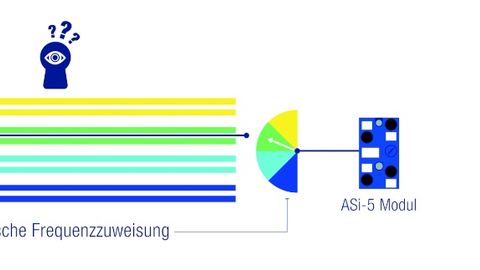
Data transmission using OFDM with dynamic frequency allocation makes unwanted eavesdropping more difficult.
© Bihl + WiedemannAnother important point is that the signal strength is not equally good at all spatial positions, depending on the frequency. The ASi-5 gateway and module negotiate this with each other in an optimized manner, but this makes it much more difficult to listen in. In comparison, recording Ethernet telegrams with commercially available Ethernet TAPs or standard mirror ports is comparatively easy.
Extensive safety tests
Bihl+Wiedemann's development department already ensures a high level of security: firstly, all software components used are selected with security aspects in mind; secondly, the developers constantly monitor error and security reports. In the company's experience, open source software can often be a very good alternative due to a large, active community.
In addition, extensive security tests are carried out regularly using various tools. These include test systems such as the 'Achilles' test platform from General Electric. This test system stresses the test object in a mixture of random test patterns and known problematic patterns - for example in relation to differences between the actual and declared length of data blocks or exceeding permitted lengths. For further tests, Bihl+ Wiedemann uses load generators that make it possible to simulate high network loads. These can, for example, stop individual tasks in the test object, which can result in unexpected reactions.
In practice, such tests in development repeatedly reveal astonishing effects. Discovering these in the laboratory - before they occur in the user's environment - is a decisive factor in quality assurance.
In-system updates increase security

Thomas Rönitzsch is responsible for corporate communications at Bihl+Wiedemann in Mannheim.
© Bihl+WiedemannBeing able to easily carry out software updates is also essential for a high level of security. As the example of the 'Heartbleed bug' shows, errors can also occur in supposedly tried-and-tested packages that are considered secure and only be discovered after a very long time. If this is the case, it must be possible to react immediately. The best way to do this is to offer the user a reliable in-system update. This not only allows them to install urgently needed security updates, but also functional enhancements and improvements as a kind of side effect.

Bihl+Wiedemann offers this option for all ASi-5 gateways and modules directly via its 'Software Suite'. The software of the devices on the ASi bus is compared with the software tools released for the corresponding serial numbers on the update server. If there is a newer version, it can be updated directly - with the express consent of the user. Several security features are integrated into the update process to ensure that the security chain is not interrupted: Each TCP/IP-capable device receives an individual certificate for SSL communication during production. The software on the update server is signed and the signature can be verified by the devices. And last but not least, updates are only possible via the update server and an encrypted connection.


You might also be interested in
Up to 16 digital I/Os possible
The first products in the Bihl+Wiedemann family of self-configuring I/O modules are the two ASi-5 modules BWU4230 and BWU4231 in protection class IP67, each with 16 I/Os.
 read more...
Portfolio expanded
Bihl+Wiedemann has expanded the ASi product portfolio with ASi-5 motor modules - on the one hand for direct control of roller drives with 24 V(DC) and 48 V(DC) via ASi, and on the other hand for decentralized control of three-phase AC drives with...
read more...SPS Connect 26.11. - 11:40 - 12:00 a.m.
The Next Cyber-Attack Could Be At Your Factory
As the surface of cyber attacks changes, the security risk and need for security solutions increases. It is imperative that factories adopt a resilient stance against cyber attacks.
read more...SPS Connect 26.11. - 11:40 - 12:00 a.m.
Non-reactive OT security in various industry examples
IT security in production networks is the topic of the moment. There are plenty of examples of real-life attack scenarios in the media.
read more...SPS Connect 11/26 - 11:05 - 11:25 a.m.
"No Way" was yesterday! Networking critical systems one way
The "No Way!" paradigm still applies in many places when it comes to networking critical systems This means: simply no networking at all for safety reasons.
read more...SPS Connect 26.11. - 11:00 - 11:20 a.m.
Industrial security use case: PoC in the networked factory
From planning to implementation for cyber security and stability. Where should companies start to implement industrial IT security in accordance with IEC 62443 and ISO 27000?
read more...SPS Connect 11/26 - 10:15 - 10:55 a.m.
Cybersecurity in the industry
The Industrial Internet of Things (IIoT) is under attack. Cyberattacks on industrial plants can not only cause major damage but also endanger human lives.
read more...The e-paper of the November 11 issue
The e-paper of issue 11 is here. Among other things, you can read about Huawei's position in relation to the company's accusations of spying, why TSN is "a symbol of the standardization of fieldbuses" and how Single Pair Ethernet will change process...
read more...Sensorless speed monitoring simplified
With the Safeone DN3PD2 speed monitor, Dina Elektronik simplifies sensorless speed monitoring. According to the manufacturer, installation and maintenance are simple.
read more...