
Functional safety
Retrofit flexible safety
Retrofitting safety functions in existing systems is sometimes a complex undertaking. Safety I/O modules that can be used decentrally in the automation network and are easy to configure instead of requiring complex programming are helpful here.

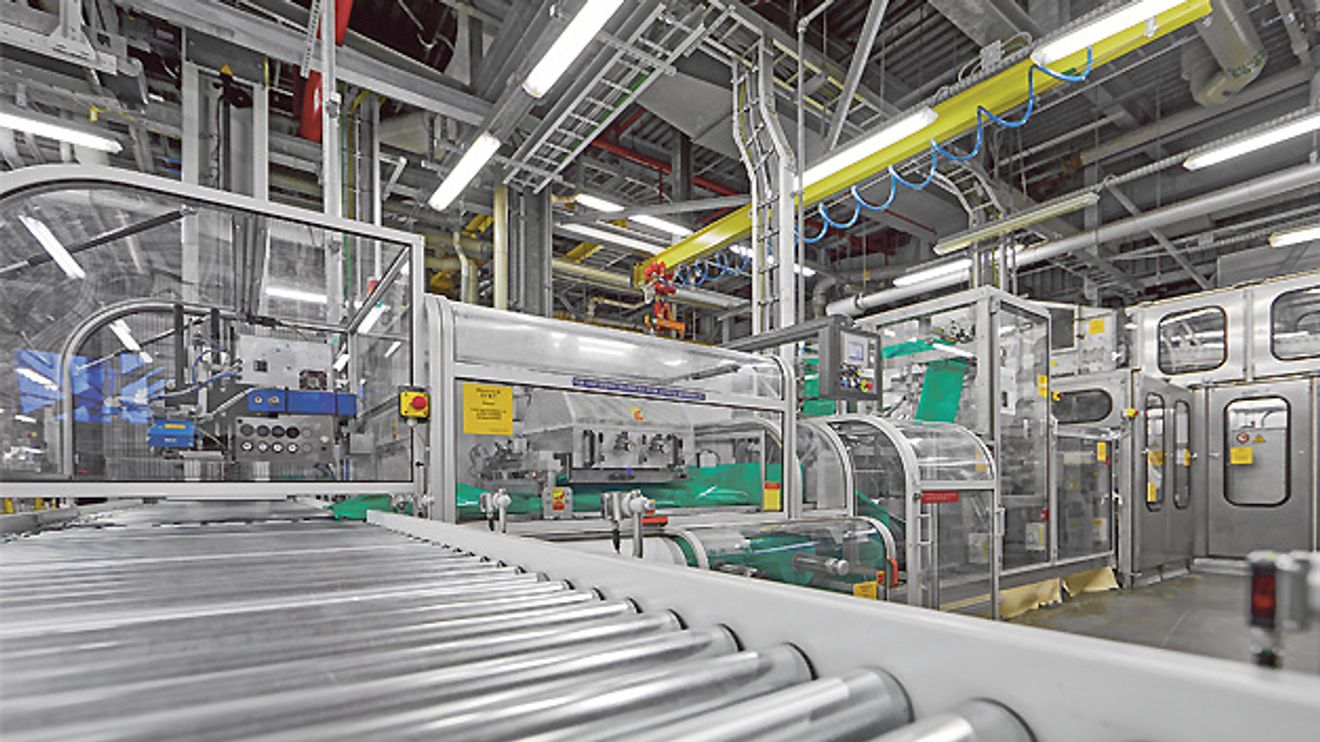
View into the production of Chemours Netherlands: The highly dynamic movements in a packaging unit ...
© Phoenix ContactAt Chemours Netherlands, based in Dordrecht in the Netherlands, around 500 employees work in an extensive plant, focusing on the production of plastics (fluoropolymers) with well-known brand names such as Teflon, Opteon and Viton, which are used in non-stick coatings and coolants. Founded in 1959, the production site is the largest in Europe within the Chemours Group.

Each of the production facilities located on the extensive premises is controlled and monitored from the central control room, where important data from all manufacturing processes converge. In the finishing department - where the individual products are completed and automatically packaged before dispatch - the machines are controlled by locally installed programmable logic controllers (PLCs), which exchange their data via the Profibus and Profinet communication standards. The employees can access the process data on several operating devices installed at different locations and thus control the processes and correct deviations if necessary. In principle, however, the process parameters should be adjusted centrally from the control room in the event of an alarm message.
The main process originally had its own safety control system, while hard-wired and therefore inflexible systems were still used in finishing and packaging. With this in mind, those responsible in Dordrecht set up a project to modernize the outdated safety PLC. The activities were aimed at achieving greater flexibility while at the same time ensuring that the new solution complied with the plant operator's strict safety guidelines.

Johan Sterrenburg, Technical Manager at Chemours Netherlands, was impressed by the simple connection of the SafetyBridge modules to the S7 controller, among other things.
© Phoenix ContactJohan Sterrenburg, technical manager for electrical systems and measuring equipment at the Dordrecht site, explains the project approach: "Right from the start of the activities, it was clear that our main focus was on separating the safety system from the main control system. After examining and evaluating all possible solution concepts, we ultimately opted for the I/O system Inline from Phoenix Contact with the TÜV-certified SafetyBridge Technology (SBT). This is because the solution can be easily connected to the S7 standard controller and also includes its own safety CPU. The solution can therefore be fully integrated into the existing network and still be operated independently of the standard controller."
The facilities for finishing and packaging with their numerous control cabinets are spread over a large area at Chemours Netherlands. The safety sensors and position switches of all processes could now be integrated into the automation solution for the first time via the decentralized safety I/O system. Specifically, the chemical producer uses version 3 of the so-called LPSDO module (Logic Programmable Safe Output Device) from the SafetyBridge portfolio in the two lines. In the current configuration, up to 16 safe input or output terminals are controlled remotely via the network. In principle, the SBT system is designed so that it can be easily configured like a safety module. Nevertheless, it offers the functionality and flexibility of a programmable logic controller with safe I/O modules that can be used in an extensive automation network - independently of the controller and the automation network.
In addition to the so-called logic module, the system consists of safe input and output modules. The I/O modules monitor the signals from the safety sensors and switch off the control components. The logic module generates and controls the safety-related SBT transmission protocol and also processes the user-defined safety logic. It also has eight additional safety outputs.
Should Chemours Netherlands require further safety signals in the future, additional I/O modules can simply be added or a new LPSDO module with the associated I/Os can be integrated into the solution. This option offers the chemical company exactly the flexibility that those responsible for the project had set as their goal.
Modules for implementing the safety functions
Using the Safeconf configuration software, the user can assign up to 16 different safety I/O modules, each with a unique address, to the central logic module. To implement the individual safety functions, the configuration software offers corresponding modules that are based on the PLCopen specification and cover all common types of safety sensors and sensor-based functions - for example muting.
The assigned hardware sensor inputs can be set accordingly to the sensor type, for example to record specific test pulse filter widths or discrepancy times. Depending on the control components used, the user can also select SBT output modules with semiconductor outputs or potential-free relay contacts. Depending on the configuration and wiring, the SafetyBridge modules are generally suitable for safety applications up to PLe in accordance with EN ISO 13849-1 or SIL 3 in accordance with EN IEC 62061.
Programming errors excluded
Once the safety logic has been implemented, the distribution and the respective installation location of the I/O modules in the network are irrelevant, as neither of these influences the safety logic. To implement or retrofit the safety logic in an existing standard controller, the programmer requires neither special experience nor training in the field of functional safety. From the perspective of the standard PLC, the SafetyBridge system is an ordinary I/O module for the transmission of safety packages, the content of which is not accessible or visible to it. The content of the safety packets is continuously monitored by the safety modules themselves. If they detect a deviation, the logic module immediately puts the system into a safe state.
It was also particularly important for the application at Chemours Netherlands that the status data is transmitted to the central control room - another advantage offered by a safety solution integrated into the network. Due to the safety measures integrated into the safety system, errors or impairments to functional safety caused by the programmer of the standard PLC are ruled out. All in all, with the Safety Bridge concept implemented, Chemours has now installed a TÜV-certified safety system in the Dordrecht plant that works independently of the S7 standard controller and yet is fully integrated into the existing plant network.
Author:
Simon Davis works for Phoenix Contact Electronics in Bad Pyrmont.
The Chemours Group
The American chemical group 'The Chemours Company' is one of the international market leaders in the field of titanium dioxide technologies, fluorine products and other chemical-based solutions. The company was spun off from Dupont's High Performance Chemicals division in 2015 and today supplies customers in the automotive, coatings, plastics, electronics, energy and telecommunications industries in over 130 countries. Although it has only been operating independently for two years, The Chemours Company can look back on 200 years of history. The Group now employs several thousand people at 45 production sites, laboratories and branches worldwide.


You might also be interested in
Safety first
The development of cobots into a commodity product is closely linked to the issue of safety in robotics - a challenge that needs to be mastered efficiently.
 read more...
Locking with need for clarification - help with risk assessment
DIN EN ISO 1419 has already been available for five years. However, there are always uncertainties regarding the actual safety functions of a guard locking device, which the machine manufacturer must evaluate based on his risk assessment. Here is...
read more...Safe operation via radio - (how) does it work?
Many machine builders want to use tablets in addition to the existing machine operation. Demanded features such as WLAN, camera, multi-touch and much more are available here - but if safety functions are required, these devices reach their limits.
read more...Heavy-duty HRC requires new safety approaches
The topic of HRC is not just for 'lightweights'. In the field of heavy-duty robotics, solutions will also be in demand in the future that allow humans and robots to work together directly without the need for a safety fence. However, this requires...
read more...Secure hold in the slip ring
Transmitting safety-relevant data via slip rings is no trivial matter. Motion control experts from Kollmorgen have developed a TÜV-certified safety solution, including UL approval, together with slip ring manufacturer Stemmann-Technik.
read more...Validation neglected
EN ISO 13849 is decisive for the integration of safety-related control functions in machines. However, the part of the standard relating to validation is often neglected in practice - a major shortcoming.
read more...Dangerous movements well secured
How can dangerous movements be safeguarded? A challenge for the user, as there are a wide variety of functional and normative requirements. An overview.
read more...The intelligent safety switch
Safety modules and safety switches that communicate at I4.0 level simplify troubleshooting. However, the communication capability also has interesting potential for predictive maintenance and tamper protection.
read more...The vampire effect of quantification
There are always controversial discussions regarding the determination of risks for products and systems. But which approaches actually make sense in the context of safety and security? What approach does the new framework for safety and security -...
read more...