
Functional safety
Heavy-duty HRC requires new safety approaches
The topic of HRC is not just for 'lightweights'. In the field of heavy-duty robotics, solutions will also be in demand in the future that allow humans and robots to work together directly without the need for a safety fence. However, this requires new approaches in terms of safety.
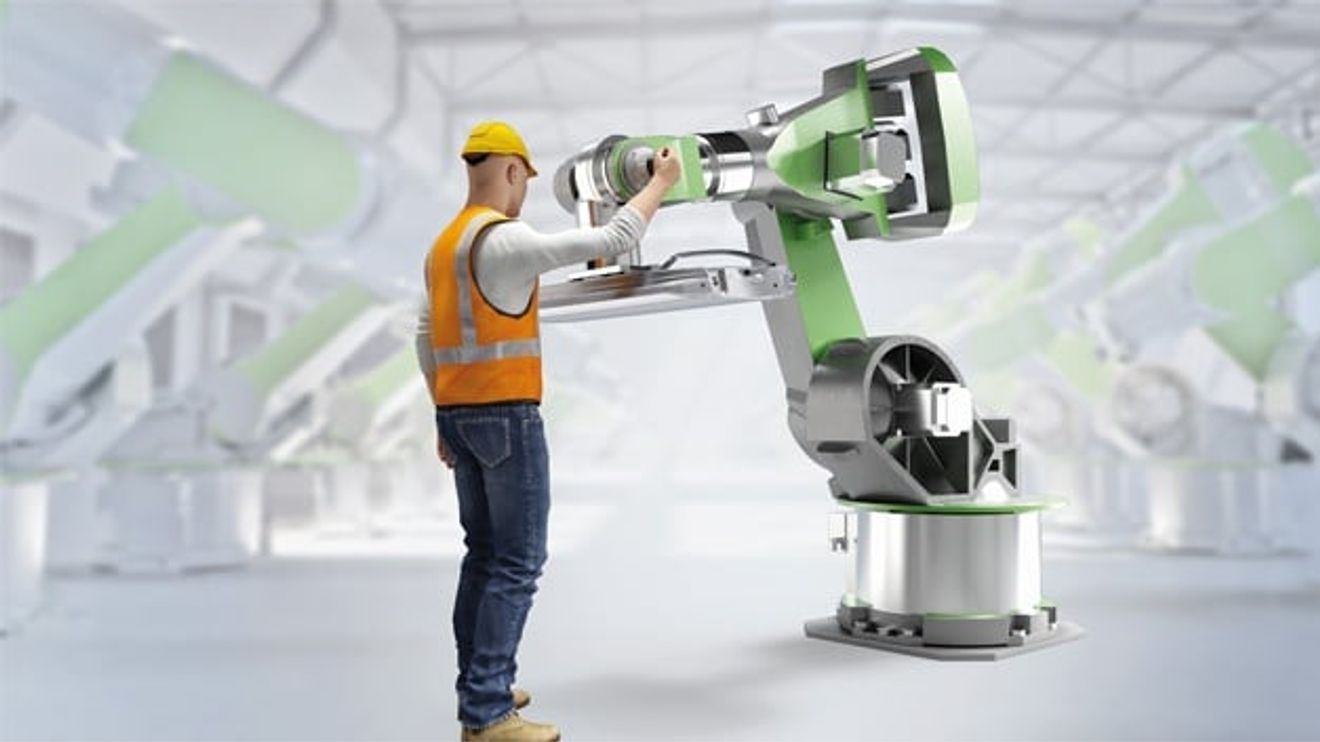
A visit to this year's Hannover Messe showed once again that the topic of human-robot collaboration (HRC) is booming. Both new and established robotics manufacturers are launching so-called cobots on the market; more and more gripper solutions for HRC applications can be found and innovative software products for easy programming of cobots are also increasingly being presented. However, to date, the topic of HRC is still almost exclusively dominated by robots with a payload of less than 15 kg. Loads that a human can actually manipulate easily and much better than a cobot. So what are the real benefits for users in an industrial environment? And what is the real advantage of human-robot collaboration?

Roland Schrattbauer, Product Manager Robotics at Keba: "In our concept, we operate standard industrial robot mechanics with our robot controller. This has the advantage that we are scalable in terms of payload and working range."
© KebaKeba has been working intensively on these issues in recent months. Roland Schrattbauer, Program Manager Robotics at the Austrian automation provider, draws initial conclusions: "The developments in the field of cobotics are of course important and correct in the long term. In the short and medium term, however, another type of human-robot collaboration is much more valuable for users and operators - namely heavy-duty HRC." In general, HRC is about 'combining' humans and robots in such a way that they work together as a smooth team, with each contributing their individual strengths. Schrattbauer: "Humans are still the best sensor available on the market and are characterized by unsurpassed problem-solving skills. The industrial robot, on the other hand, is the perfect manipulator for heavy loads with impressive precision. Cleverly combined, this results in more ergonomic and safer workplaces on the one hand and more cost-effective and flexible automation solutions on the other. This win-win situation ultimately leads to more stable processes and increased product quality." According to Schrattbauer, the primary goal when it comes to human-robot interaction must be to significantly simplify the operation of a robot - i.e. away from the expert and towards the user. With this in mind, Keba has developed a new guidance device: The so-called 'KeTop G10' has a 6D mouse including buttons and LEDs for intuitive guidance of the robot and is also equipped with an approval button for the safe release of movements. The KeTop G10 can be attached to different positions on the robot, tool or workpiece in just a few simple steps. This means it is always in the optimum position - regardless of the task at hand.
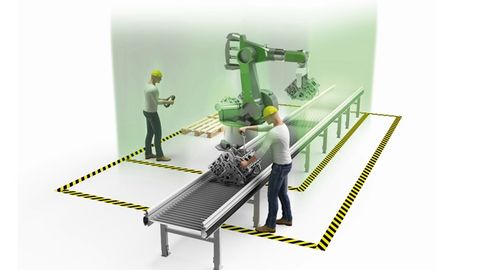
A force sensor between the robot and tool and a specially developed weight compensation system allow the robot to be moved directly over the tool or workpiece if required. This enables every production employee to guide heavy loads precisely and with ease. In addition, a human could also enter into a dialog with the robot using smart devices. In this case, the robot would send important information to the operator on the display. This allows the operator to interact with the robot and still have their hands free for the actual task at hand.
"A major challenge was the transition between a movement carried out by the robot itself and the direct guidance of the robot by the human," explains Schrattbauer. However, this is exactly what is needed to fully exploit both strengths. The robot needs to be able to carry out known and consistent movements independently. At the same time, a seamless transition to manual control should be possible. With classic robot control, the robot can only be moved by hand in 'T1' mode. Switching over, however, requires the automatic program to be terminated. This means that a smooth transition between driving and guiding is not possible. This problem was solved by extending the automatic mode with commands or sequences that allow manual guidance and then a continuation of the automatic movement.
One issue that is very often overlooked, even with the much smaller cobots, is the safe and task-oriented guidance of a robot by hand. Even if it is completely sufficient for test applications to enable all directions and the orientation of the robot, practice shows that only very few applications can be guided quickly and effectively in this way. The reason for this is that if, for example, all axes of a 7-axis robot are enabled, the robot offers no guidance support whatsoever. It is possible that the robot will change the orientation of the tool, even though you actually only want to move it in space. This means that both the position and orientation of the robot/tool must be constantly taken into account and checked during manual guidance. The focus is therefore more on the continuous monitoring of already correctly set parameters (e.g. orientation) and not on the actual task.
With this in mind, Keba has developed 'driving assistance systems' for robots for tasks where, for example, a workpiece or tool only needs to be guided absolutely straight for a few centimeters. Similar to cars, they help to keep in lane, park safely and collision-free or even drive sections of the route independently. In other words, the lane-keeping assistant ensures that the robot does not leave a predefined space or tube and indicates this to the operator using a type of 'force feedback'. Simple assistants, such as the optional blocking or unblocking of individual directions of movement, have also been integrated into the system and ensure much simpler and therefore task-oriented guidance of the robot.
The 'gray' security
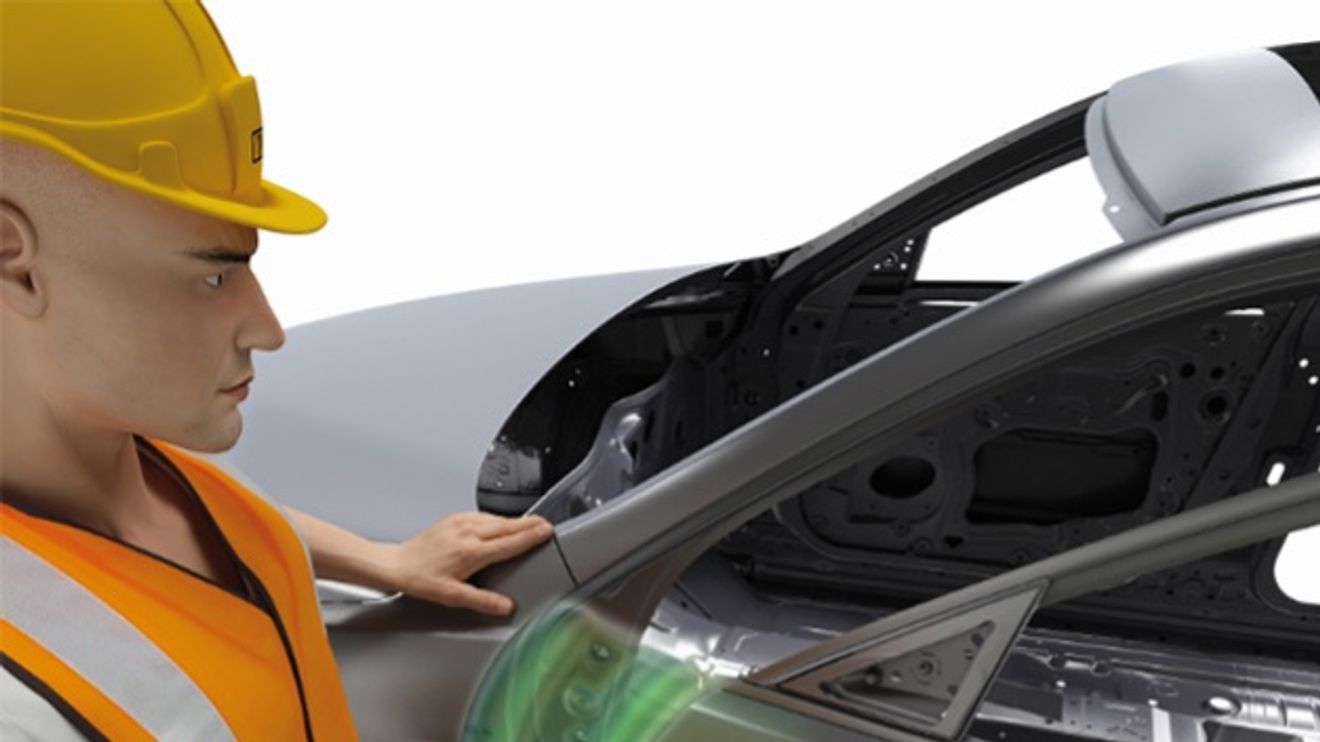
In heavy-duty HRC, humans and robots do not work opposite or next to each other - they work together. The new and further development of operator ergonomics also plays a very important role here.
© KebaWhen humans and robots work together with payloads of 200 kg and more, safety is essential. The KeSafe safety control system from Keba has therefore been further enhanced specifically for heavy-duty HRC. This means that the aforementioned force-torque sensor is not only used in the functional part of the robot controller, but also in the safe part. This enables the system to reliably detect contact forces and reduce the risk of injury to the necessary level. The evaluation of the sensor information in both the functional and the safe part of the robot controller will in future enable more than just the simple safe stopping of the robot. For example, the robot can be safely guided along a trailing conveyor belt on the basis of the sensor signals, thus preventing people from being crushed. However, the sensor between the robot flange and the tool is not the only additional measure: the aim is to integrate even more sensors, such as tactile protective covers or safe distance sensors, into the functional and safe part of the robot controller, depending on the task. At best, these are not sensors with digital but analog signals, which allow a much more specific reaction instead of a simple switch-off.
In the first step, tactile skins with analog signals will probably be available on the market. These would enable a very rapid functional reaction when an unintentional touch is detected. This prevents a dangerous situation from arising and the safety control system does not have to react by switching off, which significantly improves the availability of the system. This is also referred to as 'gray safety' - i.e. functional system reactions that are intended to prevent dangerous situations from occurring. In this context, information about the forward pointer - i.e. where the robot will move in the next few milliseconds - can be of great value. If, for example, the robot moves away from the human, the potential danger would disappear and no separate reaction would be necessary. Looking even further ahead, it would be conceivable to combine the information already available about the future robot position/movement with a calculated, probable behavior of the human - keyword artificial intelligence! -This would make 'gray safety' even more efficient.
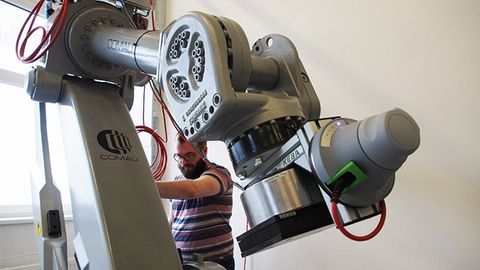
A look into Keba's test laboratory: In order to operate the mechanisms safely, the motors must be equipped with safe encoders. This allows them to be integrated directly into the safety control system.
© KebaA final, important aspect in this context: the fact that KeSafe is an integral part of Keba's control and drive system, combining functional and safe control in one solution, simplifies the implementation of safe HRC applications and ensures high system availability. The spectrum ranges from safe logic and safe single-axis movements to safe robot mechanics with up to eleven axes. In this way, machine and robot safety can be implemented on one controller without being restricted to a specific robot mechanism. Specifically, the controller provides functions such as safe cells, safe Cartesian speeds and safe monitoring of tools for a wide range of configurable robot types. This means that not only robots and their tools can be mapped in the safety PLC, but also additional axes with which the robot itself is moved or with which it works together.
In any case, the demand for heavy-duty HRC solutions is enormous. The range of conceivable applications extends from manipulation and positioning tasks in production to moving and positioning heavy tools in the automotive industry and hand-guided robot applications in operating theaters. In other words, wherever robots are already able to support people with their capabilities. In some cases, such solutions can already be implemented on the basis of standard robot mechanics and using the KeMotion control system or the functions developed for it. Among other things, KeMotion provides online and offline programming, predictive path planning and a dynamic robot model for configuring and controlling more than 30 different types of robot mechanics. Up to 16 robots can be controlled on one hardware - all mapped in one project and using common variables.
Do standards need to change?
In order to be able to exploit the full potential of heavy-duty HRC, a number of things certainly still need to change. Above all, we need to rethink our current understanding of safe control systems. The networking of non-safe sensors, the more effective use of both individual and combined sensor information and, last but not least, innovative control architectures with significantly higher availability could enable completely new solutions for the safe operation of machines and systems. However, this is not yet envisaged within the framework of current standards and regulations.
Author:
Alexander Barth is Sales Manager Europe for Robotics at Keba.


You might also be interested in
Keba grows by 20 percent
The automation specialist Keba from Linz achieved a turnover of EUR 304 million in the last financial year. This corresponds to sales growth of 20% compared to the previous year and is once again a new record in the company's history.
 read more...
Safety first
The development of cobots into a commodity product is closely linked to the issue of safety in robotics - a challenge that needs to be mastered efficiently.
read more...Locking with need for clarification - help with risk assessment
DIN EN ISO 1419 has already been available for five years. However, there are always uncertainties regarding the actual safety functions of a guard locking device, which the machine manufacturer must evaluate based on his risk assessment. Here is...
read more...Safe operation via radio - (how) does it work?
Many machine builders want to use tablets in addition to the existing machine operation. Demanded features such as WLAN, camera, multi-touch and much more are available here - but if safety functions are required, these devices reach their limits.
read more...Secure hold in the slip ring
Transmitting safety-relevant data via slip rings is no trivial matter. Motion control experts from Kollmorgen have developed a TÜV-certified safety solution, including UL approval, together with slip ring manufacturer Stemmann-Technik.
read more...Validation neglected
EN ISO 13849 is decisive for the integration of safety-related control functions in machines. However, the part of the standard relating to validation is often neglected in practice - a major shortcoming.
read more...Dangerous movements well secured
How can dangerous movements be safeguarded? A challenge for the user, as there are a wide variety of functional and normative requirements. An overview.
read more...The intelligent safety switch
Safety modules and safety switches that communicate at I4.0 level simplify troubleshooting. However, the communication capability also has interesting potential for predictive maintenance and tamper protection.
read more...The vampire effect of quantification
There are always controversial discussions regarding the determination of risks for products and systems. But which approaches actually make sense in the context of safety and security? What approach does the new framework for safety and security -...
read more...